Every construction estimate is a forecast. Drawings change, site conditions surprise you, and prices move between bid day and buyout. A construction contingency is the line in your budget that absorbs those unknowns so a single surprise does not wipe out your margin or stall the project. This guide explains what contingency is, what it should and should not cover, how to size it for your project, and how to manage it once the job starts.
If you are still working out a first number for your project, start with our guide on how much your construction project will cost, then come back here to set the contingency on top of it.
What Is a Construction Contingency?
A construction contingency is an amount added to a cost estimate to cover risks that are known to exist but cannot be priced precisely yet. It is not padding and it is not profit. It is a deliberate allowance for things like incomplete design details, quantity variations, unforeseen site conditions and coordination problems that are likely to cost something, even though nobody can say exactly what.
Contingency is usually shown as its own line in the budget, either as a percentage of construction cost or as a lump sum built up from a list of identified risks.
Owner contingency vs contractor contingency
- Owner (design or project) contingency is held by the owner for scope changes, design development and unforeseen conditions the contract assigns to the owner.
- Contractor (construction) contingency is carried inside the contractor’s price, often on GMP or negotiated work, for estimating gaps, buyout shortfalls and coordination issues within the contractor’s scope.
Both can exist on the same project. The contract should state who controls each one and how unused amounts are handled.
What Contingency Should and Should Not Cover
Contingency works best when everyone agrees on its purpose before the job starts.
Typically covered
- Design details that were not complete when the estimate was prepared
- Reasonable quantity variances between the takeoff and actual installed quantities
- Unforeseen site conditions such as unexpected soils, buried obstructions or hidden damage in renovation work
- Trade coordination conflicts discovered during construction
- Buyout gaps where a subcontract or material price comes in above the estimate
Usually not covered
- Owner-requested scope additions, which should go through change orders
- Known items that simply were not estimated; these belong in the base estimate
- Escalation, which is better carried as its own line tied to the schedule
- Allowances for defined items with undecided selections, such as finishes or fixtures
Keeping escalation, allowances and contingency separate makes the budget easier to explain and much easier to manage.
How Much Contingency Should You Include?
There is no single correct percentage. The right amount depends on how much is still unknown. Contingency is usually largest at the conceptual stage and shrinks as the design and the estimate become more detailed. Practitioners commonly use ranges that step down as design progresses, but the exact figures vary by owner, project type, contract form and company policy, so treat any rule of thumb as a starting point and justify the final number from the risks on your project.
Factors that push contingency up
- Early design stage: estimates built from concept drawings carry more unknowns than those built from construction documents.
- Renovation and adaptive reuse: hidden conditions behind walls, ceilings and floors are hard to price until demolition starts.
- Complex or specialized facilities: projects with heavy MEP systems, tight tolerances or unusual equipment have more coordination risk.
- Uncertain site conditions: limited geotechnical data, high groundwater or contaminated soils.
- Volatile pricing: materials or trades with unstable pricing or long lead times.
- Aggressive schedules: compressed timelines increase the chance of overtime, resequencing and premium costs.
Factors that bring contingency down
- Complete, coordinated construction documents
- Repeat building types your team has built and closed out before
- Firm subcontractor and supplier quotes already in hand
- A detailed, checked quantity takeoff
Percentage Method vs Risk-Based Method
Percentage method
The simplest approach applies a single percentage to the construction cost. It is fast and works for early budgets and small, familiar projects. Its weakness is that it says nothing about why the money is there, which makes it harder to defend in a budget review and harder to manage later.
Risk-based (itemized) method
A risk-based contingency starts from a risk register. For each identified risk you estimate a cost impact and a likelihood, then combine them into an expected value. The contingency is the sum of those expected values, sometimes with an additional general amount for unidentified risks. It takes longer but gives you a contingency you can explain line by line, and it shows where the project’s real exposure is.
A simple risk-based example
Suppose a renovation estimate lists three risks: possible hidden structural repairs, possible relocation of existing utilities, and a possible price increase on a long-lead item. The estimator assigns each one a rough cost if it happens and a probability, multiplies the two, and adds the results. If the total looks too thin for the level of design completeness, a general allowance is added on top. The numbers on your project will be different, but the method stays the same.
How to Build Contingency Into Your Estimate Step by Step
- Finish the base estimate first. Contingency is not a substitute for a complete takeoff. Price every known item before you think about unknowns.
- Separate escalation and allowances. Carry them as their own lines so contingency only covers true unknowns.
- List the risks. Walk the drawings, specs and site and write down what could change cost: scope gaps, site conditions, coordination issues and pricing risk.
- Size each risk. Estimate a likely cost impact and probability, or group risks by trade or phase.
- Choose the method. Use a percentage for early or simple work and a risk-based build-up for larger or riskier projects.
- Document assumptions. Record what the contingency is meant to cover and what it excludes.
- Review at each design milestone. Reduce contingency as unknowns are resolved and move money into the base estimate where scope becomes defined.
Managing Contingency During Construction
Setting contingency is only half the job. Track every draw against it with a short description, the cost and the reason, so you can see how fast it is being used compared with project progress. If contingency is being spent faster than the work is being completed, that is an early warning that the estimate or the risk assumptions need another look.
Agree up front who approves draws, how changes are documented and what happens to unused contingency at closeout. Clear rules prevent disputes between owners and contractors later.
Common Contingency Mistakes
- Using contingency to hide an incomplete estimate
- Applying the same percentage to every project regardless of risk
- Mixing escalation, allowances and contingency into one number
- Spending contingency on owner scope changes instead of issuing change orders
- Never reducing contingency as the design is completed
Frequently Asked Questions
What is a normal contingency for a construction project?
It depends on design completeness, project type and risk. Early conceptual budgets carry more contingency than estimates based on complete construction documents. Size it from the risks on your project rather than relying on a single fixed percentage.
Is contingency the same as an allowance?
No. An allowance covers a known item whose exact selection or price is not yet decided, such as fixtures or finishes. Contingency covers unknown or uncertain costs.
Does contingency include escalation?
It is better practice to carry escalation separately, tied to the project schedule and expected price movement, so contingency remains available for true unknowns.
Who controls the construction contingency?
The contract decides. Owner contingency is usually controlled by the owner, while contractor contingency is controlled by the contractor, often with reporting or approval requirements on GMP contracts.
Can an accurate takeoff reduce contingency?
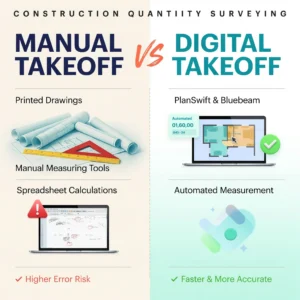
Yes. A detailed, checked quantity takeoff removes much of the quantity risk, which lets you carry contingency for real unknowns instead of estimating errors.
Get an Estimate You Can Build Contingency On
The best contingency starts with a reliable base estimate. CSI Estimation LLC prepares detailed quantity takeoffs and cost estimates for contractors, developers and owners across the US, from early budget estimates to bid-ready construction cost estimating. Send us your drawings through our contact page and our estimators will help you price your project with confidence.