
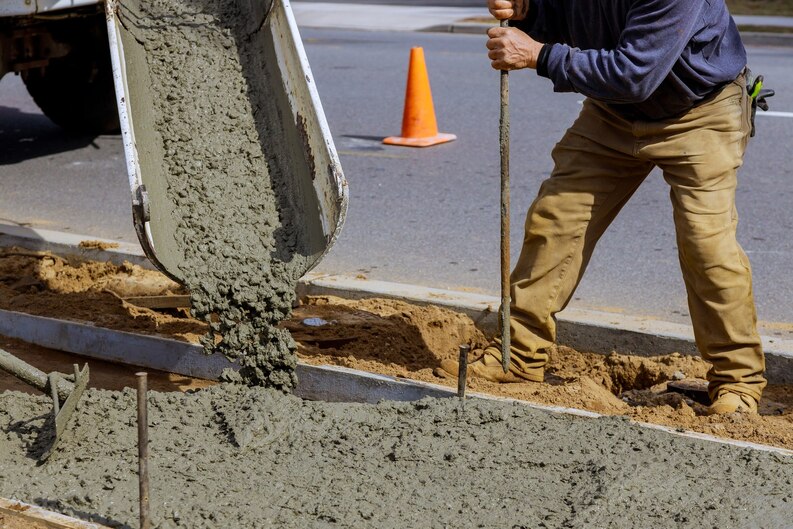
Material is the easy part of a concrete bid. Yards of concrete, tons of rebar and rolls of vapor barrier come straight off the drawings and the supplier quote. Labor is where concrete contractors win or lose money, because it depends on crew size, production rates, site conditions and how many times the crew has to mobilize. This guide walks through how to estimate concrete labor step by step, so the labor line in your bid reflects how the job will actually be built.
If you are new to concrete bidding, start with our guide to writing a concrete bid proposal and our walkthrough of how to do a concrete takeoff. Labor pricing builds directly on the quantities from that takeoff.
Why Concrete Labor Is the Riskiest Line in the Bid
Two contractors can pull the same quantities from the same plans and still be far apart on price. Most of that gap is labor. Concrete work is sequence-driven: forms go up, rebar is placed and inspected, concrete is placed and finished, then forms are stripped and cleaned. Every step depends on the one before it, so a slow pour day, a missed inspection or a small pour that still needs a full crew can push labor hours well past the estimate.
Labor is also highly local. Wage rates, union or open-shop agreements, prevailing wage requirements on public work, travel time and overtime rules all change what an hour of labor costs. That is why labor should be built from hours and crew rates for your market, not copied from a cost-per-square-foot number from another job.
Step 1: Start From an Accurate Quantity Takeoff
You cannot price labor until you know what is being built. Break the takeoff into the same work items your crew performs, because each one has a different production rate:
- Formwork in square feet of contact area (SFCA), split by element: footings, grade beams, walls, columns, elevated deck edges.
- Reinforcing in tons of rebar or square feet of welded wire, noting bar sizes and congestion.
- Placement in cubic yards, split by placement method (direct chute, pump, buggy, bucket).
- Finishing in square feet, split by finish type (broom, trowel, exposed, polished prep).
- Accessories and joints such as sawcut joints in linear feet, embeds, anchor bolts, sleeves and blockouts as counts.
- Curing, protection and cleanup by area or by pour.
A takeoff organized this way lets you see where the labor actually sits. A slab-on-grade job is finishing-heavy; a foundation wall job is forming-heavy. Treating both as “cubic yards of concrete” hides the difference.
Step 2: Set Production Rates for Each Task
A production rate is how much work a crew completes per hour or per day, for example square feet of wall form set per labor hour or square feet of slab finished per crew day. The best production rates come from your own past jobs. Track actual hours against installed quantities on every project and you will build a rate library that reflects your crews, your equipment and your market.
If you do not have historical data yet, published cost guides and estimating databases can give a starting point, but adjust them for the conditions on this job. Factors that lower production include:
- Small or cut-up pours with many corners, steps and blockouts
- Tall walls, one-sided forms or architectural finishes
- Congested rebar or heavy embeds that slow placement
- Restricted site access, long hose runs or no room for trucks
- Hot or cold weather placement with extra protection
- Elevated work that needs shoring, fall protection and hoisting
Step 3: Convert Quantities Into Labor Hours
Once you have quantities and production rates, the math is simple: labor hours = quantity ÷ production rate. Do this line by line for forming, rebar, placing, finishing and stripping.
Illustration only, not a benchmark: if your records show a crew sets and strips footing forms at a certain number of SFCA per labor hour, divide the footing SFCA from your takeoff by that rate to get forming hours. Repeat for every work item. The point is the method, since your own rates will differ by crew and region.
For slab finishing, think in crew-days rather than hours. A pour needs a full finishing crew on site from the first truck until the last trowel pass, so a small pour can carry nearly the same crew cost as a larger one. Count the number of separate pours, not just the total square footage.
Step 4: Build Crew Rates, Not Just Wage Rates
An hour of concrete labor costs more than the base wage. Build a loaded crew rate that includes:
- Base wages for each trade in the crew (foreman, finishers, carpenters, laborers, rodbusters if self-performed)
- Payroll taxes and workers’ compensation insurance, which is often significant for concrete classifications
- Fringe benefits or union fringes where applicable
- Overtime premiums for early pour starts or long finishing days
- Prevailing wage rates on public projects, which must follow the published wage determination
Multiply your labor hours by the blended crew rate for each task. A forming crew and a finishing crew have different mixes of trades, so they should carry different rates.
Step 5: Add the Hours That Are Not on the Drawings
Many concrete bids are lost money on hours nobody priced. Before you finalize labor, check for:
- Mobilization and demobilization for each phase, especially when footings, walls and slabs are poured weeks apart.
- Layout and survey time if it is not provided by the general contractor.
- Pump and equipment setup, washout and cleanup on every pour day.
- Inspection waiting time before pours.
- Cold or hot weather protection such as blankets, heaters, windbreaks or evaporation retarders.
- Punch list and patching after forms are stripped.
- Supervision that is not already in the crew rate.
Step 6: Check the Labor Against the Schedule
Total your labor hours by phase and divide by crew size to get the number of working days. Compare that with the project schedule. If the schedule gives you fewer days than your hours require, you will need a larger crew, overtime or a second crew, and each of those changes your cost. If the schedule is longer, plan for extra mobilizations or idle time. A labor number that does not match the schedule is a warning sign.
Step 7: Review Labor as a Share of the Concrete Bid
As a final sanity check, compare the labor-to-material ratio of this bid with similar jobs you have built. A forming-heavy foundation job should look different from a large open slab, but if this bid is far outside your own history for the same type of work, go back and check the production rates and pour count. You can also review our guide on how to price concrete jobs for how labor fits with materials, equipment, overhead and profit.
Common Concrete Labor Estimating Mistakes
- Pricing labor per cubic yard for every element instead of by task
- Ignoring the number of pours and treating the job as one big pour
- Using wage rates without burden, insurance and fringes
- Forgetting stripping, cleaning and re-setting forms
- Copying production rates from a different type of job or region
- Leaving out weather protection on winter or summer pours
Frequently Asked Questions
How do you estimate labor for a concrete job?
Break the takeoff into tasks (forming, rebar, placing, finishing, stripping), divide each quantity by a production rate to get labor hours, multiply by a loaded crew rate, then add mobilization, setup, protection and supervision hours that are not shown on the drawings.
Should concrete labor be priced per square foot or per hour?
Build it from hours. A per-square-foot number can be useful as a check against past jobs, but it hides the effect of pour count, forming complexity and site access, which are the factors that usually cause labor overruns.
Where do concrete production rates come from?
The most reliable rates come from your own job cost records. Published estimating guides can be a starting point, but they should be adjusted for your crews, local conditions and the complexity of each project.
Do I need a separate labor rate for prevailing wage jobs?
Yes. Public projects that require prevailing wages must use the rates in the project’s wage determination, which can differ significantly from your normal open-shop rates, so price those jobs with their own crew rates.
Can CSI Estimation prepare concrete labor and material estimates?
Yes. Our team prepares detailed concrete takeoffs and estimates that separate forming, reinforcing, placement and finishing so you can apply your own labor rates or use ours. See our concrete estimating services and quantity takeoff services.
Get a Bid-Ready Concrete Estimate
Accurate labor pricing starts with an accurate, task-by-task takeoff. CSI Estimation turns your plans into detailed concrete quantities and cost estimates for footings, foundations, walls, slabs and elevated decks, ready to plug into your bid. Contact CSI Estimation today to send your drawings and request a quote.