

In Georgia and Tennessee, the contractor who wins the bid is rarely the one who simply guesses lowest. It is the one whose numbers are tight enough to compete and accurate enough to still make money once the job is built. Both states are seeing steady construction activity, from mixed-use towers and apartment communities in Atlanta and Nashville to warehouses, plants and distribution centers along their interstate corridors. More work means more bid invitations, and it also means more competitors pricing the same drawings. In that environment, the quality of your quantity takeoff decides whether you win the job, lose it, or win it at a price that quietly eats your margin.
This guide explains how accurate takeoffs help contractors in Georgia and Tennessee win more bids, what local conditions change the math in each state, which takeoff details separate winning bids from losing ones, and when it makes sense to hand takeoffs to a specialist so your team can bid more jobs.
What an Accurate Takeoff Means in a Competitive Bid
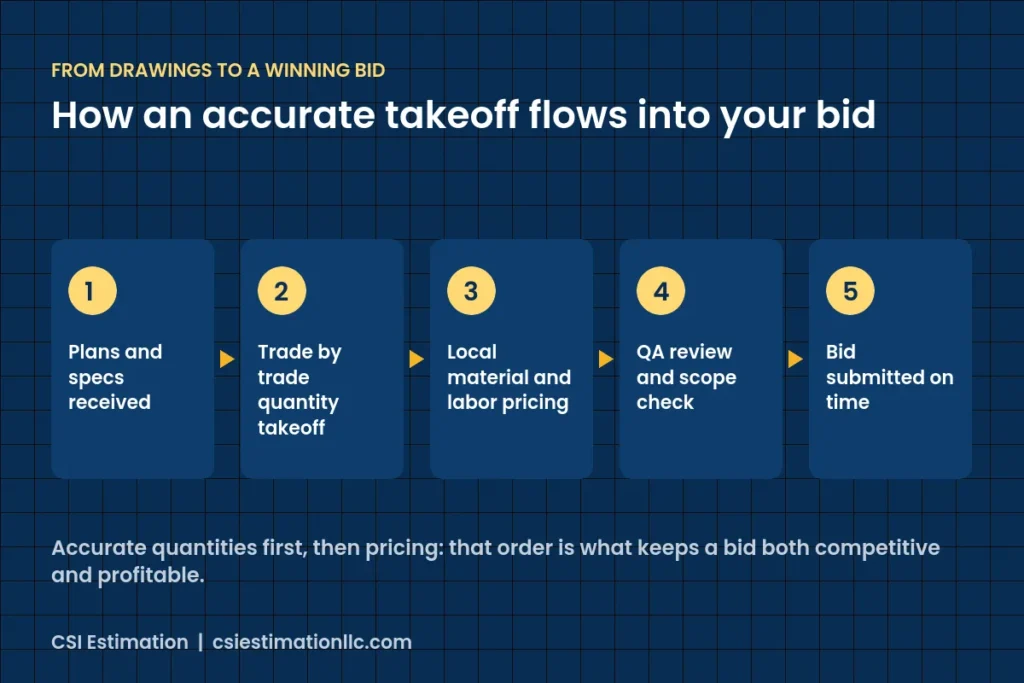
A quantity takeoff is the measured list of every material a project needs: cubic yards of concrete, tons of rebar, linear feet of wall framing, square feet of drywall and roofing, counts of doors, fixtures and devices, and so on, trade by trade. Pricing comes after the takeoff. If the quantities are wrong, every price applied to them is wrong too, no matter how good your supplier rates are.
In a competitive bid, accuracy works in two directions. Overstated quantities push your number up and hand the job to a competitor. Understated quantities make you look attractive on bid day, then turn into change-order arguments, unplanned material runs and lost profit during construction. A dependable takeoff removes both problems, so your bid reflects the real job and the only thing left to decide is your markup.
Why Bid Margins Are Tight in Georgia and Tennessee Right Now
Growing markets attract contractors from neighboring states, and general contractors in both states commonly receive several subcontractor numbers for each trade package. When the spread between bids is small, the details decide the outcome: a missed addendum, an incorrect waste factor, or a scope item that one bidder carried and another excluded. Material prices that move between the estimate and the purchase order add more pressure, which makes it even more important that the quantities themselves are right.
That is why many contractors in both states treat takeoffs as a specialist task rather than an afterthought. Our quantity takeoff services are built for exactly this situation, giving bidders verified quantities they can price with confidence.
How Accurate Takeoffs Win Bids in Georgia
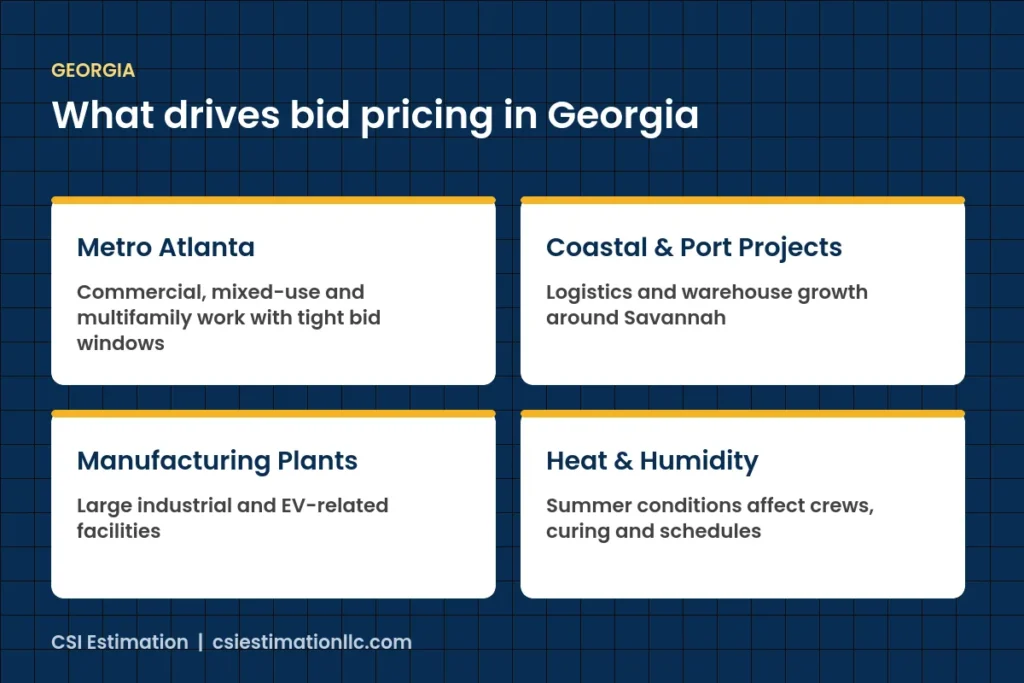
Georgia combines a large metro market with fast-growing industrial and logistics work, and each segment rewards accurate quantities in a different way.
Metro Atlanta’s Commercial and Multifamily Pipeline
Atlanta’s mixed-use, office interior, healthcare and multifamily projects often come with large drawing sets, frequent addenda and short bid windows. Multifamily work in particular repeats unit types across many floors, so a small error in one unit’s takeoff multiplies across the whole building. An accurate takeoff counts each unit type carefully, applies it to the right floors, and captures the amenity spaces, corridors and parking structures that are easy to overlook.
Industrial, Logistics and Manufacturing Projects
Warehouse and distribution work around Savannah’s port and along the state’s interstate corridors, together with large manufacturing facilities, involves big slabs, heavy foundations, tilt-up or metal building envelopes and long runs of site utilities. On these projects, concrete and rebar quantities, earthwork volumes and site work often drive the bid. Measuring them precisely, and carrying realistic allowances for over-excavation and waste, is how bidders stay competitive without leaving money on the table.
Codes, Climate and Schedule in Georgia
Georgia enforces the state minimum standard codes, based on the International Building and Residential Codes with state amendments, and local jurisdictions add their own requirements. Long, hot and humid summers affect crew productivity, concrete placement and curing, and coastal projects carry wind-related requirements. A good takeoff reflects the specified assemblies and protection measures in the drawings, so these costs show up in the bid instead of in a dispute later. Contractors working across the state can learn more about our Georgia construction estimating services.
How Accurate Takeoffs Win Bids in Tennessee
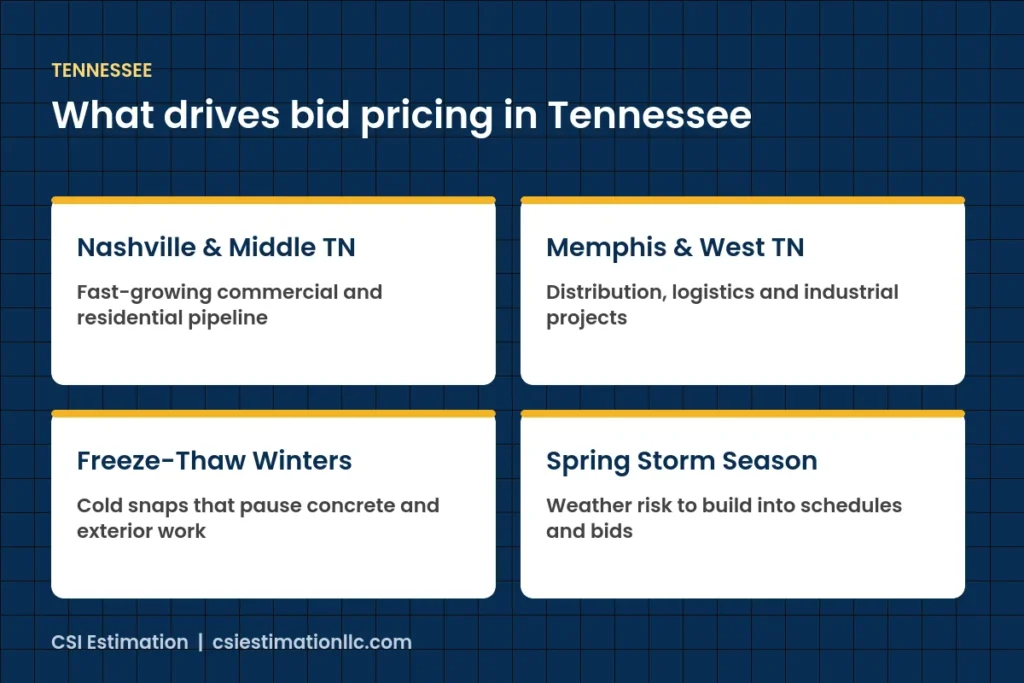
Tennessee’s market is spread across three very different regions, and each one changes what bidders need to watch in their quantities.
Nashville and Middle Tennessee Growth
Nashville and the surrounding counties continue to see commercial, hospitality, healthcare and residential construction, including large single-family subdivisions and build-to-rent communities. Residential subdivisions reward takeoffs that are organized by plan type and lot, so builders can price phases quickly and reuse verified quantities. Commercial projects in the urban core often involve tight sites, structured parking and complex MEP systems, where detailed counts matter more than square-foot rules of thumb.
Memphis, Chattanooga and Knoxville
West Tennessee’s logistics and distribution work centers on large-footprint buildings where slab, roofing and site quantities dominate. East Tennessee projects in Chattanooga and Knoxville often deal with sloped sites and rock, which makes earthwork and foundation quantities a common source of bid risk. Measuring cut and fill accurately, and noting where geotechnical information is incomplete, protects your number on these jobs.
Weather, Soils and Seasonal Scheduling in Tennessee
Winter cold snaps can pause concrete and exterior work, and the spring storm season brings schedule risk across the state. Accurate takeoffs help you price the temporary protection, cold-weather concrete measures and phasing that the specifications call for, rather than discovering them after award. For bidders across the state, our Tennessee construction estimating services provide trade-by-trade quantities with these local conditions in mind.
The Takeoff Details That Separate Winning Bids From Losing Ones
Most lost bids are not lost on price alone. They are lost on scope gaps, inconsistent assumptions and numbers that a general contractor or owner cannot compare easily. These are the details that make the difference.
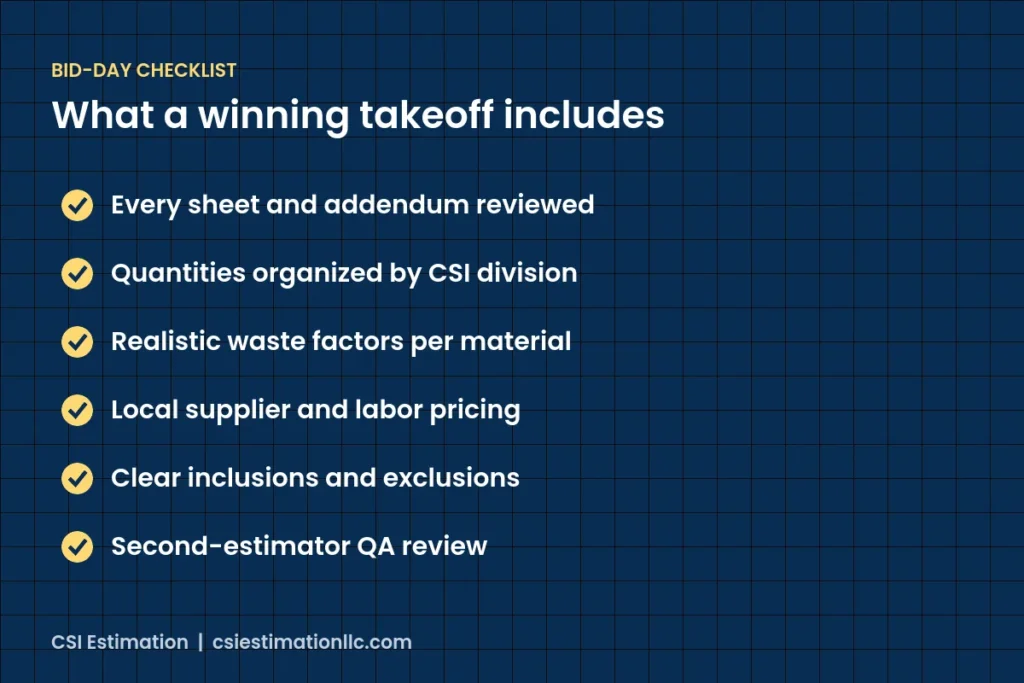
Complete Scope Coverage Across Every Sheet and Addendum
Winning takeoffs start with a full review of the drawing set and specifications, including every addendum issued before bid day. Items hidden in details, schedules and general notes, such as blocking, firestopping, sealants, sleeves and supports, are exactly the ones that get missed. A structured review makes sure they are counted once, in the right trade.
Quantities Organized by CSI Division
Organizing quantities by CSI MasterFormat division makes your bid easy to check and easy to compare. General contractors can see what you carried at a glance, and your own team can trace any number back to the drawings when questions come up after award.
Realistic Waste Factors and Local Pricing
Waste factors should match the material and the installation method, not a single blanket percentage. Lumber, drywall, tile, rebar and roofing all behave differently. Once quantities are right, applying current local supplier and labor pricing is what turns an accurate takeoff into a competitive bid. Our material takeoff services include material-specific waste allowances so your pricing starts from the right base.
Clear Inclusions, Exclusions and Assumptions
A short, clear list of what is included, what is excluded and what was assumed protects you during bid leveling. When two bids are close, the contractor whose scope is easiest to understand is usually the one who gets the call.
Common Takeoff Mistakes That Cost Contractors Bids
Even experienced estimators fall into the same traps when they are rushing to meet a deadline. The most common ones include measuring from outdated sheets after an addendum has changed the design, counting repeated floors or unit types incorrectly, forgetting items that only appear in details or specifications, using the wrong scale on scanned drawings, and applying one waste percentage to every material. Each mistake either pushes your number too high to win or too low to profit.
A second-estimator review is one of the simplest ways to catch these errors. Checking totals against expected ratios, such as rebar per cubic yard of concrete or drywall per linear foot of wall, quickly flags quantities that do not make sense before the bid goes out.
Turning an Accurate Takeoff Into a Winning Bid Package
A strong takeoff is the foundation, but the way you build the bid on top of it also affects whether you win.
Price From Verified Quantities, Not Square-Foot Averages
Square-foot costs are useful for early budgets, but they hide the details that decide a hard bid. Pricing directly from verified quantities lets you see exactly where your number comes from and adjust individual line items when a supplier quote changes, instead of moving the whole bid up or down by feel.
Set Markup by Market and Project Type
Competition, risk and payment terms vary between a downtown Atlanta high-rise, a suburban Nashville subdivision and a rural industrial site. Once your quantities are reliable, you can set overhead and profit with confidence for each opportunity, sharpening your number where competition is fierce and protecting it where risk is higher.
Submit Early, Clean and Easy to Compare
General contractors and owners appreciate bids that arrive on time, follow their bid form and clearly state scope. Organized quantities make this easy. A clean bid that is simple to level often earns a follow-up call, and that conversation is where many jobs are actually won.
When to Outsource Your Takeoffs Instead of Doing Them In-House
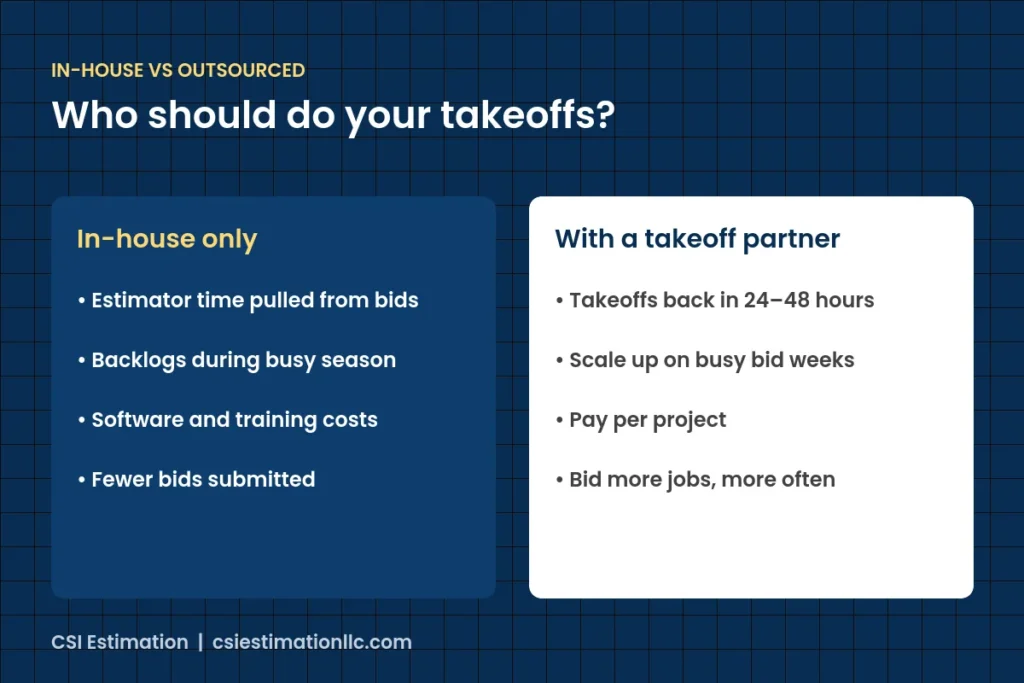
In-house estimating gives you control, but it has limits. Every hour your estimator spends measuring is an hour not spent on pricing strategy, supplier negotiations or chasing new bid invitations. During busy bid seasons, backlogs build up and contractors start skipping opportunities they could have won.
Outsourcing takeoffs makes sense when you are bidding more jobs than your team can measure, when a project includes trades outside your usual scope, or when deadlines are too tight to do the work twice. A specialist partner delivers verified quantities quickly, you pay per project rather than for full-time overhead, and your team stays focused on winning work. Our outsource estimating services are designed to plug into your existing bidding process without changing how you price or present your numbers.
How CSI Estimation Supports Contractors in Georgia and Tennessee
CSI Estimation LLC works with general contractors, subcontractors, builders and developers across the United States, including Georgia and Tennessee. Our estimators prepare detailed quantity takeoffs and cost estimates using industry software such as PlanSwift, Bluebeam and RS Means, organized by CSI division so they drop straight into your bid. We cover commercial estimating, residential estimating and every major trade, from concrete to MEP, with fast turnaround for tight bid deadlines.
Frequently Asked Questions
How do accurate takeoffs help contractors win more bids?
Accurate takeoffs let you price the real job instead of padding for uncertainty. Your number can be competitive without hidden scope gaps, which means you win more often and keep your margin after award.
How long does a professional quantity takeoff take?
It depends on the size and complexity of the project, but many trade takeoffs can be delivered within 24 to 48 hours once the full drawing set and specifications are received.
Do takeoffs need to change between Georgia and Tennessee projects?
The measuring method is the same, but local codes, climate, soil conditions and pricing differ. A good takeoff reflects the specified assemblies for each project, and pricing should always use current local supplier and labor rates.
Can I outsource takeoffs for only one trade?
Yes. Many contractors outsource a single trade, such as concrete, drywall or MEP, while keeping the rest of the estimate in-house. You get verified quantities for the scope where you need them most.
Conclusion: Win More Bids With Numbers You Can Trust
Georgia and Tennessee offer plenty of opportunity, but every bid is contested. The contractors who win consistently are the ones who start from accurate quantities, account for local conditions and present a clear, complete scope. Whether you are pricing a multifamily project in Atlanta, a warehouse near Savannah, a subdivision outside Nashville or a distribution center in Memphis, accurate takeoffs give you the confidence to bid sharp and still protect your profit.
Send us your drawings and get verified takeoffs back in as little as 24 hours, so you can bid more jobs and win more of them.