
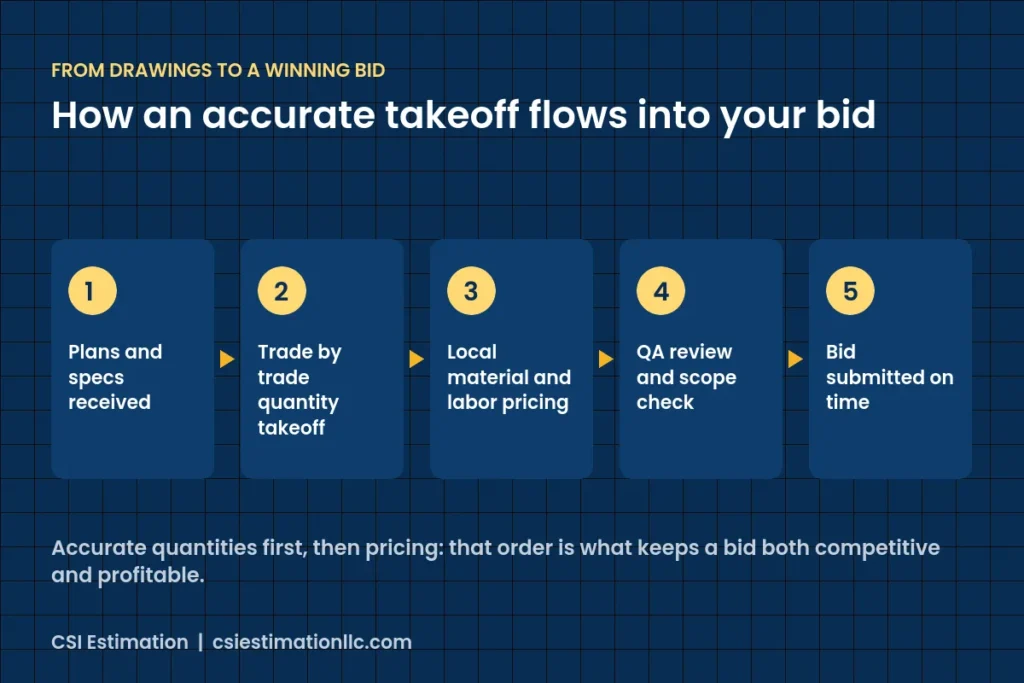
Contractors, owners and project managers often use “takeoff” and “estimate” as if they mean the same thing. They don’t. A takeoff tells you how much material and work a project needs. An estimate tells you how much it will cost to deliver that work. Mixing up the two is one of the most common reasons bids come in too high to win or too low to make money.
This guide explains takeoff vs estimate in plain terms: what each one contains, who prepares it, how one feeds the other, and where errors usually creep in. If you are new to the topic, start with our overview of what takeoff in construction is and why it matters, then come back here for the side-by-side comparison.
Takeoff vs Estimate: The Short Answer
A quantity takeoff is a measured list of everything shown on the drawings and specifications: cubic yards of concrete, linear feet of wall, square feet of drywall, number of doors, tons of rebar, lengths of pipe and so on. It contains quantities and units, not dollars.
A cost estimate takes those quantities and applies prices to them: material unit costs, labor hours and wage rates, equipment, subcontractor pricing, general conditions, overhead, contingency and profit. The result is a projected cost or a bid price.
Put simply: the takeoff is the “what and how much,” and the estimate is the “what will it cost.” You cannot build a reliable estimate without a reliable takeoff underneath it.
What a Construction Takeoff Includes
A takeoff is built by reading the plans sheet by sheet and measuring every item within the scope you are pricing. A thorough takeoff typically includes:
- Counts such as doors, windows, light fixtures, plumbing fixtures, outlets and anchor bolts.
- Linear measurements such as footings, walls, trim, piping, conduit, curbs and handrails.
- Area measurements such as slabs, flooring, roofing, wall finishes, ceilings and paving.
- Volume measurements such as concrete, excavation, backfill and aggregate base.
- Weights such as structural steel and reinforcing bar.
- Notes and assumptions covering what was included, what was excluded and any drawing conflicts found.
Good takeoffs are organized by trade or by CSI MasterFormat division so they can be checked, priced and handed to subcontractors cleanly. For a trade-specific example, our drywall estimating guide walks through a full takeoff workflow.
Material Takeoff vs Quantity Takeoff
You will also hear the term material takeoff. In practice it is a quantity takeoff focused on purchasable materials, often converted into ordering units: sheets of plywood, bags of mortar, boxes of fasteners, sticks of pipe. A quantity takeoff may also measure items that are priced as labor or installed units, such as square feet of formwork or linear feet of saw cutting.
What a Construction Cost Estimate Includes
An estimate starts where the takeoff ends. Typical components are:
- Material costs: takeoff quantities multiplied by current supplier pricing, plus waste factors, delivery and sales tax where it applies.
- Labor costs: production rates (for example, hours per unit) multiplied by quantities and by the crew’s wage and burden rates.
- Equipment costs: owned or rented equipment, fuel and mobilization.
- Subcontractor costs: quotes for scopes you will not self-perform, checked against your own takeoff.
- General conditions: supervision, temporary facilities, permits, insurance, bonds and cleanup.
- Overhead, contingency and profit: company costs, risk allowances and margin.
The estimate also reflects things a takeoff cannot see on its own: the project schedule, site access, local labor market, union or prevailing wage requirements, material price volatility and the level of design completion.
Side-by-Side Comparison
| Factor | Quantity Takeoff | Cost Estimate |
|---|---|---|
| Main question | How much material and work? | How much will it cost? |
| Output | Quantities and units (CY, LF, SF, EA, tons) | Dollar amounts, totals and bid price |
| Main inputs | Drawings, specifications, addenda | Takeoff, unit prices, labor rates, quotes, schedule |
| Location dependent? | Mostly no: quantities are the same anywhere | Yes: prices and wages vary by region |
| Changes when prices change? | No | Yes |
| Typical owner | Estimator, quantity surveyor or takeoff specialist | Estimator, project manager or contractor |
| Order in the workflow | First | Second, built from the takeoff |
How a Takeoff Flows Into an Estimate
On most bids the process follows the same basic steps:
- Review the bid documents. Confirm the drawing set, specifications, addenda and scope boundaries before measuring anything.
- Set the drawing scale and organize by trade. Verify scale on each sheet, especially on reduced or scanned plans.
- Measure and count. Capture every item in scope and tag it with a location or area so it can be checked later.
- Apply waste and conversion factors. Turn net quantities into orderable quantities where needed.
- Price the quantities. Attach material, labor and equipment costs to each line.
- Add indirect costs and markup. Include general conditions, overhead, contingency and profit.
- Review and level. Compare subcontractor quotes against your own quantities and check the total against similar past projects.
Steps 1 through 4 are takeoff work. Steps 5 through 7 are estimating work. When the first half is rushed, every price applied in the second half carries the error forward.
Why the Difference Matters When You Bid
Knowing where the takeoff ends and the estimate begins helps you find problems faster:
- If your number is far off from other bidders, check quantities first. A missed sheet, wrong scale or skipped addendum is usually a takeoff problem, not a pricing problem.
- If quantities are right but margins are thin, look at the estimate side: production rates, labor burden, equipment or markup.
- If material prices move between bid and award, you only need to re-price the estimate. The takeoff stays valid as long as the drawings have not changed.
- If drawings are revised, update the takeoff first, then let the changes flow into the estimate.
Keeping the two separate also makes it easier to reuse work. A clean takeoff can be priced by different subcontractors, re-priced for a value engineering option or used later to build a purchase order list.
Common Mistakes That Blur Takeoff and Estimate
- Pricing straight from the plans without a written takeoff. It feels faster, but nothing can be checked afterward.
- Using square-foot pricing too early. Cost-per-square-foot figures are useful for early budgets, but they are not a substitute for measured quantities on a hard bid.
- Applying waste twice. Some estimators add waste in the takeoff and again in the unit price.
- Ignoring the specifications. Specs often change the material grade, finish level or testing requirements, which affects the estimate even when quantities are unchanged.
- Not documenting exclusions. Unclear scope is where most change-order disputes start.
Should You Outsource Takeoffs, Estimates or Both?
Many contractors keep pricing in-house because it depends on their own crews, suppliers and margins, but outsource the measuring work to free up estimator time. Others hand off the full estimate for larger or unfamiliar project types. Either approach can work as long as the scope, drawing set and pricing basis are agreed up front.
CSI Estimation provides both. Our quantity takeoff services deliver organized, trade-by-trade quantities you can price yourself, and our construction cost estimating services carry those quantities through to a priced estimate. For supply-focused scopes, our material takeoff services convert quantities into orderable material lists.
Frequently Asked Questions
Is a takeoff the same as an estimate?
No. A takeoff measures quantities from the drawings, while an estimate applies material, labor, equipment and overhead costs to those quantities to arrive at a price. The takeoff is one input to the estimate.
Which comes first, the takeoff or the estimate?
The takeoff comes first. Without measured quantities, any estimate is an educated guess, except at the early budget stage where square-foot or assembly pricing may be used before detailed drawings exist.
Does a takeoff include prices?
A pure quantity takeoff does not. Some deliverables combine quantities with unit pricing, but at that point it is functioning as an estimate. It helps to agree on which one you need before work begins.
How long does a construction takeoff take?
It depends on project size, number of trades, drawing quality and how many revisions or addenda are involved. A single-trade takeoff on a small project may take hours, while a multi-trade commercial takeoff can take several days.
Can takeoff software replace an estimator?
Takeoff software speeds up measuring and reduces manual math errors, but someone still has to read the drawings correctly, interpret the specifications, decide what is in scope and apply realistic pricing. The software is a tool, not a replacement for judgment.
Get Accurate Takeoffs and Estimates From CSI Estimation
Whether you need clean quantities to price yourself or a complete bid-ready estimate, CSI Estimation can help you bid with confidence. Send us your plans through our contact page and tell us your scope and deadline, and our team will reply with a quote and turnaround time.