

If you have ever asked what takeoff in construction is, you are asking one of the most foundational questions in the entire estimating process. A construction takeoff is the detailed measurement and counting of every material, component, and system required to complete a building project before a single dollar is committed to procurement or labor. It is the first step every contractor, estimator, and project manager must complete before a cost estimate can be built, a bid can be submitted, or a project can be planned with any meaningful financial accuracy.
Without an accurate takeoff, every number that follows it is built on an unreliable foundation. This article explains exactly what a construction takeoff is, how it works, who performs it, and why getting it right is one of the most important things a contractor can do before entering a competitive bidding environment.
What Does Takeoff Mean In Construction

In construction, a takeoff refers to the process of reviewing project drawings and specifications and extracting precise quantities of every material required to complete the work. The term comes from the act of taking quantities off a set of drawings, which is exactly what an estimator does when they work through a blueprint page by page and record every measurement, count, and calculation needed to build what the designer has specified.
A takeoff produces a verified list of quantities organized by material type, trade, and construction phase. This list becomes the foundation for all cost estimating work that follows, including material procurement, labor hour calculations, subcontractor scope documents, and the final bid price submitted to the project owner. The takeoff itself does not include pricing. It is a quantity document that tells the estimator exactly how much of everything the project requires before any cost is applied to those quantities.
Professionals in the field also use terms like quantity takeoff and material takeoff to describe the same process, with slight variations depending on whether the focus is on raw material quantities or on a broader scope that includes equipment and system components.
The Role Of A Construction Takeoff In Project Planning
A construction takeoff does far more than support the bidding process. It feeds directly into every planning decision made during the preconstruction phase of a project. Once quantities are verified, the project team can build a realistic procurement schedule, confirm material lead times, plan subcontractor sequencing, and allocate crew resources across each phase of construction.
When the takeoff is accurate, every downstream decision benefits from that accuracy. The project manager knows how much material to order and when to order it. The superintendent knows how long each phase will take based on verified quantities and realistic labor productivity rates. The estimator knows which line items carry the most financial risk and where contingency allowances need to be strengthened.
When the takeoff is inaccurate, the opposite happens. Procurement gaps emerge mid-construction, subcontractors dispute scope, and change orders accumulate in ways that strain the project budget and damage the owner relationship. Contractors who want to explore how professional construction estimating services support this planning process can learn more through the CSI Estimation Services page, which covers the full scope of estimating support available across residential and commercial project types.
Difference Between A Construction Takeoff And A Cost Estimate
One of the most common points of confusion in the construction estimating process is the difference between a takeoff and a cost estimate. These two terms are related, but they describe different stages of the pre-construction workflow, and understanding the distinction helps contractors evaluate the quality of the estimating work they commission or perform internally.
A construction takeoff is a quantity document. It measures and counts every material and component required to complete the project scope, but does not assign any pricing to those quantities. The output of a takeoff is a verified list of measurements and counts organized by trade and material type.
A cost estimate is a pricing document. It takes the verified quantities produced by the takeoff and applies current labor rates, regional material pricing, equipment costs, overhead allowances, and profit margins to produce a total project cost. The cost estimate is what the contractor submits as a bid. The takeoff is what makes the cost estimate reliable.
A cost estimate produced without a verified takeoff behind it is built on assumptions rather than measurements, which means it carries a meaningful risk of significant cost gaps that only become visible after the contract is signed and construction begins.
Who Performs Construction Takeoffs
Construction takeoffs are performed by professional estimators, quantity surveyors, and in-house estimating teams at contracting firms of all sizes. On larger commercial and industrial projects, dedicated estimating departments handle takeoff work as a full-time function. On smaller residential projects, the general contractor or a single in-house estimator often performs the takeoff alongside other project management responsibilities.
Increasingly, contractors of all sizes are choosing to outsource their takeoff work to professional estimating firms that specialize in quantity measurement and cost analysis. This approach gives the contractor access to trade-specific expertise, dedicated estimating software, and current regional pricing data without the fixed overhead of maintaining a full-time in-house estimating function.
Professional estimators who focus exclusively on takeoff and estimating work develop a speed and accuracy that a generalist contractor managing multiple responsibilities simultaneously cannot consistently match. For contractors evaluating whether to handle takeoffs internally or partner with a professional estimating firm, the decision typically comes down to bid volume, project complexity, and the financial risk tolerance of the business.
What A Construction Takeoff Typically Includes
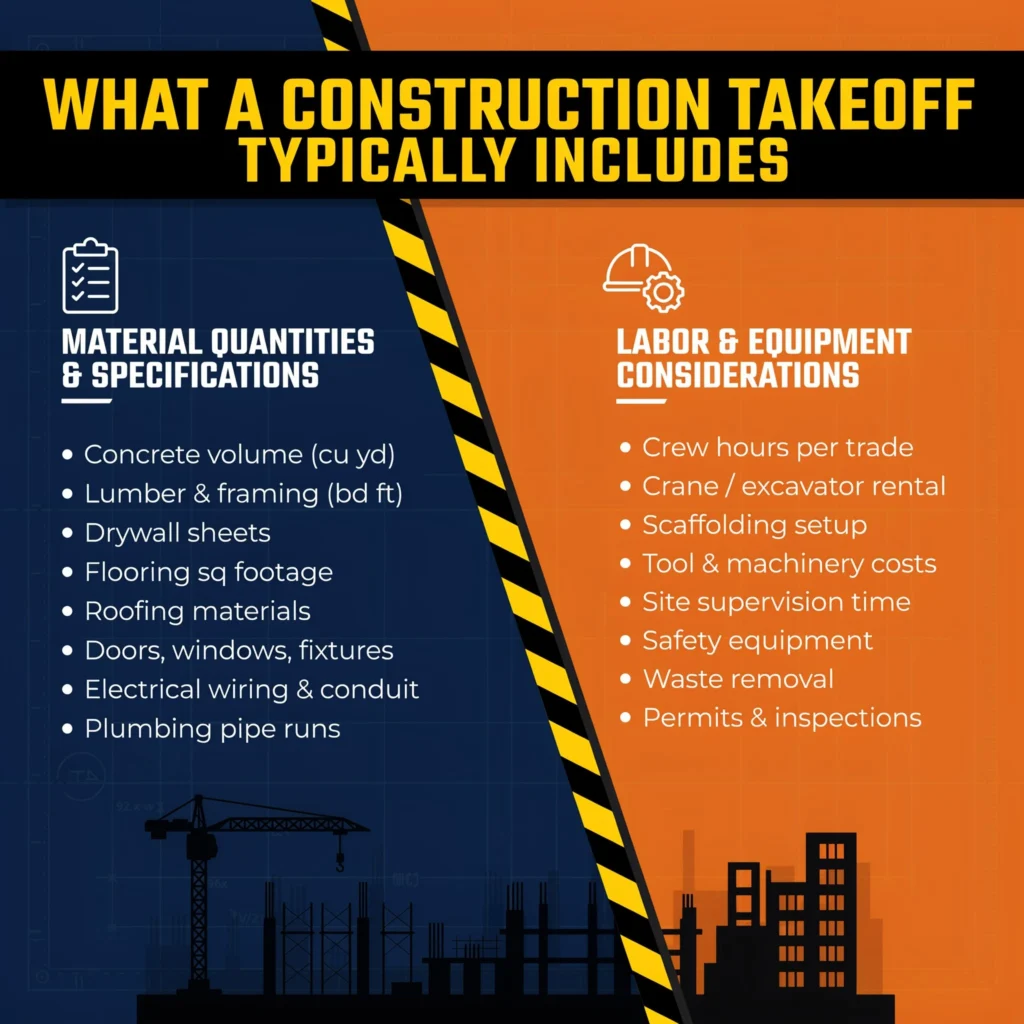
A complete construction takeoff covers every material, component, and system that the project requires across all trades involved in the scope of work. The depth and detail of the takeoff vary by project type and trade, but two core categories appear in virtually every takeoff regardless of project size or sector.
Material Quantities And Specifications
The material portion of a takeoff documents every physical item required to build the project, including concrete, structural steel, framing lumber, masonry, roofing systems, insulation, drywall, flooring, windows, doors, plumbing fixtures, electrical conduit and wiring, and mechanical equipment. Each item is measured in the unit most relevant to its trade, whether that is linear feet of pipe, square feet of drywall, cubic yards of concrete, or individual counts of fixtures and devices.
Material specifications from the project documents must be captured alongside the quantities because different specifications carry different costs. A takeoff that records a quantity without capturing the specification that determines the material grade, thickness, or performance standard is incomplete and will produce an estimate that does not reflect the actual cost of what the designer specified. Contractors looking for professional support with this stage of the process can review the material takeoff services offered by CSI Estimation LLC to understand how specialist estimators handle this work across multiple trade categories.
Labor And Equipment Considerations
Beyond materials, a comprehensive takeoff also captures the labor and equipment requirements associated with each scope item. Labor considerations include the number of crew members required for each phase, expected installation productivity rates for each trade, and the local wage rates that apply to the project location. Equipment considerations include the type and duration of equipment needed for site preparation, concrete placement, structural erection, and specialty installations.
While some estimators treat labor and equipment as a separate calculation applied after the material takeoff is complete, integrating these considerations into the takeoff process itself produces a more accurate and more useful deliverable that the project team can act on immediately without requiring a second round of analysis.
Manual Takeoff Versus Digital Takeoff Methods

Construction takeoffs can be performed manually using printed drawings and measuring tools or digitally using dedicated estimating software platforms that allow estimators to measure and count directly on screen from digital drawing files.
Manual takeoff methods involve the estimator physically measuring distances and counting items on printed plan sheets, recording quantities on paper or in a spreadsheet, and transferring those figures into the cost model. This approach is straightforward and requires no specialized software, but it is slower, more prone to human error, and more difficult to review and verify than digital methods.
Digital takeoff methods use platforms such as PlanSwift, Bluebeam Revu, and CostX to allow the estimator to trace, measure, and count directly on digital drawings. The software records every measurement automatically, reduces the risk of mathematical errors, and produces a quantity output that can be reviewed, sorted, and exported in formats suitable for cost modeling and procurement planning.
Most professional estimating firms use digital takeoff methods as their standard workflow because the speed, accuracy, and reviewability of digital output are substantially better than manual methods on projects of any meaningful scale. Contractors who rely on manual takeoff methods for complex commercial or multi-trade projects are accepting a higher risk of quantity errors that digital workflows largely eliminate.
Step-by-Step Process Of Performing A Construction Takeoff
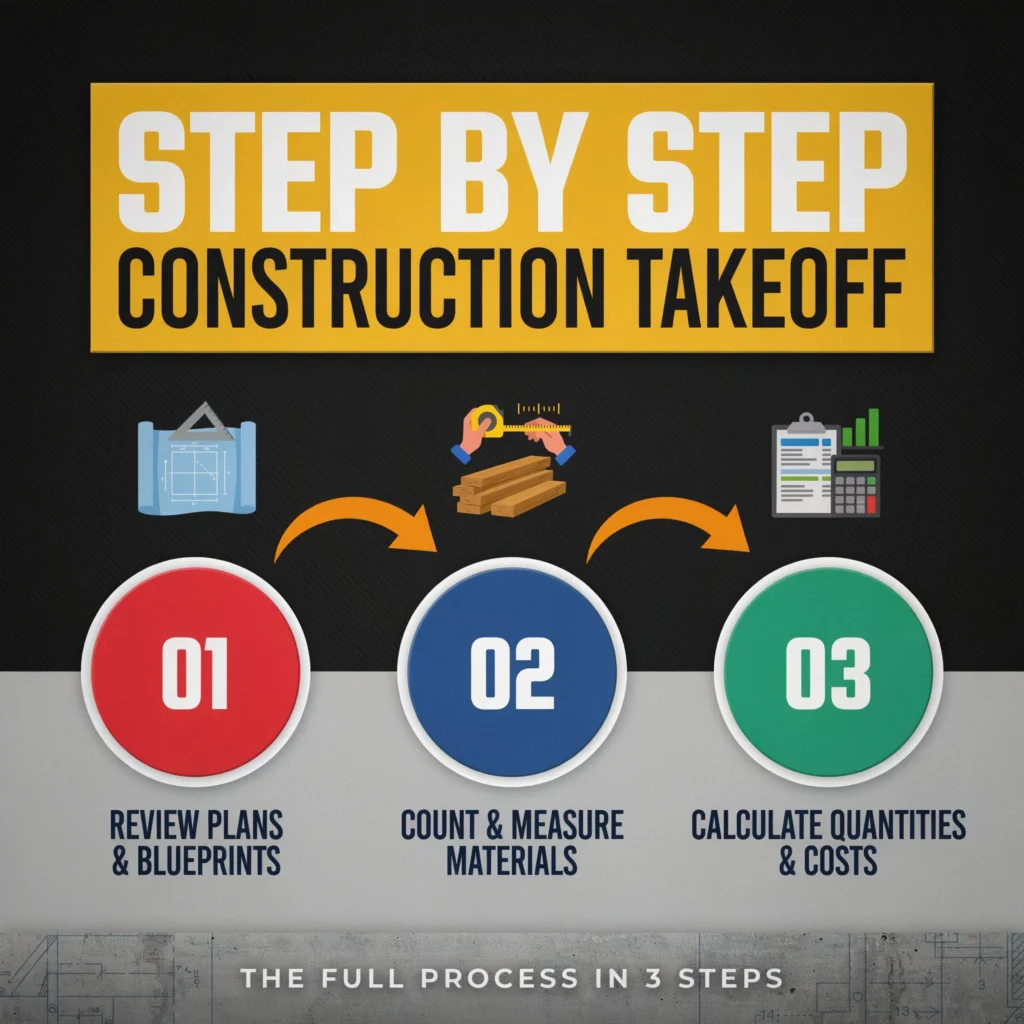
Performing a construction takeoff correctly requires a disciplined, sequential workflow that moves from drawing review through measurement to quantity verification. Skipping any stage in this sequence transfers the error into the cost estimate rather than catching it before it reaches the bid.
Reviewing Project Plans And Blueprints
The first step in any construction takeoff is a thorough review of the full drawing package before any measurement work begins. The estimator reviews architectural drawings, structural plans, MEP drawings, and project specifications to confirm that the drawing set is complete, that all trades are represented, and that there are no coordination conflicts between disciplines that would affect material quantities or installation sequences. Blueprint reading accuracy at this stage determines the reliability of everything that follows. An estimator who begins measuring before reviewing the full drawing set risks missing scope items that only appear on certain drawing sheets or in specification sections that are not reflected graphically on the plans.
Counting And Measuring Materials
Once the drawing review is complete, the estimator works through the drawing set trade by trade, measuring every material component in the sequence it appears in the construction process. This means starting with site work and foundations, moving through structural systems, then enclosure systems, then interior finishes, and finally mechanical, electrical, and plumbing systems. Working in a construction sequence rather than jumping between trades reduces the risk of double-counting and scope omission. Building material calculation at this stage requires the estimator to apply the correct unit of measurement to each item and to capture the material specification alongside the quantity so that the cost model reflects what the project actually requires.
Calculating Quantities And Costs
The final step is compiling the measured quantities into an organized quantity list and verifying that every item in the list has a documented measurement basis traceable to a specific drawing location. This verification step is what transforms a raw set of measurements into a reliable takeoff document that the cost estimating process can build on with confidence. Contractors who want to see how verified quantity output translates into a complete cost estimate can review the construction cost estimating services page at CSI Estimation LLC, which covers how professional estimators apply current market pricing to verified quantities across all major trade categories.
Why Accurate Takeoffs Matter For Bidding Success
Accurate construction takeoffs are the foundation of competitive and profitable bidding. When the quantities in a takeoff are correct, the cost estimate built from them reflects the true cost of the project, which allows the contractor to submit a bid that is competitive enough to win while being financially sound enough to execute profitably.
When the quantities are wrong, the bid reflects a false picture of the project’s cost. An underestimated takeoff produces a bid that looks competitive because it is priced below the true cost of the work, which means the contractor wins the contract but absorbs the financial gap between the bid price and the actual cost once construction begins. An overestimated takeoff produces a bid that loses the contract to a competitor whose numbers are more accurate.
In markets where multiple qualified contractors are competing for the same project, the difference between a winning bid and a losing one is often a matter of a few percentage points. Accurate construction bidding process discipline, starting with the takeoff, is what allows contractors to price those margins correctly rather than guessing at them under deadline pressure.
Common Mistakes That Reduce Takeoff Accuracy

The most damaging takeoff mistakes are not caused by a lack of effort. They are caused by workflow habits that seem efficient in the short term but produce unreliable quantity output that costs far more to correct after a bid is submitted than it would have cost to prevent during the takeoff process.
Skipping the full drawing review before measurement begins is the most common source of scope omissions. Estimators who move directly to measurement without confirming that the drawing set is complete regularly miss scope items that appear only on drawing sheets they did not review. Applying incorrect units of measurement to specific materials produces quantity errors that appear internally consistent but are systematically wrong. Failing to capture material specifications alongside quantities produces takeoffs that measure correctly but cannot support accurate pricing because the estimator does not know which grade or performance standard the specification requires. And carrying unverified quantities directly into a bid without a final cross-check against the drawing set is the workflow habit most consistently responsible for post-award cost surprises that erode project margins.
How Professional Estimating Services Improve Takeoff Accuracy
Professional estimating firms improve takeoff accuracy by applying dedicated workflows, trade-specific expertise, and current market data to every project they handle. Unlike an in-house estimator managing multiple responsibilities simultaneously, a professional estimating team focuses exclusively on measurement and cost analysis, which produces faster and more consistent quantity output across varying project types and trade categories.
CSI Estimation LLC provides professional material and quantity takeoffs to contractors across all 50 states, covering residential, commercial, and industrial project scopes with standard turnaround times of 24 to 48 hours for most project types. Their estimating team includes trade-specific specialists who apply verified assembly data and current regional pricing to every quantity they measure, producing deliverables that contractors can carry directly into their bids with confidence.
For contractors who manage variable bid volumes and cannot justify the fixed overhead of a full-time in-house estimating function, outsourcing to a professional estimating firm provides access to a higher standard of accuracy without the recruitment, training, and software costs that in-house estimating requires. Contractors managing residential projects can explore the residential estimating services page, while those working on commercial scopes can review the commercial estimating services available through CSI Estimation LLC.
Final Thoughts On Construction Takeoffs
Understanding what takeoff in construction is is the starting point for every contractor who wants to bid accurately, win profitably, and execute projects without the financial surprises that inaccurate quantity data produces. A construction takeoff is not a procedural formality. It is the measurement foundation that every reliable cost estimate, procurement plan, and project schedule is built on, and getting it right from the start is one of the most financially impactful things any contractor can do before submitting a bid.
Contractors who want professional takeoff support for their next project are welcome to contact CSI Estimation LLC and submit their project drawings for a fast, accurate, and trade-specific quantity takeoff delivered within 24 to 48 hours.