
How Can Construction Estimating Services Help You Save Money is answered through five specific mechanisms: verified material takeoffs that eliminate procurement waste, current regional market pricing that prevents overbidding and margin loss, pre-construction cost planning that avoids budget overruns, change order prevention through scope verification, and subcontractor negotiation savings from verified market benchmarks. Contractors who do not use professional estimating services absorb all five of these financial losses on every project they estimate without verified data.
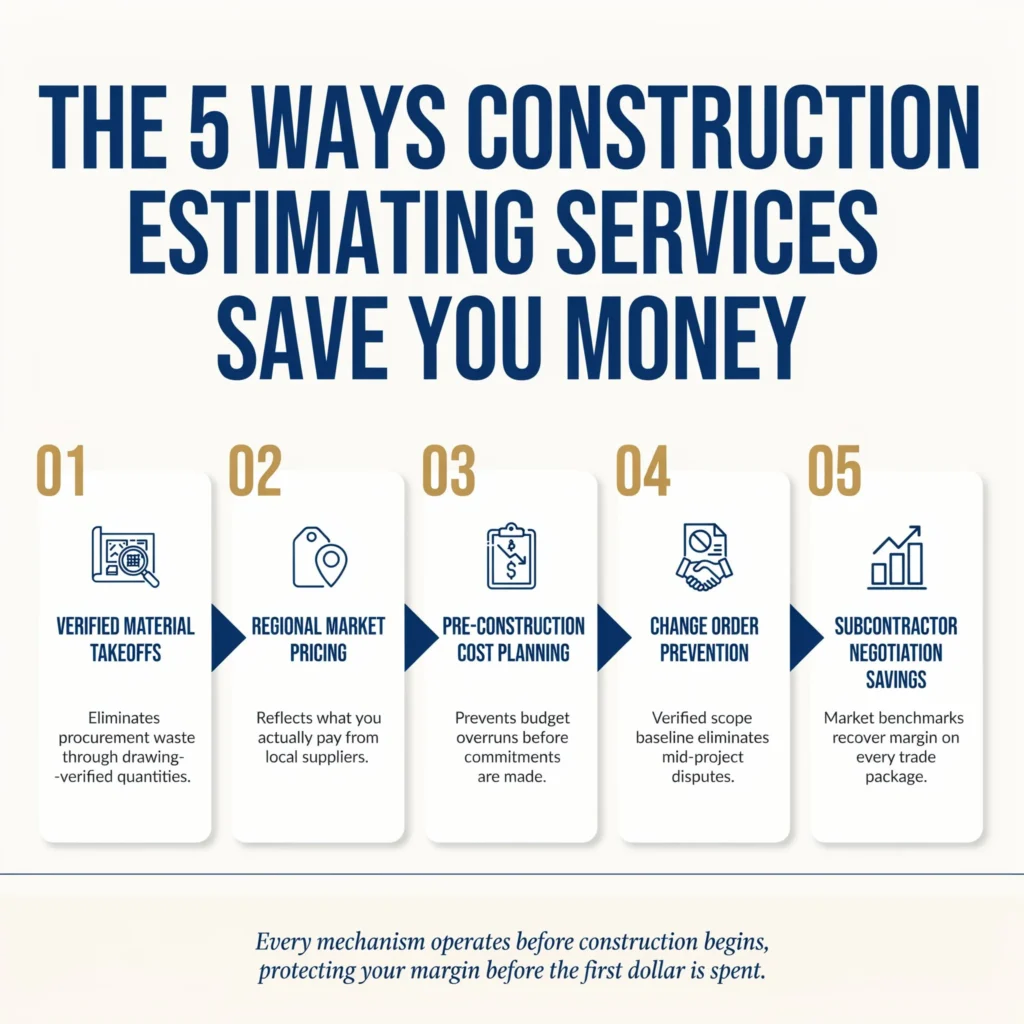
Most construction projects do not lose money during construction. They lose money before construction begins, in the estimating process, when material quantities are guessed rather than measured, when labor rates are pulled from databases that do not reflect current regional market conditions, and when scope items visible on the drawing set are missed entirely because no one reviewed the drawings with the systematic discipline that professional estimating requires.
By the time the crew is on site, and the gap between the estimated cost and the real cost becomes visible, the options for managing that gap are expensive and limited. Understanding how construction estimating services can help you save money is not an academic question for contractors and project owners. It is the most financially consequential operational decision they make before every project they build.
Why Do You Need a Professional Construction Estimate Before Every Project?
A professional construction estimate provides something that informal estimating and in-house approximation cannot: a cost model built on verified quantities measured from the actual project drawings, current market pricing sourced from active regional suppliers and labor databases, and trade-specific cost calculations that reflect what the project will actually cost to build in the specific market where it is located.
The difference between this and an estimate produced from memory, experience, or national pricing databases is not a matter of degree. It is a fundamental difference in the reliability of the financial information on which every subsequent project decision is based. Our professional construction cost estimating services deliver this level of verified, market-calibrated cost data to contractors and project owners across all 50 states for every project we handle.
The financial consequence of beginning a project without a professional estimate is not simply a vague risk of overspending. It is a specific and predictable set of cost events that occur when the gap between the estimated cost and the real cost is discovered in the field rather than at the drawing review stage.
Every dollar of procurement shortfall that requires an emergency purchase order, every change order that covers scope the original estimate missed, and every subcontractor negotiation conducted without verified market benchmarks represents a real financial loss that a professional estimate would have prevented at a fraction of the cost of the loss itself.
How Construction Estimating Services Reduce Your Project Costs
Professional construction estimating services reduce project costs through specific financial mechanisms that operate at the measurement, pricing, and documentation stages of the pre-construction process rather than through the generic accuracy improvements that most competing content describes without explaining how they actually work.
Eliminating Material Waste Through Verified Quantity Takeoffs
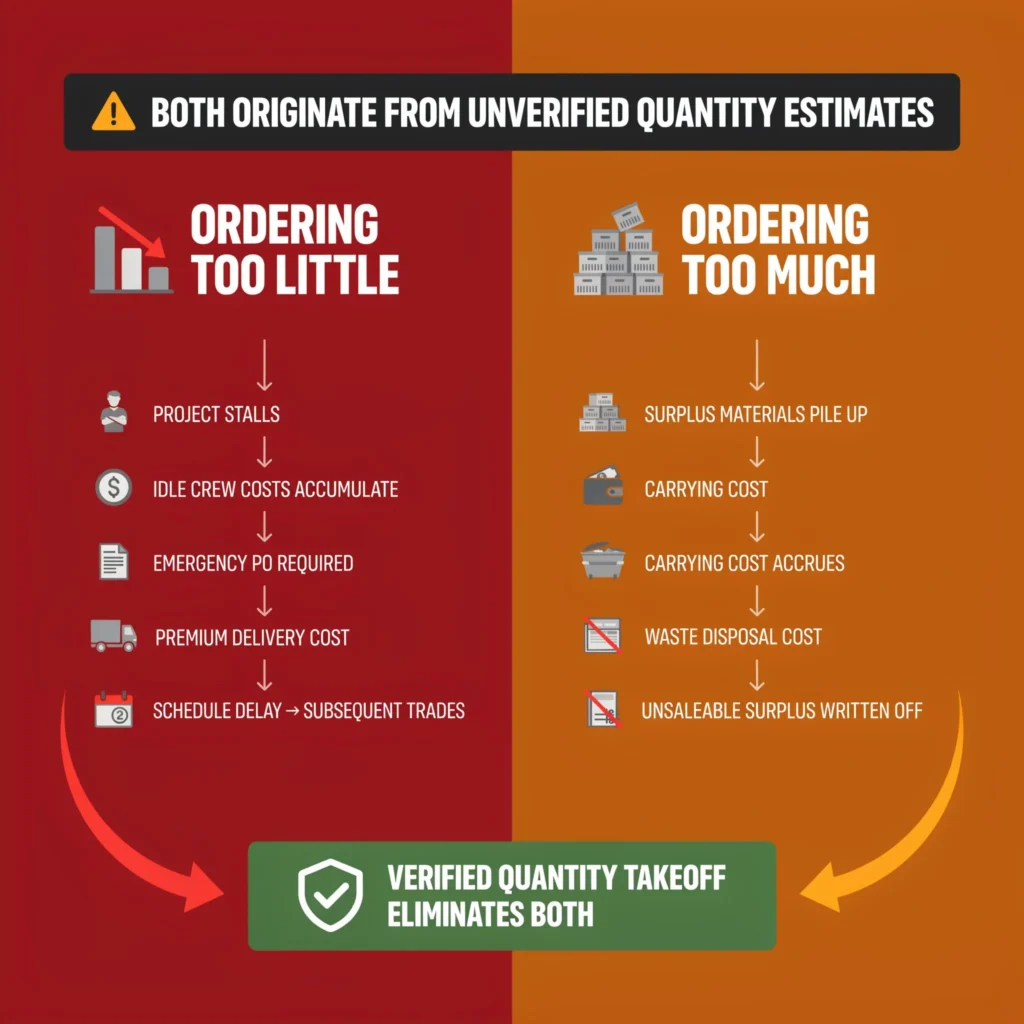
Material waste in construction procurement occurs in two directions that both destroy the project margin. Ordering too little of any material stalls the project while crews wait for additional delivery, generating idle labor costs that accumulate at the daily rate of the entire crew regardless of project size or trade category.
Ordering too much generates carrying costs, waste disposal costs, and the permanent loss of whatever portion of the surplus cannot be returned to the supplier. Both categories of waste originate from quantity errors in the estimating process, and both are eliminated when quantities are verified against the actual drawing set by a professional estimating team.
Our professional material takeoff services produce line-by-line verified quantity lists traceable to specific drawing locations, which contractors use directly for procurement planning and subcontractor scope documentation across every trade the project involves.
Applying Regional Market Pricing That Reflects What You Actually Pay
National pricing databases are the most consistently dangerous tool in in-house estimating because they carry the appearance of authoritative data while systematically misrepresenting what contractors pay in specific regional markets.
The gap between national database unit costs and current regional supplier pricing commonly reaches 15 to 20 percent in active construction markets. This gap produces cost errors that operate in both financially damaging directions.
When the database overstates local material costs, the estimate yields a bid price higher than competitors with regional market knowledge, and the contractor loses contracts they should have won. When the database understates local labor rates or material costs, the estimate produces a bid price that appears competitive but destroys project margin when actual procurement and payroll costs are incurred against a budget that was never adequate.
Construction Cost Planning as the Foundation of Budget Control
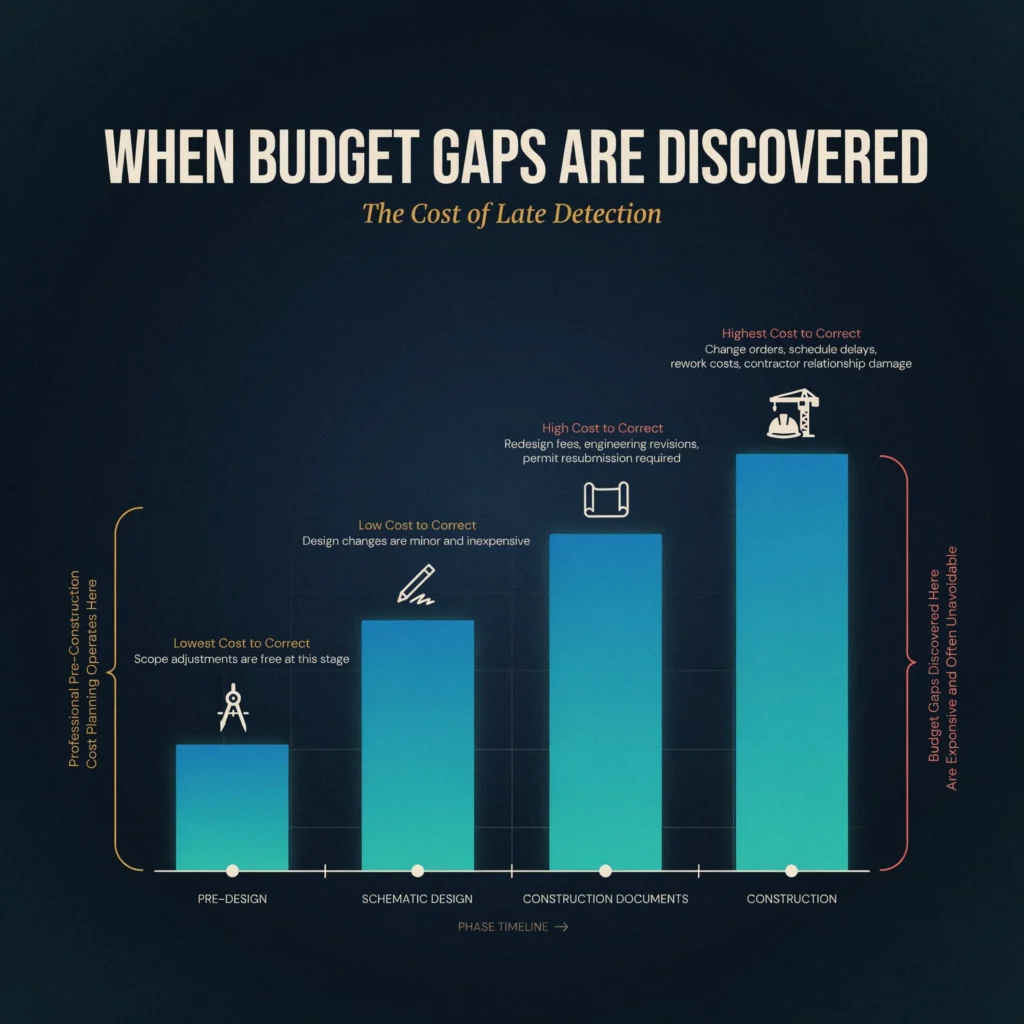
The most expensive estimating error that construction project owners and developers encounter is not a miscalculated quantity or an incorrect labor rate. It is the discovery, after architectural fees, engineering fees, and permit application costs have already been committed, that the project scope they have designed cannot be built within the budget they have available.
Professional pre-construction cost analysis prevents this scenario by establishing the realistic cost of the project scope before those commitments are made. At this stage, the design team still has the flexibility to adjust scope, specification grades, or system choices to bring the project cost in line with the available budget without penalty or waste.
Professional construction cost planning also produces the financial baseline that the project team uses throughout the construction phase to manage procurement timing, sequence subcontractor mobilization, and control cash flow against a verified cost model rather than an optimistic budget that was never grounded in real market data.
Working with budget estimating services that apply professional construction cost planning methodology at the earliest stage of project development gives contractors and project owners the financial control framework that prevents the cascading budget pressures that begin when the first cost gap becomes visible during construction.
The Financial Impact of Professional Material Takeoff Services
A professional material takeoff is not a list of materials. It is a verified, drawing-referenced record of every material and system component the project requires, organized by trade and specification type, with quantities traceable to specific drawing locations that every party to the project can independently verify.
The financial value of this document extends far beyond the procurement planning that it supports directly. It is the reference document that answers scope questions throughout the construction phase, supports subcontractor scope documentation, and provides the verified baseline against which change order claims are evaluated when genuine scope additions arise during construction.
The three cost events where material takeoff accuracy has the most significant financial impact are the procurement shortfall that stalls a project while crews wait for additional materials, the subcontractor change order that covers scope items never fully quantified in the original bid package, and the warranty dispute that arises when a material specification was misread during an unverified in-house takeoff.
All three of these events are preventable through professional takeoff accuracy, and the cost of each one substantially exceeds the cost of the professional quantity takeoff services that would have prevented it.
How Accurate Bid Preparation Saves Money and Wins More Contracts
Professional bid preparation saves money in a way that most contractors do not recognize until they experience an automatic disqualification on a public sector project: the cost of a lost bid opportunity is not zero.
It is the full cost of the estimating time, administrative effort, and missed revenue that the disqualified bid represents, plus the reputational cost of appearing unprepared to an evaluation committee that the contractor may never have the opportunity to bid for again.
On public sector projects in most states, incomplete or improperly formatted bids are disqualified automatically without review of the pricing. This means a contractor whose bid is technically flawed loses the contract regardless of how competitive their pricing is.
Professional bid preparation also improves bid win rates on private sector projects through a mechanism that is equally specific. Bids built on verified quantities and current regional market pricing are neither high enough to be uncompetitive nor low enough to make the project unprofitable.
This is the specific accuracy balance that consistently produces the highest bid win rates in markets where multiple qualified contractors are competing on the same project. Our professional virtual bid management services provide the documentation assembly, formatting, and submission support that ensures every bid package meets the completeness and presentation standards that both public and private sector clients expect.
Reducing Financial Risk Through Change Order Prevention
Change orders are the most consistently underestimated source of financial loss in construction contracting because their cost is always higher than the direct cost of the additional work they authorize.
Every change order imposes a schedule impact that delays other trades, a management overhead cost that the project team absorbs regardless of whether the change is billable to the owner, and a relationship cost that strains the contractor-owner dynamic in ways that affect future business opportunities.
Professional estimating services reduce change order exposure by verifying every scope item against the drawing set before the bid is submitted, producing a documented quantity baseline that answers most scope questions before they arise in the field as disputes.
When genuine scope additions do arise during construction, a contractor who worked from a professional estimate occupies a fundamentally stronger position in the change order conversation. A verified, drawing-referenced quantity baseline demonstrates that the original estimate accounted for every specified scope item in full.
This means any addition to that scope is clearly outside the original contract and billable to the owner without the ambiguity that in-house estimates frequently produce when scope boundary questions arise. The combination of change order reduction and improved change order recovery is one of the most financially significant benefits that professional estimating services deliver.
The Savings From Replacing In-House Estimating With Professional Outsourced Services
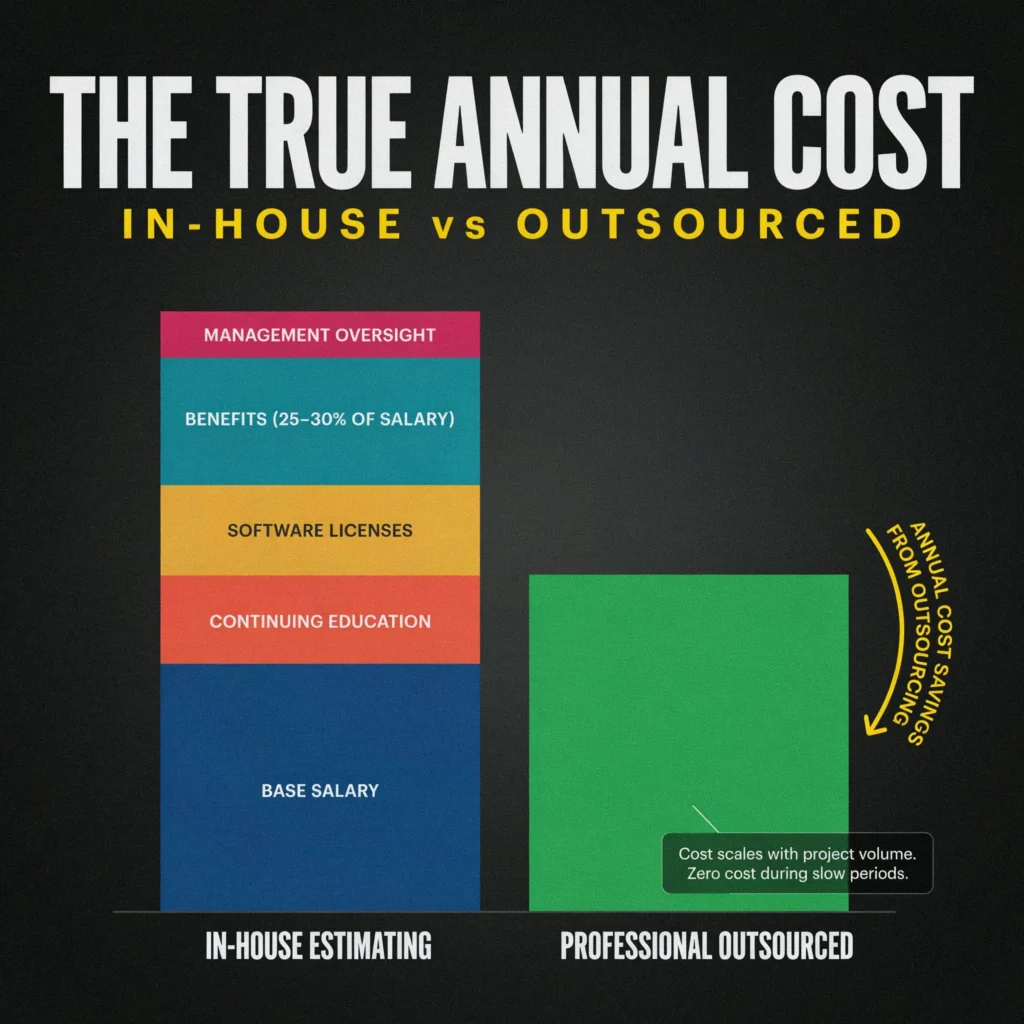
The full overhead cost of maintaining in-house estimating capacity is substantially higher than the salary line alone represents. Most contractors who evaluate this cost comparison make the error of comparing only the invoice cost of outsourced services against the salary of their in-house estimator.
A complete cost comparison must include the benefits package that adds 25 to 30 percent above the base salary, the annual estimating software license costs for professional-grade platforms, the continuing education and professional development investment required to keep the estimator’s knowledge current, and the management time required to supervise, review, and quality-check the estimator’s output on every project they produce.
When these factors are combined honestly, the realistic annual overhead of a single in-house estimator is substantially higher than that of contractors who have not completed the full analysis.
The outsourced estimating model converts this fixed overhead into a variable cost that scales directly with actual project volume. When the bid pipeline is active, outsourced estimating capacity scales to meet the demand. When bid volume is lower between project cycles, the cost drops correspondingly rather than continuing to accumulate as a fixed salary and benefits obligation.
Beyond the direct cost comparison, the coverage advantage of a specialist outsourced estimating team provides further financial value that a single in-house generalist cannot replicate at any salary level. When contractors outsource their construction estimating to a professional firm with verified regional market knowledge and trade-specific expertise, they access both a lower total estimating cost and a higher quality of estimating output.
Value Engineering: The Hidden Source of Construction Cost Savings
Value engineering in professional construction estimating is the systematic review of project design and specification decisions to identify where alternative materials, construction methods, or system configurations can deliver the same functional and aesthetic outcome at a lower total installed cost.
It is not a cost-cutting exercise that compromises project quality. It is a professional cost optimization discipline that requires the same depth of trade-specific knowledge as the original estimate because the alternatives it identifies must meet the same performance, code compliance, and design intent requirements as the specifications they replace.
Professional estimating firms that include value engineering as a standard service review the project scope not only to measure and price what is specified but to identify where the specification produces a higher cost than the design intent requires.
An alternative roofing system specification that meets the same energy performance standard at lower installed cost, an optimized structural framing layout that reduces lumber quantities without changing structural performance, and a more efficient MEP routing plan that reduces pipe and conduit quantities while meeting every system performance requirement are all value engineering outcomes that professional estimators with genuine trade knowledge identify routinely.
The financial savings these alternatives generate before construction begins are permanent savings that compound through every subsequent phase of the project rather than the temporary cost deferral that budget cuts during construction typically produce.
How Subcontractor Negotiation Savings Add to Your Bottom Line
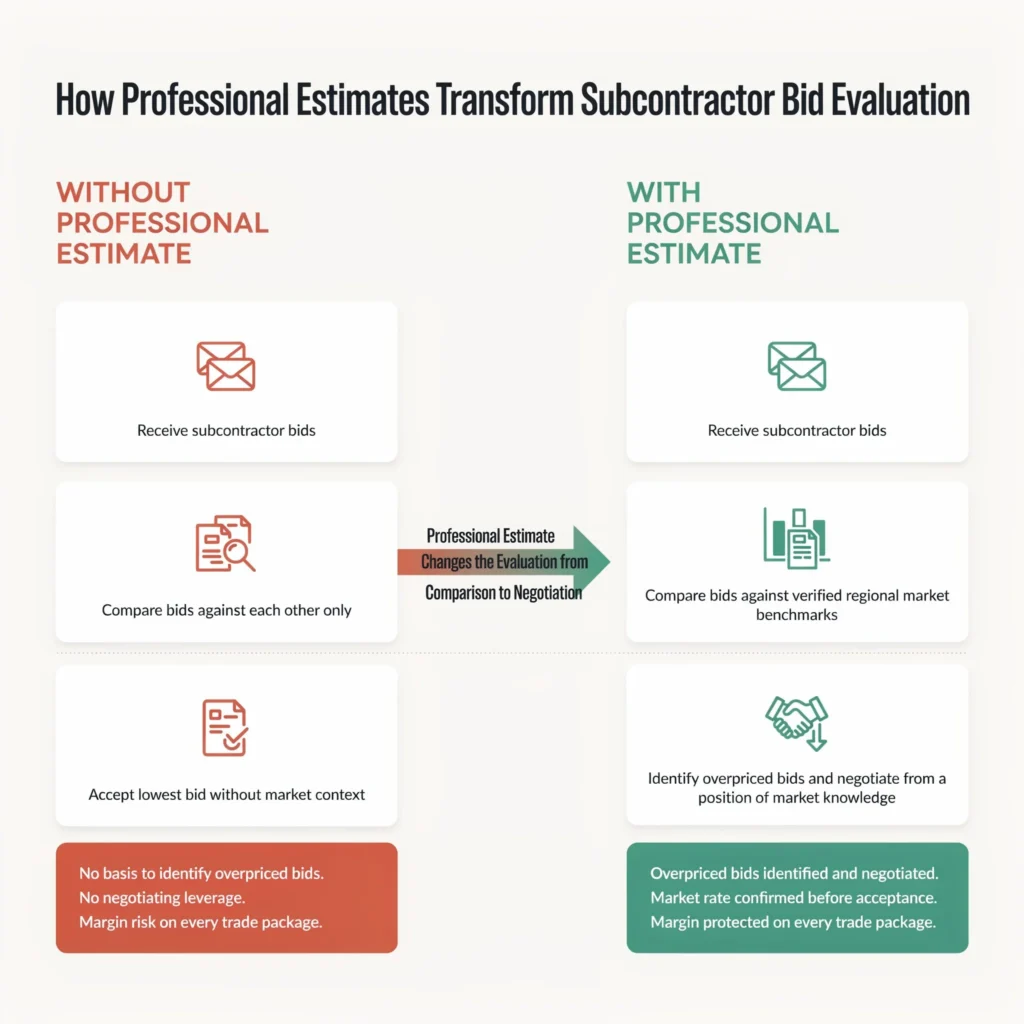
Professional construction estimating gives the general contractor something that transforms their subcontractor bid evaluation process from a comparison of submitted numbers into a disciplined negotiation: verified market benchmarks for what each trade scope should cost at current regional market rates.
When a general contractor receives a subcontractor bid for a mechanical scope on a commercial project, a professional estimate that covers the same mechanical scope with verified quantities and current regional labor rates tells the contractor whether the subcontractor’s bid reflects fair market pricing or includes a premium that is not justified by the scope or market conditions.
This market knowledge converts the subcontractor bid evaluation from an acceptance decision into a negotiating conversation where the contractor holds the verified data that supports their position.
The financial significance of subcontractor negotiation savings compounds across a full year’s project volume. A contractor who consistently applies verified market benchmarks to subcontractor bid evaluation across every trade on every project recovers modest percentages on individual trade packages, and those modest recoveries add up across a full project pipeline into margin improvement that contributes meaningfully to annual financial performance.
How CSI Estimation LLC Delivers Every Category of Savings Described in This Guide
CSI Estimation LLC delivers trade-specific professional estimating services to contractors, developers, and project owners across all 50 states, applying every saving mechanism described in this guide as standard practice on every project they handle.
Their estimating team produces verified material takeoffs with quantities traceable to specific drawing locations, applies current regional market pricing sourced from active supplier databases rather than national averages, conducts value engineering reviews on applicable project scopes, and prepares complete and professionally formatted bid documentation.
Their commercial estimating services and residential estimating services are both built on the same foundation of trade-specific specialist knowledge and locally calibrated market data that produces estimates accurate enough to win bids and protect margins from award through project completion.
For contractors who have been absorbing the financial losses described in this guide through their current in-house estimating process, CSI Estimation LLC’s standard turnaround of 24 to 48 hours for most residential and commercial project types means that transitioning to professional outsourced estimating does not require adjusting bid timelines or slowing down the contractor’s response to bid invitations.
Every saving mechanism described in this guide is accessible on the next project the contractor submits, without setup costs, without hiring delays, and without the software investment that in-house professional estimating quality would require.
Start Saving on Your Next Project by Submitting Your Drawings Today
Every financial loss described in this guide is a preventable loss, and every saving mechanism described is a recoverable financial benefit that professional construction estimating services deliver beginning on the first project they are applied to.
The cost of a professional estimate is a fraction of the cost of a single procurement shortfall, a single unverified change order, or a single bid disqualification, which means the return on the professional estimating investment is immediate and measurable on every project where it is applied.
Submit your project drawings to CSI Estimation LLC today and receive a complete, trade-specific professional estimate within 24 to 48 hours for most standard project types. Their estimating team covers every trade in your project scope, applies verified quantities and current regional market pricing to every cost component, and delivers a cost breakdown that protects your budget before the first dollar is committed to construction.
Contact CSI Estimation LLC today and take the first step toward estimates that save money on every project you build.