
What is CPM Scheduling is answered in precise terms: it is the Critical Path Method, a network-based construction scheduling methodology that calculates the longest sequence of dependent activities through a project to determine the minimum possible completion date. A CPM schedule identifies which activities are critical, calculates float across all other activities, and produces the documented baseline that protects contractors and project owners from the financial consequences of unmanaged delays.
Construction projects that are managed without a documented critical path schedule share a predictable pattern. Delays accumulate in activities that no one identified as controlling the project completion date. Resources are deployed on activities that have scheduling flexibility, while critical activities fall behind for lack of attention. By the time the delay impact becomes visible on site, the options for recovery are expensive and limited.
What is CPM Scheduling is the question that every contractor and project manager who has experienced this pattern eventually asks. The answer is a methodology that prevents it by identifying, before construction begins, exactly which activities control the project completion date and exactly how much scheduling flexibility exists across every other activity in the project.
What Is CPM Scheduling in Construction?
CPM scheduling, which stands for Critical Path Method scheduling, is a network-based project planning methodology that calculates the minimum duration required to complete a construction project by identifying the longest sequence of logically dependent activities from project start to project finish.
This longest sequence and is the critical path. Every activity on the critical path directly controls the project completion date, which means any delay to a critical path activity delays the project by an equal amount unless corrective action is taken.
CPM scheduling is the dominant professional scheduling methodology in commercial and industrial construction because it produces information that simpler scheduling tools cannot: the identification of which activities carry schedule risk, the quantification of scheduling flexibility across non-critical activities, and the documented baseline that supports delay claim analysis when project completion is affected by events outside the contractor’s control.
Our professional CPM scheduling services produce complete, logic-driven CPM schedules for contractors and project owners across all 50 states, delivering the critical path analysis and baseline documentation that professional contract requirements and project management standards demand.
What Are the Key Elements of a CPM Construction Schedule?
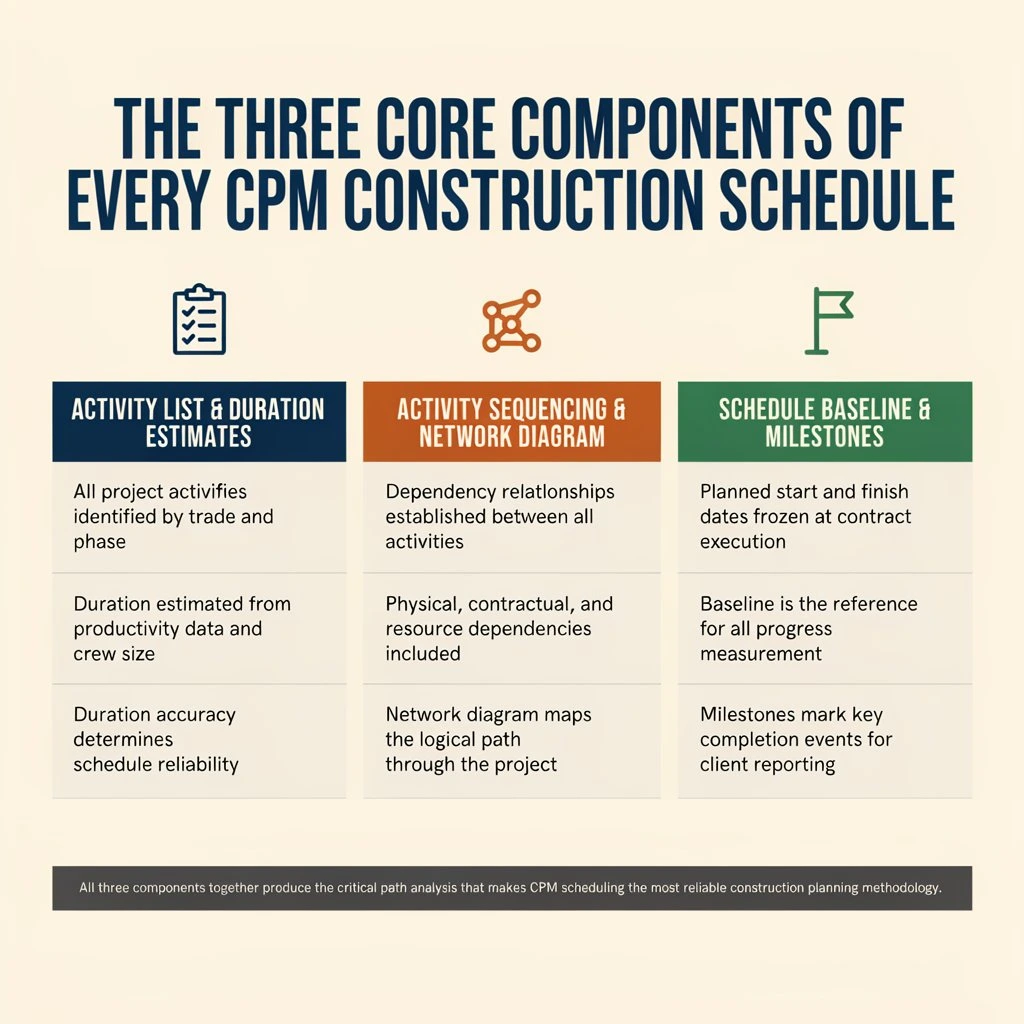
A complete CPM construction schedule contains specific technical components that together produce the critical path analysis on which the methodology is built. Each component is essential, and the absence of any one of them reduces the schedule from a CPM schedule to a simpler planning document that does not deliver the same analytical capability.
Activity List and Duration Estimates
Every CPM schedule begins with a complete list of all project activities and a verified duration estimate for each one. Activity duration estimation in construction draws from trade-specific productivity data, historical crew output rates, site-specific conditions, and the scope of work each activity covers.
A duration estimate that is not grounded in these factors produces a CPM schedule that is mathematically precise but practically unreliable, because the critical path calculation is only as accurate as the duration inputs that drive it. Using the semantic keyword “activity duration estimation construction” throughout this section reflects how professional schedulers approach this foundational step.
Activity Sequencing and Network Diagram
Once the activity list is complete, each activity is arranged in the logical sequence it must follow based on construction dependencies. Some dependencies are physical: concrete must cure before formwork can be stripped. Some are contractual: inspections must be completed before concealment work begins. Some are resource-based: a single crew cannot perform two activities simultaneously.
These dependencies are represented in the CPM network diagram using the Activity on Node format, where each activity is a node and arrows between nodes show the dependency relationships. The network diagram is the structural foundation of the entire CPM schedule and the source of the logical path that the forward and backward pass calculations travel.
Schedule Baseline and Milestones
Once the network is built and durations are applied, the CPM calculations produce a planned start and finish date for every activity. These planned dates, frozen at the point of project award or contract execution, form the construction schedule baseline.
The baseline is the reference document against which all actual progress is measured throughout construction. Project milestones mark the key completion events within the baseline, providing the client-facing progress checkpoints that project owners use to track whether the project is on schedule and the project team uses to trigger payment applications, procurement orders, and subcontractor mobilizations.
How the Forward Pass and Backward Pass Work in CPM Scheduling
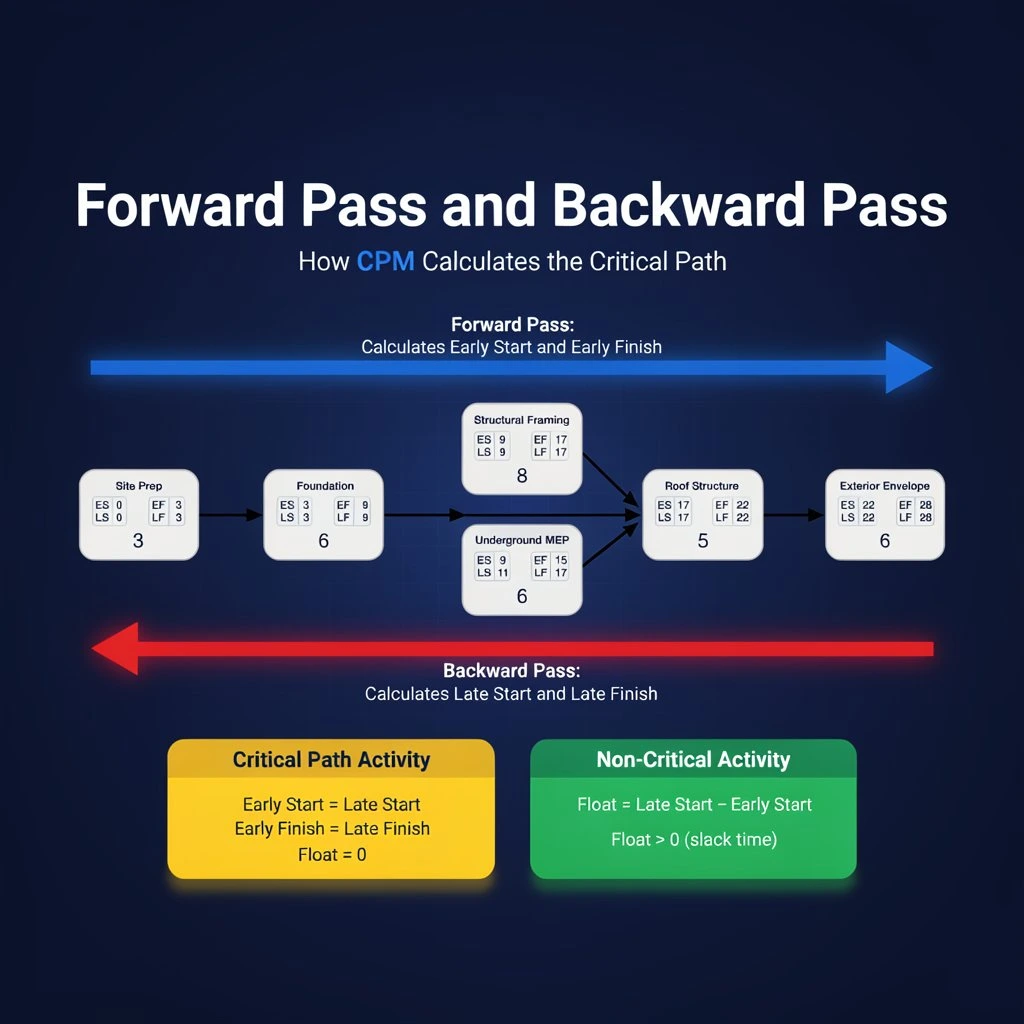
The forward pass and backward pass are the two sequential calculations that identify the critical path and calculate float across all activities in the schedule. Together, they transform the activity network into a complete CPM schedule with quantified dates and float values for every activity.
The Forward Pass: Calculating Early Start and Early Finish
The forward pass moves through the network from the first activity to the last, calculating the earliest possible start date and earliest possible finish date for each activity given the durations and dependencies already established in the network.
The early start of each activity is determined by the early finish of its predecessor activities. The early finish of each activity is its early start plus its duration. When the forward pass reaches the last activity in the network, its early finish gives the earliest possible project completion date based on the planned activity durations and logical sequence.
The earliest completion date is the scheduled answer that most clients and project owners want. It is also the number that schedule compression decisions are made against when the planned completion date does not meet the contractually required completion date.
The Backward Pass: Calculating Late Start and Late Finish
The backward pass moves through the network in reverse, from the last activity back to the first, calculating the latest allowable start date and latest allowable finish date for each activity without pushing the project completion date beyond the date established by the forward pass.
The late finish of each activity is determined by the late start of its successor activities. The late start of each activity is its late finish minus its duration.
The difference between the early dates and late dates for any given activity is its float value, which tells the scheduler exactly how much scheduling flexibility that activity carries. Activities where the early dates and late dates are identical have zero float and are on the critical path.
What Is Float in CPM Scheduling and Why Does It Matter?
Float is one of the most practically useful pieces of information that CPM scheduling produces, and one of the most consistently misunderstood by contractors who encounter CPM schedules for the first time.
Total float is the amount of time an activity can be delayed without delaying the project completion date. An activity with ten days of total float can start up to ten days later than its early start date without pushing the project past its scheduled completion. An activity with zero total float is a critical activity, and any delay to it delays the project.
Free float is a more precise measure. It is the amount of time an activity can be delayed without delaying the early start of any of its immediate successor activities. Free float is useful for resource allocation decisions where the scheduler needs to know whether an activity can be rescheduled without affecting the next activity in the sequence, even when total float is available.
Float management is the ongoing practice of monitoring how available float is being consumed as the project progresses. When a non-critical activity consumes its float due to a delay or resource constraint, it becomes critical and joins the critical path. The project team then has two critical paths to manage where previously there was one, which increases schedule risk.
Understanding float is also essential for contract administration. Many construction contracts contain provisions governing the ownership of float, and a project team that does not understand how float works in their CPM schedule cannot effectively protect their contractual rights when schedule disputes arise.
CPM Scheduling vs Bar Chart Schedule: What Is the Difference?
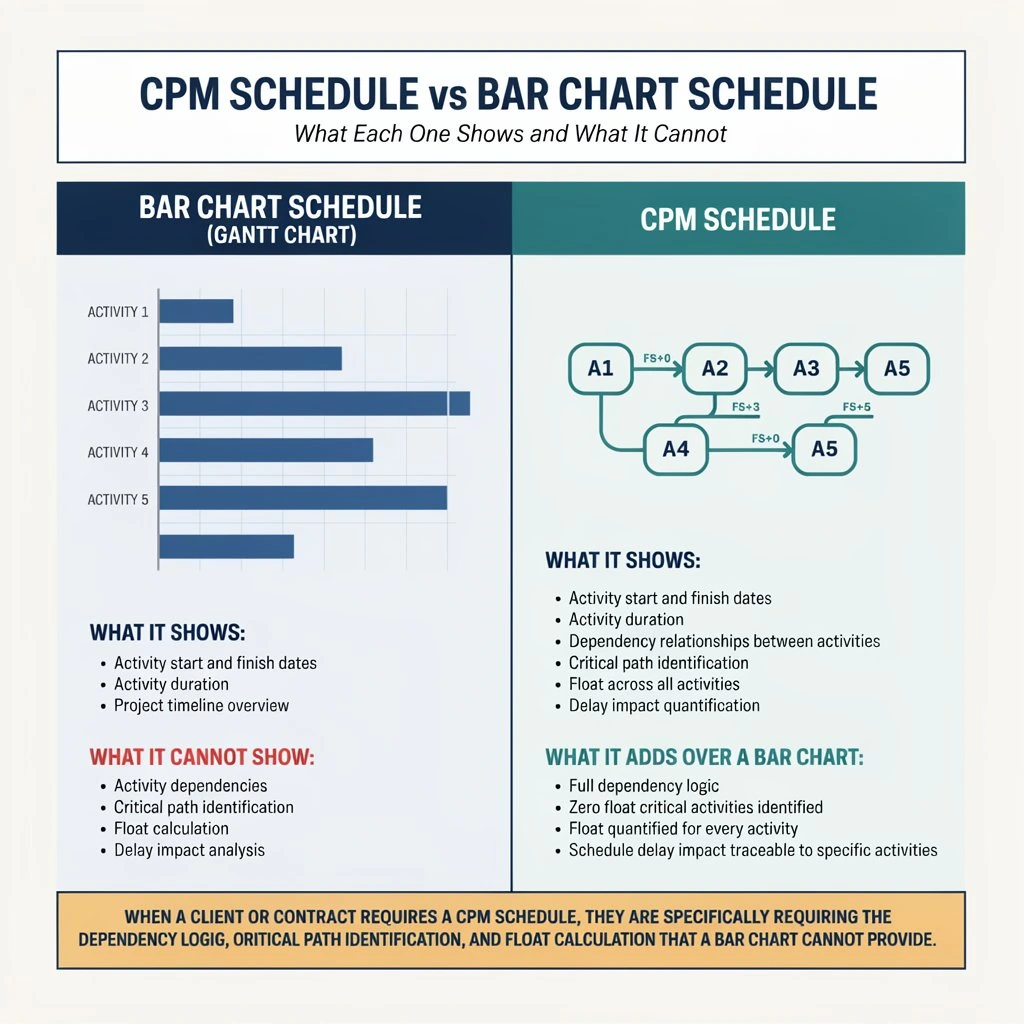
A bar chart schedule, commonly called a Gantt chart, displays construction activities as horizontal bars on a timeline showing when each activity starts and finishes. It is easy to read, easy to produce, and widely used in construction project planning at every scale.
What a bar chart schedule does not show is the dependency logic between activities. A bar chart tells you when each activity is planned to happen, but it does not tell you which activities control which other activities. It cannot identify the critical path because it does not model the dependency network. It cannot calculate a float because it has no mechanism for comparing early dates against late dates. And it cannot answer the question that matters most when a delay occurs: which activities are now in jeopardy and by how much.
A CPM schedule adds all of these capabilities to the basic timeline display of a bar chart. Professional CPM scheduling software displays the schedule as both a bar chart and a network diagram simultaneously, giving the project team the visual clarity of a Gantt chart alongside the analytical power of a dependency network. This combination is what client organizations, public agencies, and institutional lenders require when they specify that a CPM schedule must be submitted rather than a simple bar chart.
The Benefits of CPM Scheduling for General Contractors and Project Owners
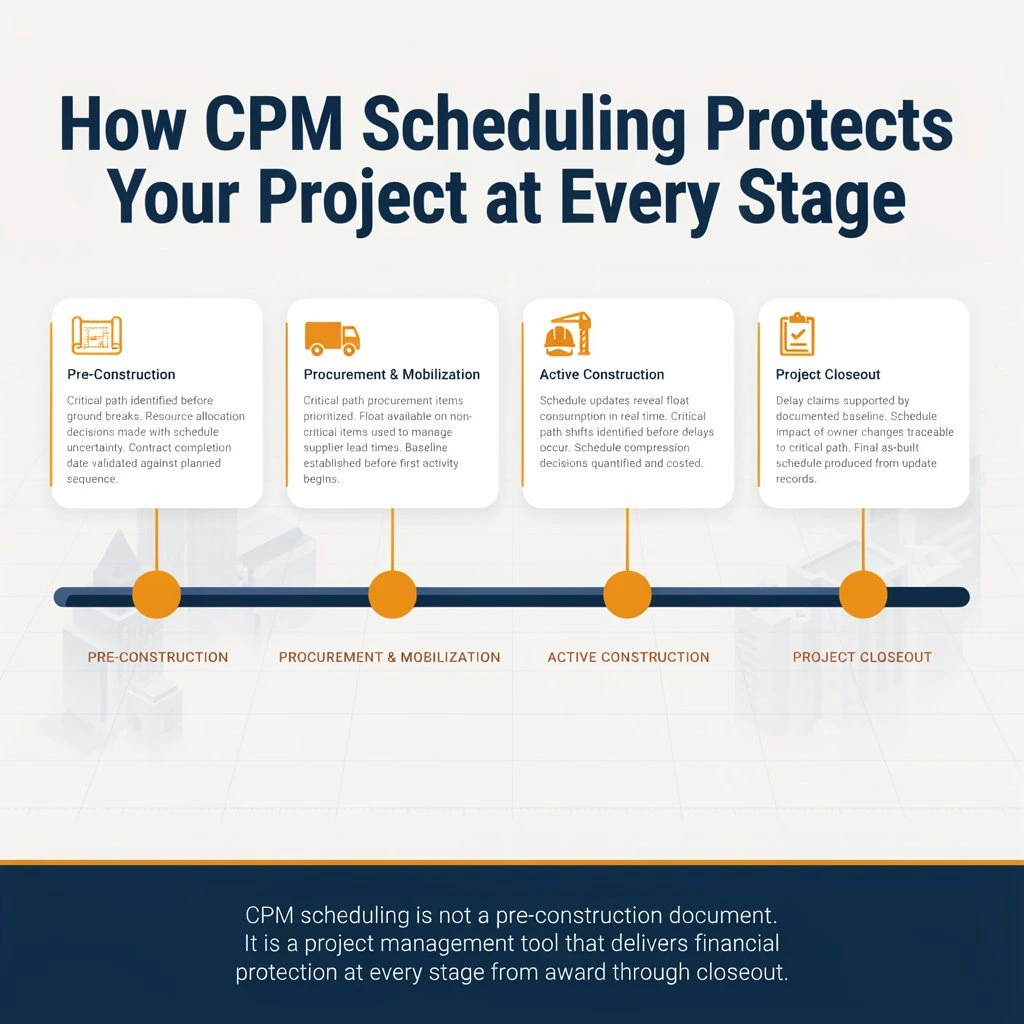
CPM scheduling delivers specific, measurable benefits at every stage of a construction project from pre-construction planning through project closeout, and those benefits are directly financial for both contractors and project owners.
Protecting Project Timelines and Preventing Schedule Delays
CPM scheduling protects project timelines by identifying, before construction begins, exactly which activities control the project completion date. This identification allows the project team to concentrate management attention, resource deployment, and procurement priority on critical path activities rather than distributing attention equally across all activities regardless of their schedule impact.
When a procurement delay threatens a critical path activity, the CPM schedule tells the project team how much time they have to resolve it before the project completion date is affected. When a weather event disrupts site work, the CPM schedule tells the team which recovery actions will actually restore the completion date and which will consume cost without restoring the schedule. This decision support is one of the most financially valuable outputs of professional CPM scheduling and one that our construction cost management services are designed to support alongside the schedule management itself.
Supporting Delay Claims and Contract Documentation
When construction is delayed by events outside the contractor’s control, such as owner-directed changes, unforeseen site conditions, or third-party utility conflicts, the contractor’s ability to recover additional time and compensation depends on demonstrating the causal connection between the delay event and its impact on the project completion date.
A documented CPM schedule baseline makes this demonstration possible. Without a baseline that shows what the planned schedule looked like before the delay event occurred, the causal connection is extremely difficult to establish in a contract dispute or formal claim proceeding.
Contractors who operate without a CPM schedule baseline frequently find that they cannot quantify their delay entitlement even when the causing event is clearly the owner’s responsibility, because they have no document that proves what the schedule impact actually was. A professionally produced CPM schedule eliminates this vulnerability by creating the baseline documentation at the outset of the project when the schedule is planned rather than reconstructed after a dispute arises.
How CPM Scheduling Software Is Used in Construction Projects
CPM scheduling is performed using specialized software platforms that automate the forward pass and backward pass calculations, maintain the activity network logic, and produce the schedule reports and graphics that clients and project owners require. The three platforms most commonly encountered in professional construction scheduling are Primavera P6, Microsoft Project, and Asta Powerproject.
Primavera P6 is the industry standard for large commercial, industrial, and infrastructure projects. It handles complex networks with thousands of activities, supports resource loading and cost loading of the schedule, and produces the detailed reports that major institutional clients and government agencies specify in their contract requirements.
Microsoft Project is the most widely used platform across mid-sized commercial and residential projects. It is more accessible than Primavera P6 for contractors without dedicated scheduling staff and produces CPM schedules that meet the requirements of most private sector contracts.
What distinguishes a professionally produced CPM schedule from a schedule produced in the same software by someone without CPM methodology expertise is not the platform. It is the accuracy of the activity list, the logic of the dependency network, and the validity of the duration estimates. Software automates the calculation. Professional expertise determines whether the inputs that drive the calculation are reliable enough to produce a schedule that reflects how the project will actually be built.
Tracking Progress With a CPM Schedule During Construction
A CPM schedule is not a static document produced once at project inception and filed until the project is complete. It is a living management tool that is updated throughout construction to reflect actual progress against the planned baseline and to recalculate the current project completion date based on that progress.
Schedule updates involve recording the actual start and finish dates of completed activities, updating the remaining duration of activities that are in progress, and recalculating the forward and backward passes to produce a revised critical path and updated completion date forecast. Most professional CPM scheduling contracts require schedule updates at regular intervals, typically monthly for standard commercial projects and more frequently for fast-track or compressed schedules.
What schedule monitoring reveals during construction is often more valuable than the original schedule itself. When non-critical activities consume float faster than the baseline assumes, the updated schedule identifies the emerging risk before the activity becomes critical and triggers a delay.
When critical path activities are completed ahead of schedule, the updated CPM reveals where float has been created and how it can be used to absorb risk elsewhere in the sequence. Our quantity takeoff services support the duration estimation process, making these schedule updates reliable by providing verified material quantities that underpin realistic activity duration assumptions for material-dependent construction activities.
Schedule Compression Techniques Used in CPM Scheduling
When the CPM schedule produces a planned completion date that exceeds the contractually required completion date, the project team must evaluate schedule compression options. CPM scheduling makes this evaluation quantitative rather than intuitive by identifying which activities can be compressed, by how much, and at what cost.
Crashing is the first compression technique. It involves reducing the duration of critical path activities by adding resources, increasing crew sizes, extending working hours, or procuring materials earlier than planned. The CPM schedule quantifies the duration reduction achievable through crashing and the cost premium associated with each decision, allowing the project team to evaluate which crashing options deliver the best schedule recovery per dollar of additional cost.
Fast tracking is the second compression technique. It involves overlapping activities that would normally be performed sequentially, starting a successor activity before its predecessor is complete. CPM scheduling identifies which activities can be safely fast-tracked by examining the dependency logic and assessing whether the overlap creates an unacceptable quality or safety risk.
Both techniques are most effective when applied to the critical path specifically, because compressing non-critical activities produces no schedule benefit regardless of the resources invested.
How CSI Estimation LLC Delivers Professional CPM Scheduling Services
CSI Estimation LLC produces complete CPM schedules for contractors and project owners across all 50 states, covering every technical component described in this guide on every project they handle. Their scheduling team develops the activity list from project scope documents, establishes the dependency network based on construction methodology expertise, applies duration estimates from trade-specific productivity data, performs the forward and backward pass calculations, identifies the critical path and calculates float, and produces the baseline documentation in Primavera P6 or Microsoft Project, depending on client and contract requirements.
Their professional CPM scheduling services are available for residential, commercial, industrial, and infrastructure projects at every scale and in every regional market, with turnaround times designed to support bid submission deadlines and contract execution timelines.
CSI’s CPM scheduling integrates directly with their broader pre-construction planning capabilities. A CPM schedule produced alongside a verified cost estimate from their construction cost estimating services creates a complete pre-construction planning package that supports both competitive bid submission and project execution planning, providing the contractor and project owner with a financial model and a schedule model built from the same scope understanding and project assumptions.
Get Your CPM Schedule Produced by Professionals Within 48 Hours
A project managed without a professional CPM schedule carries risks that accumulate silently until they become schedule delays, contract disputes, and cost overruns that are expensive to resolve and difficult to prevent once they have materialized. A professionally produced CPM schedule eliminates the most significant of these risks by identifying the critical path, quantifying float, and creating the baseline documentation that protects the contractor and project owner throughout the construction process.
Submit your project documents to CSI Estimation LLC today and receive a professionally produced CPM schedule built to the technical standard described in this guide, delivered within 48 hours for most standard commercial and residential project types, and ready to meet the schedule submission requirements of any client, contract, or regulatory body your project involves.
Contact CSI Estimation LLC today and take the first step toward a construction schedule that is accurate enough to manage and defensible enough to present.