
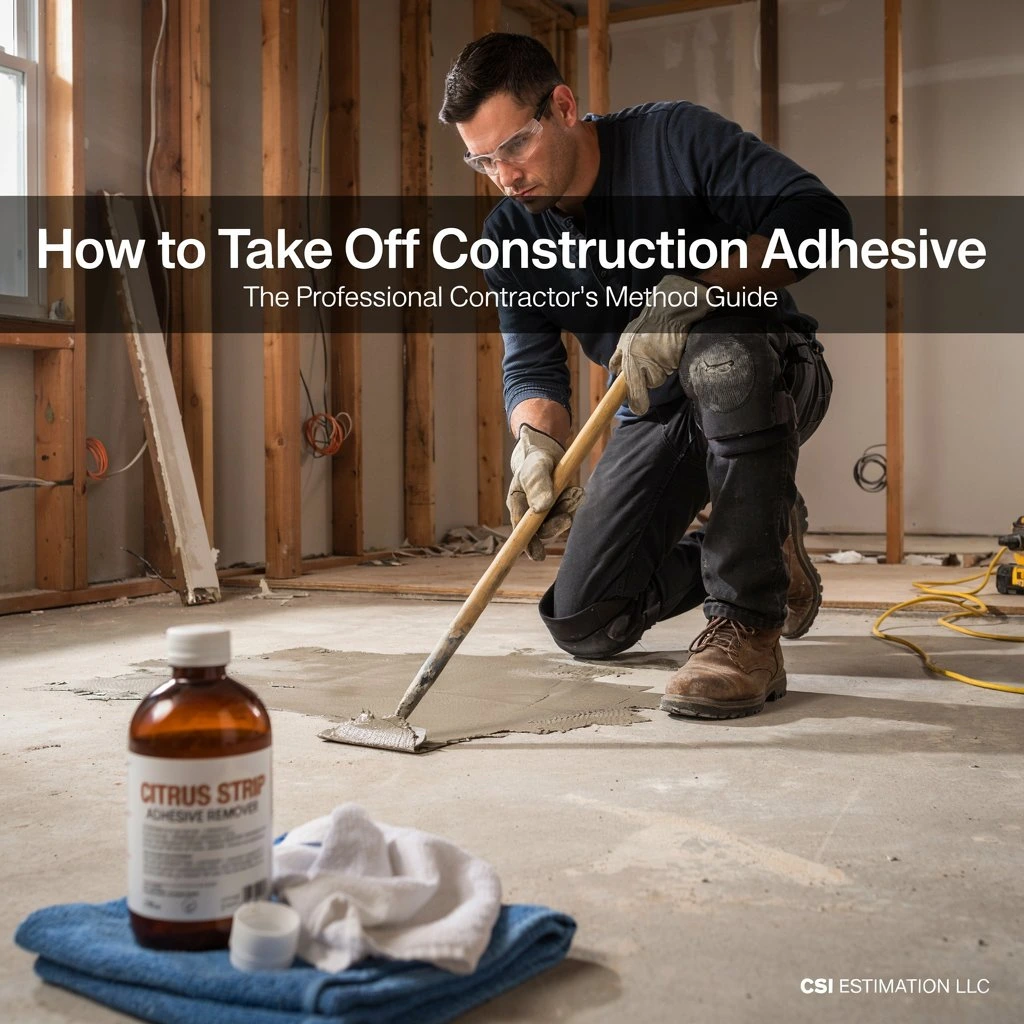
How to Take Off Construction Adhesive requires selecting the right removal method for the specific adhesive type and substrate combination involved: mechanical scraping and grinding for fully cured adhesive on hard substrates, heat gun application for partially cured flexible mastics, and chemical or solvent-based removal for adhesive residue and film after bulk mechanical removal is complete. Applying the wrong method to the wrong substrate produces damage that costs more to repair than the adhesive removal itself.
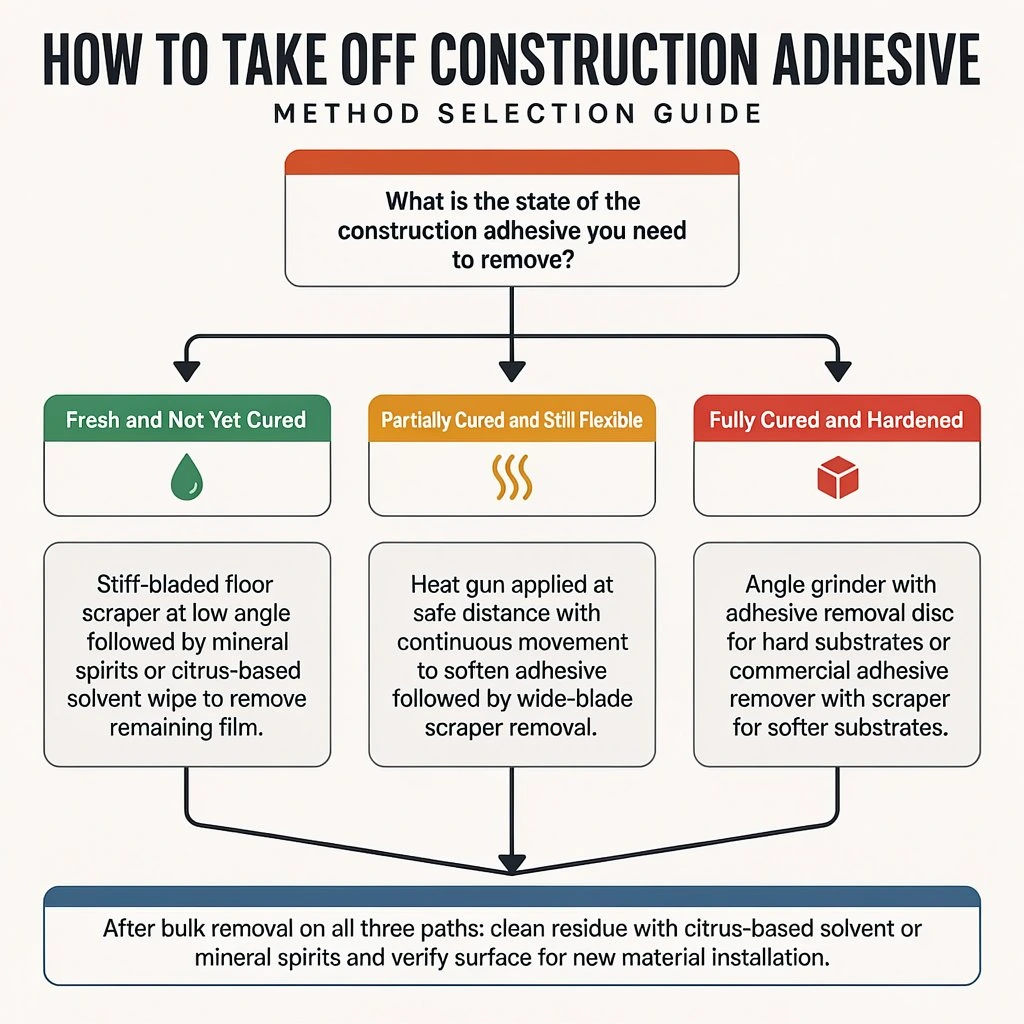
Construction adhesive removal is one of the most technically demanding scope items in renovation and remodeling work, not because the process is complicated, but because the combination of adhesive type, substrate material, and cure state creates a decision matrix that most contractors encounter in too many variations to rely on a single standard method. Applying a solvent that works perfectly on mastic residue on a concrete slab to a wood subfloor can raise the grain and contaminate the surface for new adhesive bonding.
Understanding how to take off construction adhesive correctly for each substrate and adhesive combination protects the substrate, protects the project schedule, and ensures that the surface preparation phase of every renovation project delivers a clean, ready-to-receive substrate before the first new material is installed.
Why Construction Adhesive Removal Requires a Strategy
Construction adhesive removal fails most often not because the contractor lacks the right tools but because the removal method was selected without considering the specific adhesive type, the substrate material, and the cure state of the adhesive at the time of removal. A heat gun applied to fresh mastic on a wood subfloor softens the adhesive effectively and allows clean scraper removal with minimal substrate damage. The same heat gun applied to a fully cured polyurethane adhesive on the same substrate does not soften the adhesive enough for clean removal and raises the risk of scorching the wood surface.
The three variables that determine which removal method is appropriate are the adhesive type, which determines its chemical composition and therefore its response to solvents and heat; the substrate material, which determines which methods are safe to apply without causing damage; and whether the adhesive is fresh, partially cured, or fully cured. Identifying all three before committing to a removal method is a professional standard that prevents substrate damage.
Working with professional remodeling estimating services at the planning stage helps renovation contractors account for the full labor scope of adhesive removal before the project begins, rather than discovering its complexity after mobilization.
Construction Adhesive Types and What Makes Each One Different to Remove
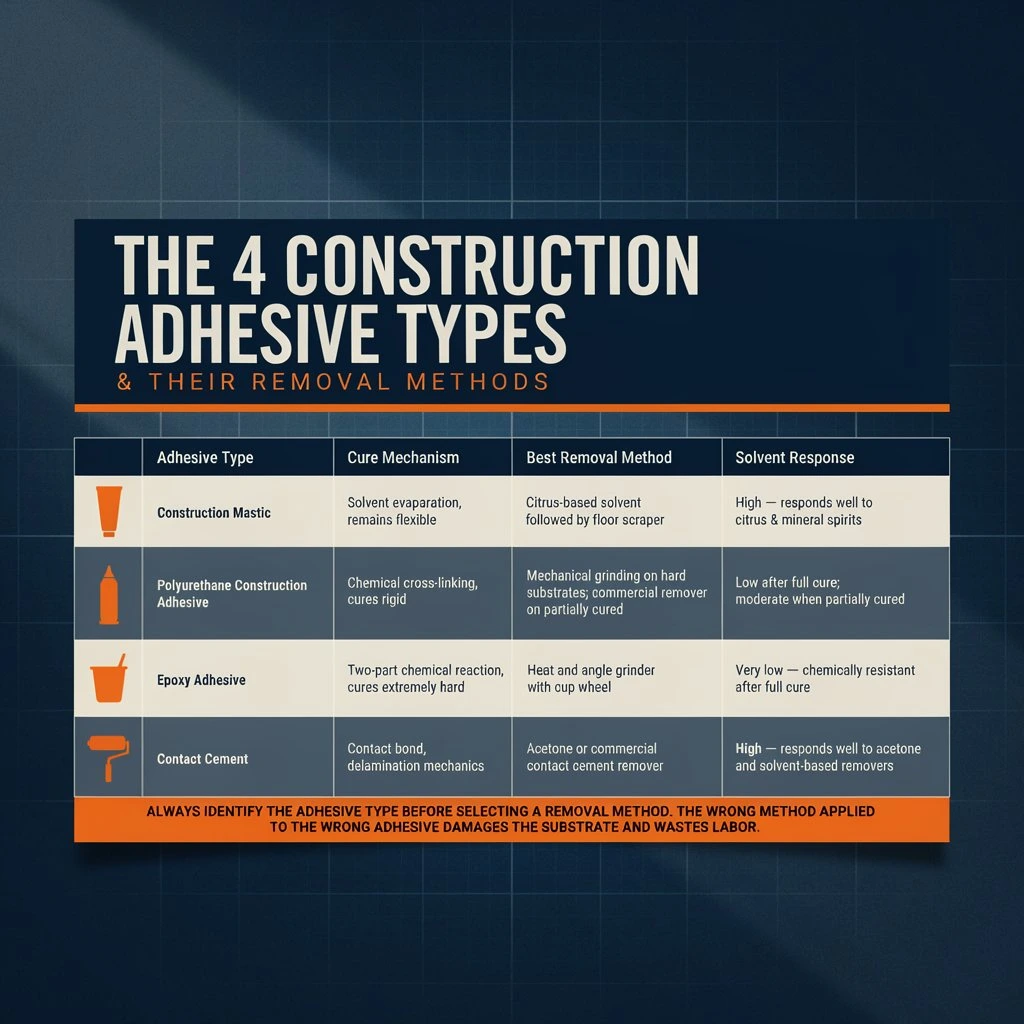
The four adhesive types most commonly encountered on renovation projects each respond differently to removal methods, and identifying the adhesive type from the project documents or site investigation before selecting a removal approach is the first professional step in any adhesive removal scope.
Construction mastic is a solvent-based adhesive used historically for floor tile and panel installation. It remains somewhat flexible after cure and responds well to chemical removers, particularly citrus-based solvents, which soften the adhesive film for scraper removal without requiring aggressive mechanical grinding.
Polyurethane construction adhesive cures into a rigid state through a chemical reaction rather than solvent evaporation. Once fully cured, it bonds mechanically and chemically with porous substrates like concrete and wood, making it the most labor-intensive adhesive to remove. Mechanical grinding is frequently the only fully effective method after complete cure.
Epoxy adhesive cures to a hard, chemically resistant film that responds poorly to solvents. Heat and mechanical grinding are the primary removal methods. Contact cement forms a bond through delamination mechanics and responds to solvent application, particularly acetone and commercial contact cement removers, more readily than any other adhesive type on this list.
How to Take Off Construction Adhesive from Concrete
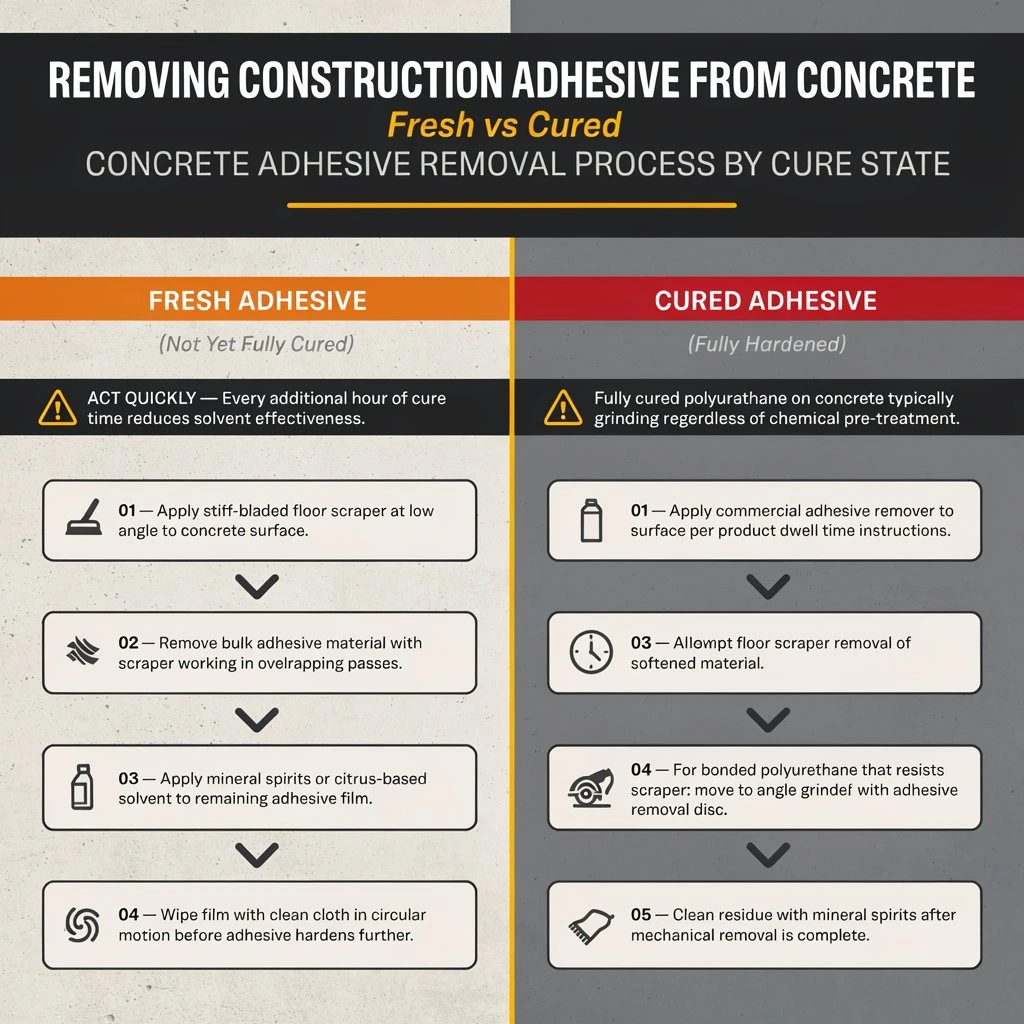
Concrete is the most common substrate from which renovation contractors must remove construction adhesive, and the removal method differs substantially depending on whether the adhesive is still workable or has fully cured to its final hardness.
Removing Fresh Construction Adhesive from Concrete
Fresh construction adhesive that has not yet fully cured can be removed from concrete using a stiff-bladed floor scraper applied at a low angle to the surface. Working at a low angle reduces the risk of the scraper gouging the concrete surface and allows the blade to slide under the adhesive rather than driving into it.
After bulk removal with the scraper, the remaining adhesive film is removed by applying mineral spirits or a citrus-based solvent to the residue with a clean cloth and wiping in a circular motion to lift the adhesive film before it hardens further.
Speed matters with fresh adhesive removal because every hour of additional cure time reduces the effectiveness of solvent-based removal and increases the mechanical effort required to achieve a clean surface.
Removing Cured Construction Adhesive from Concrete
Fully cured construction adhesive on concrete typically requires a combination of mechanical grinding and chemical softening rather than scraping alone. An angle grinder fitted with an adhesive removal disc or a cup wheel addresses large areas of bonded cured adhesive, while a long-handled floor scraper manages the loosened material between grinding passes.
For cured mastic and flexible adhesives that have not cross-linked as rigidly as polyurethane, a commercial adhesive remover applied according to the product’s dwell time instructions can soften the adhesive enough for floor scraper removal before grinding becomes necessary.
Fully cured polyurethane construction adhesive on concrete is the most demanding scenario in this category. Grinding is frequently the only method that achieves a clean substrate without leaving bonded residue that will prevent new adhesive from achieving its rated bond strength.
How to Take Off Construction Adhesive from Wood Subfloors
Wood subfloor adhesive removal requires more care than concrete removal because wood is susceptible to grain damage from aggressive mechanical scraping, moisture damage from water-based solvent products, and surface scorching from heat gun applications held too close to the surface or maintained in one position too long.
The recommended removal sequence for wood subfloors begins with a wide-blade floor scraper held at a very shallow angle to the surface. The shallow angle minimizes the downward pressure on the wood grain and allows the blade to shear the adhesive from the surface rather than split the grain by driving into it.
After bulk scraping, the remaining adhesive residue is softened using a citrus-based solvent or mineral spirits applied with a brush or cloth. Water-based adhesive removers should be avoided on wood subfloors because excess moisture raises the grain and can cause swelling that affects the flatness of the subfloor under new flooring.
An oscillating multi-tool fitted with a scraper blade attachment is the most effective tool for adhesive removal in corners, along wall plates, and in areas around floor penetrations where a standard floor scraper cannot reach without damaging adjacent surfaces. This tool is a standard item in professional renovation equipment inventories.
Accurately quantifying the wood subfloor adhesive removal scope as a distinct line item alongside other renovation material quantities is supported by working with professional material takeoff services that measure renovation scope from drawings before work begins.
How to Take Off Construction Adhesive from Drywall and Wall Surfaces
Drywall is the most damage-sensitive substrate for construction adhesive removal because the paper facing tears easily under metal scraper pressure and absorbs solvents that can soften the gypsum core if applied in excess. Aggressive removal attempts on drywall frequently produce substrate damage that requires patching or full panel replacement before finish surfaces can be applied.
The recommended approach for wall adhesive removal from drywall begins with identifying how much of the adhesive has cured and whether any of it can be peeled from the paper surface without mechanical tools. Adhesive that has been applied recently and has not fully bonded to the paper surface sometimes peels cleanly with hand pressure before any tools or chemicals are introduced.
For adhesive that has bonded to the drywall surface, a commercial adhesive remover is applied directly to the adhesive using a brush in the minimum quantity needed to wet the adhesive surface, and the product is allowed to dwell for the time specified on the label before removal is attempted.
Removal is performed with a plastic scraper rather than a metal scraper to avoid cutting through the paper face. If the paper face is compromised during removal despite these precautions, the damaged section must be skim-coated or the panel replaced before the finish surface is applied.
The Three Removal Methods Every Contractor Should Know
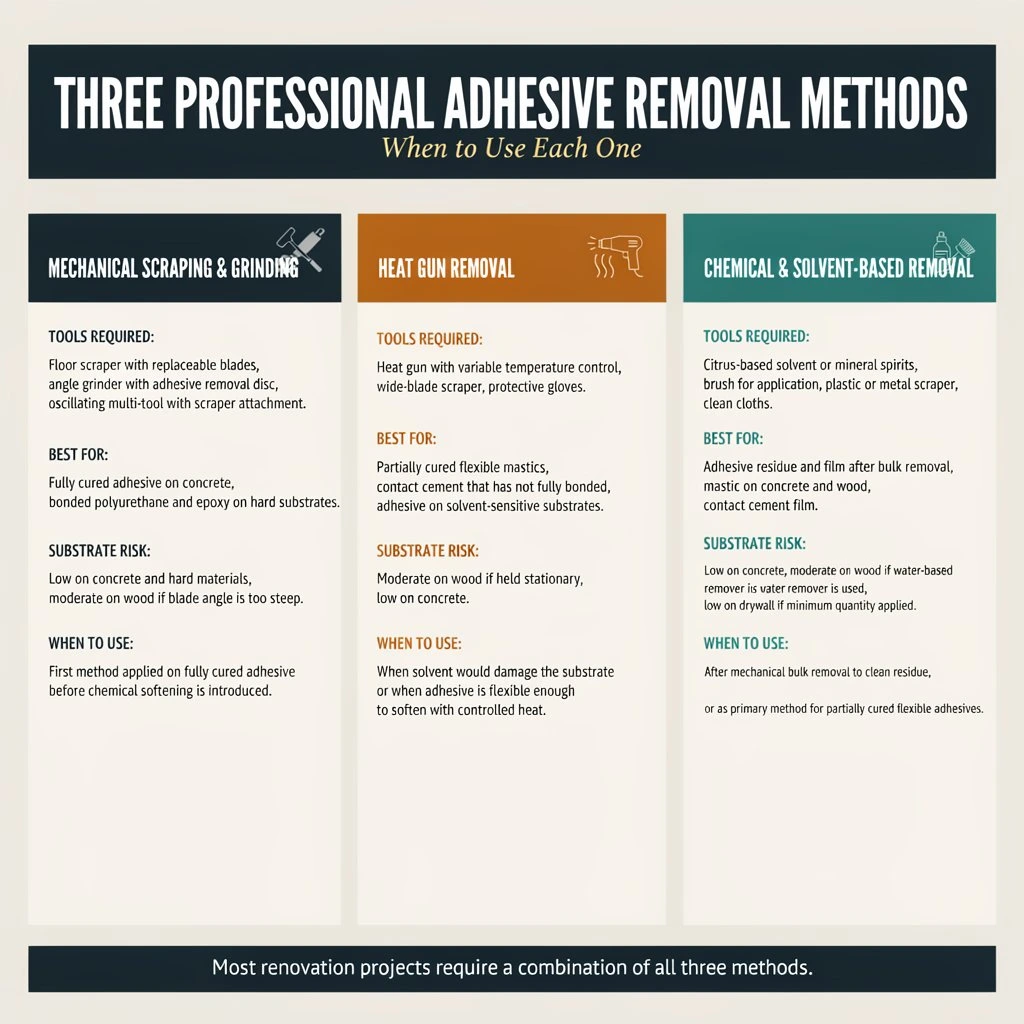
Professional construction adhesive removal draws from three distinct method categories, and effective removal on most renovation projects requires selecting from or combining these methods based on the specific adhesive and substrate combination involved.
Mechanical Scraping and Grinding
Mechanical removal is the primary method for fully cured adhesive on hard substrates and is typically the first method applied before chemical softening is introduced. Floor scrapers with replaceable blades handle large open floor areas on concrete and wood. Angle grinders fitted with adhesive removal discs or cup wheels address bonded cured polyurethane and epoxy adhesives on concrete where scraper blades cannot achieve a clean surface. Oscillating multi-tools with scraper attachments cover corners and tight areas where larger tools cannot operate without causing damage to adjacent surfaces.
Heat Gun Adhesive Removal
Heat gun removal is most effective for partially cured flexible mastics, for contact cement that has been applied but not fully bonded, and for adhesive on substrates where solvent application would cause damage. The heat gun is held at a distance that softens the adhesive without scorching the substrate and is kept moving continuously rather than held stationary. On wood surfaces, this is particularly important because concentrated heat in one location chars the wood surface before the adhesive is soft enough for clean scraper removal.
Chemical and Solvent-Based Removal
Chemical removal is the most appropriate method for softening adhesive residue after mechanical bulk removal and for cleaning adhesive film from surfaces where the adhesive type responds to solvent dissolution. Citrus-based solvents are the safest option across the widest range of substrates and are appropriate for mastic residue on concrete and wood, contact cement film, and construction adhesive residue on drywall, where the minimum quantity is applied with a brush. Mineral spirits are effective for mastic removal on concrete and wood subfloors. Commercial construction adhesive removers are appropriate for heavy applications where citrus solvents do not achieve sufficient adhesive softening within a practical dwell time.
Surface Preparation After Adhesive Removal
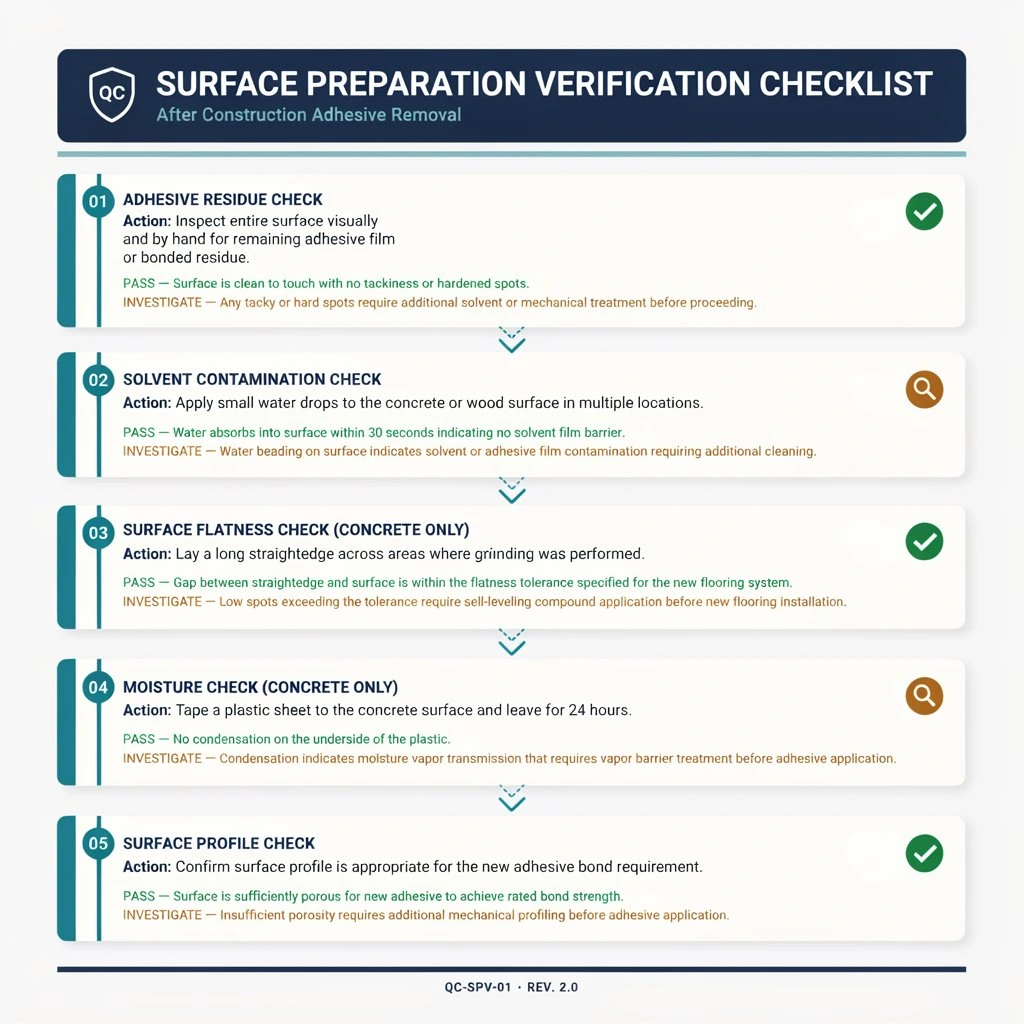
After construction adhesive removal is complete, the substrate must meet specific surface preparation standards before new materials can be installed. The substrate must be clean of all adhesive residue, free of solvent contamination that would prevent new adhesive from bonding at rated strength, and assessed for any mechanical damage that occurred during the removal process.
For concrete slabs that will receive new flooring, the surface preparation verification sequence includes testing for residual adhesive contamination by observing whether water beads on the surface rather than absorbing into the concrete. A beading response indicates solvent or adhesive film contamination that will prevent new adhesive from bonding and requires additional surface cleaning before installation proceeds.
Surface flatness is checked with a long straightedge after grinding operations to identify low spots created by the grinding process. Grinding adhesive from concrete removes some concrete along with the adhesive, and the resulting surface profile must be assessed against the flatness tolerance specified for the new flooring system before installation begins.
Construction Adhesive Removal Safety on Renovation Projects
Solvent-based adhesive removal in enclosed renovation spaces requires specific safety measures before work begins. Adequate cross-ventilation through open windows and temporary fans is required before solvent application to prevent the accumulation of solvent vapors at concentrations that create health risks or an ignition hazard. Respiratory protection appropriate for the specific solvent VOC rating is required for all personnel in the work area during and for a period after solvent application.
Ignition sources, including electrical switches, pilot lights, and power tool sparks must be eliminated from the work area when flammable solvents are in use. The flammability rating of every solvent product used in the renovation scope should be confirmed from the product safety data sheet before work begins in any enclosed space.
Physical safety for mechanical removal operations requires hearing protection during angle grinder use, eye protection against adhesive and substrate particle ejection during scraping and grinding, and knee and lower back protection for extended floor scraping work. Accurately scoping the renovation work through professional quantity takeoff services before mobilization helps contractors allocate the right equipment and personnel for the adhesive removal scope without underresourcing the operation.
How Adhesive Removal Scope Fits Into Your Renovation Estimate
Construction adhesive removal is a distinct estimating line item in renovation project budgets, not a scope item that should be absorbed into a general demolition allowance. Adhesive removal labor varies significantly by substrate type, adhesive type, adhesive age, and the area coverage involved.
A renovation estimate that lumps adhesive removal into a flat demolition allowance consistently underestimates the true cost of surface preparation, which is one of the most common sources of budget overruns in renovation and remodeling projects. The contractor discovers the true removal labor requirement only after mobilization, at which point the budget gap cannot be recovered without absorbing the cost or initiating a change order conversation with the owner.
Professional renovation estimators quantify the adhesive removal scope by measuring the square footage of each substrate type from the renovation drawings, identifying the adhesive type from site documentation or investigation, and applying substrate-specific productivity rates that reflect the specific removal method the combination requires.
How CSI Estimation LLC Supports Your Renovation and Remodeling Estimates
CSI Estimation LLC produces complete renovation and remodeling project estimates for contractors across all 50 states, covering demolition and surface preparation scope items, including adhesive removal, alongside every finish trade in the renovation project.
Their estimating team applies substrate-specific labor productivity rates to adhesive removal quantities rather than flat demolition allowances, producing budget line items that reflect the actual cost of surface preparation for each substrate type and adhesive condition in the project scope. Their professional remodeling estimating services and broader construction cost estimating services are available for residential and commercial renovation projects at every scale.
Most standard residential renovation estimates are delivered within 24 to 48 hours of complete drawing and scope document submission, and commercial remodeling estimates are delivered within 3 to 5 business days, depending on project scale and scope complexity.
Get Your Renovation Estimate Completed by Professionals Today
Knowing how to remove construction adhesive correctly protects the substrate and the project schedule. Accurately estimating the adhesive removal scope protects the project budget before a single square foot of adhesive is addressed.
Submit your renovation project documents to CSI Estimation LLC today and receive a complete, trade-specific renovation estimate that accounts for adhesive removal, surface preparation, and every finish trade in your project scope, delivered within 24 to 48 hours for most standard residential renovation projects.
Contact CSI Estimation LLC today to take the first step toward a renovation estimate that accurately reflects the true cost of every scope item in your project.