
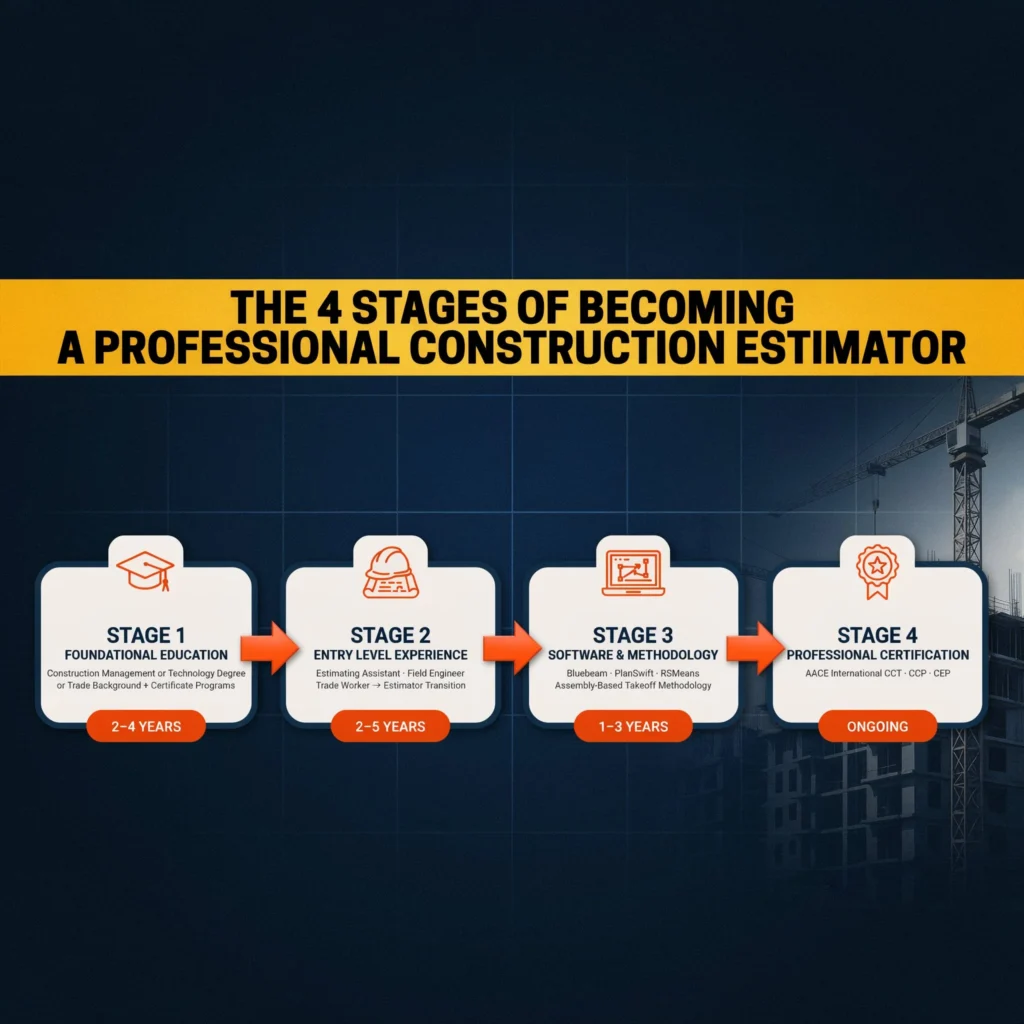
How to Become A Construction Estimator requires completing four career development stages in sequence: foundational education in construction or a related technical field, hands-on experience in the field or in an estimating support role, professional proficiency in industry-standard estimating software platforms and quantity takeoff methodology, and formal certification through AACE International or an equivalent professional body that validates your expertise to employers and clients.
The difference between a contractor who estimates their own work and a professional construction estimator is not simply a matter of job title. It is a difference in the depth of trade-specific knowledge, the precision of the measurement and pricing methodology, and the professional accountability that a certified estimating professional brings to every cost model they produce. Contractors who submit bids based on intuition and experience win some work and lose money on more of it than they realize. Professional construction estimators who apply verified quantity takeoffs, current regional market pricing, and systematic quality review to every estimate they produce win more bids and protect the margins those bids are supposed to deliver. Understanding how to become a construction estimator at the professional level is the first step toward a career that sits at the financial center of every construction project that gets built.
What Is A Construction Estimator?
A construction estimator is a specialized professional who calculates the complete cost of a construction project before a single dollar is committed to materials, labor, or equipment. Estimators work at the pre-construction stage of every project, translating architectural drawings, engineering plans, and project specifications into verified cost models that contractors use to submit competitive bids, that project owners use to evaluate whether a project is financially viable, and that construction management teams use to plan procurement, schedule subcontractors, and manage project cash flow throughout the construction phase. The estimator’s output is the financial foundation that every subsequent project decision is built on, which means the accuracy of that output has direct financial consequences for every party involved in the project from the day the bid is submitted through the day the final trade walks off site.
Professional construction estimators work for general contractors, specialty subcontractors, construction management firms, owner-representative organizations, and independent professional estimating firms that serve contractors across multiple project types and regional markets. What distinguishes a professional construction estimator from a contractor who estimates their own work is the depth of trade-specific knowledge, the methodological rigor of the quantity measurement and pricing process, and the professional certification that validates that expertise to the employers and clients who rely on the estimator’s output for financial decisions of significant consequence.
What Does A Construction Estimator Do?
The daily work of a construction estimator begins with the drawing set. An estimator receives architectural and engineering documents for an upcoming project and works through them systematically, identifying every scope item that must be quantified and priced before a cost model can be produced. This involves performing detailed quantity takeoff services across every trade involved in the project, measuring material quantities from the drawings, and applying assembly-based cost components that connect those quantities to their associated material lists, labor hours, and equipment requirements. The estimator then applies current regional labor rates and material pricing from local suppliers and verified cost databases to produce a cost model that reflects what the project will actually cost to build in the specific market where it is located, rather than what national averages suggest it should cost.
Beyond the core quantity measurement and pricing work, a professional construction estimator also conducts value engineering reviews that identify opportunities to reduce project costs without compromising scope or quality, prepares subcontractor scope documents that define the work each specialty trade is being asked to price, assists with construction bid preparation by assembling and formatting the complete bid package that the contractor submits to the project owner, and supports the construction management team during the execution phase by providing cost management analysis that tracks actual costs against the original estimate and identifies variances before they become unmanageable. These broader responsibilities are what elevate a professional estimator beyond the role of a quantity measurer and position them as a genuine strategic partner in the financial management of construction projects.
Education Requirements For A Construction Estimator
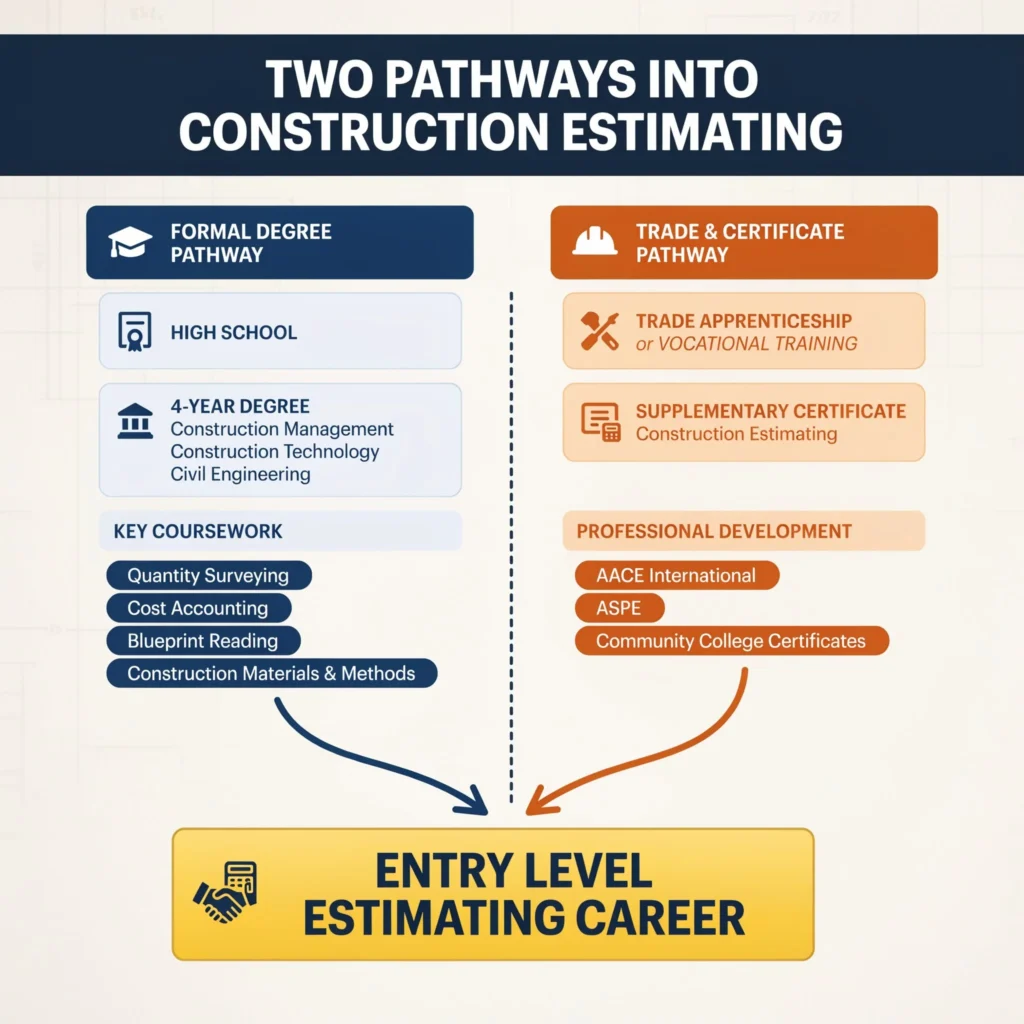
Construction estimating is one of the few professional disciplines in the construction industry that accepts candidates from two distinctly different educational pathways and treats both as credible foundations for a professional career when they are combined with the right hands-on experience and professional certification.
Degree Programs That Lead to Construction Estimating Careers
The most direct formal educational pathway to a professional construction estimating career is a bachelor’s degree in construction management, construction technology, civil engineering, or architecture. Within these programs, the coursework most directly applicable to professional estimating practice includes construction materials and methods, quantity surveying, cost accounting, blueprint reading and drawing interpretation, project scheduling, and contract documentation. A construction management degree estimating curriculum provides graduates with the foundational ability to read architectural and engineering drawings accurately, understand how buildings are assembled across multiple trades, and apply systematic cost calculation methods to real project documentation. Programs accredited by the American Council for Construction Education carry particular weight with employers because they ensure that graduates have been trained to a consistent professional standard rather than to whatever curriculum a particular institution has assembled without external quality validation. Construction technology degree estimating programs at the associate level can also serve as effective entry points, particularly when combined with supplementary professional development coursework in estimating methodology.
Alternative Educational Backgrounds That Qualify Candidates
Formal construction management degrees are not the only educational pathway that leads to professional estimating careers. Many of the most capable professional estimators working today entered the field through vocational training in a specific construction trade, supplemented by self-directed study in estimating methodology and professional development courses offered through AACE International, the American Society of Professional Estimators, and community college certificate programs in construction estimating. A candidate who has completed a four-year apprenticeship in electrical installation, for example, brings a depth of trade-specific knowledge about material specifications, labor productivity, and installation methods that a construction management graduate typically lacks at the same career stage. The combination of genuine trade knowledge and formal construction estimating training produces a professional who can measure quantities accurately, evaluate the reasonableness of subcontractor bids with genuine authority, and identify scope gaps in drawing packages that a candidate without trade experience would miss entirely.
How To Get Into Construction Estimating
Getting into professional construction estimating requires building foundational knowledge before seeking employment, gaining initial experience in an environment that develops the practical skills formal education cannot provide, and developing the methodology proficiency that makes an estimator’s output reliable enough to trust in a competitive bid environment.
Build Your Foundational Knowledge of Construction and Drawing Reading
The foundational knowledge requirement for professional construction estimating begins with the ability to read and interpret architectural and structural drawings fluently, and extends to a working understanding of construction materials, installation methods, and the CSI MasterFormat division structure that organizes professional estimate documents into their standard cost categories. A candidate who cannot read a structural plan with enough fluency to identify every element that must be quantified cannot perform a reliable quantity takeoff regardless of how capable they are with estimating software. This foundational drawing literacy is the first professional standard that every aspiring estimator must develop before any employer or client can have confidence in the accuracy of their output. Construction cost estimator qualifications consistently require this baseline before any other skill is evaluated in the hiring process, and candidates who recognize this and invest time in developing drawing reading proficiency before they begin applying for estimating positions consistently outperform those who expect to develop this skill on the job after hiring.
Gain Entry Level Experience in the Field or in an Estimating Support Role
Entry-level construction estimating careers typically begin in one of three positions: as an estimating assistant or junior estimator at a general contractor or specialty subcontractor, as a field engineer or project engineer with regular exposure to quantity verification and construction cost tracking, or as a construction trade worker whose hands-on installation experience builds the intuitive understanding of labor and material requirements that no classroom can fully replicate. Each of these entry points develops a different dimension of the professional estimating skill set. The estimating assistant role develops methodology and software proficiency under the supervision of experienced senior estimators. The field engineering role develops construction sequence knowledge and the ability to translate field conditions into cost implications. The trade worker background develops the trade-specific depth that allows an estimator to evaluate subcontractor bids with genuine authority rather than simply comparing numbers against a database. Exploring construction estimating career opportunities at professional estimating firms gives candidates an understanding of what employers look for when evaluating entry-level candidates across these different background profiles.
Develop Proficiency in Professional Estimating Methodology
Methodology proficiency is what separates an estimator who can produce a number from one whose number can be trusted. Professional estimating methodology covers assembly-based quantity takeoff, in which each measured element of a project is linked to its complete material list, labor component, and equipment requirement through a verified assembly database rather than estimated from memory or experience. It covers unit cost estimating, in which the total cost of a scope item is calculated by multiplying a verified quantity by a current regional unit cost that reflects what contractors actually pay from local suppliers and at local wage rates. It covers parametric cost modeling, in which historical cost data from comparable completed projects is used to develop preliminary estimates for projects at the early design stage where detailed drawings are not yet available. Developing genuine proficiency in all three methodologies, rather than relying exclusively on one, is what gives a professional estimator the range to produce reliable cost models across every project type and every stage of the design process. Construction cost analysis skills of this breadth are what the most competitive estimating employers look for in candidates seeking advancement beyond the entry level.
On The Job Training In Construction Estimating
On-the-job training in construction estimating develops capabilities that no formal educational program or software tutorial can replicate. The ability to recognize when a quantity looks wrong before verification confirms it, the trained intuition that identifies a scope gap in a drawing package during the review stage rather than discovering it as a field problem after bid submission, and the regional market knowledge that allows an estimator to identify an overpriced subcontractor bid by comparison to a verified cost benchmark are all capabilities that emerge from sustained practice under the supervision of experienced professionals rather than from classroom instruction. Trade background construction estimating brings an additional dimension to this on-the-job learning because estimators who have worked in the field understand how materials are actually installed, how labor productivity varies with site conditions, and which specification details drive cost implications that are invisible to someone who has only seen construction on a drawing sheet.
The professional estimating firms that provide the strongest on-the-job training environments are those that assign junior estimators to projects alongside senior specialists, expose them to multiple trade categories rather than siloing them in a single scope, and require them to participate in the post-bid review process that evaluates where estimates aligned with actual costs and where they diverged and why. Working alongside professionals who practice professional construction cost estimating at a consistently high standard accelerates the development of professional estimating judgment in ways that estimating in isolation, regardless of how much software practice the candidate accumulates, simply cannot replicate.
Key Skills Every Construction Estimator Needs
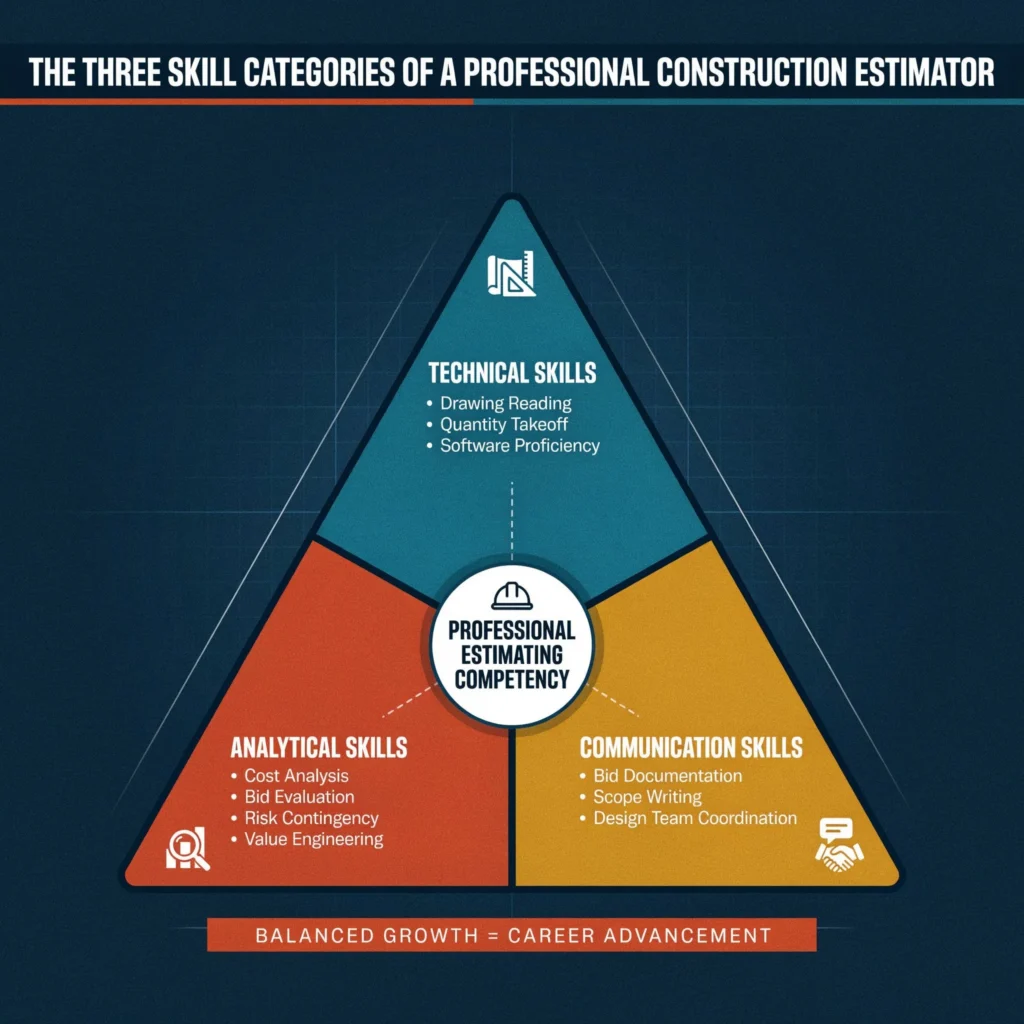
Professional construction estimating demands a combination of technical measurement skills, analytical cost modeling capabilities, and professional communication proficiency, and career advancement at the senior level requires genuine development across all three categories rather than deep expertise in one at the expense of the others.
H3: Technical Skills and Quantity Takeoff Proficiency
Technical skills in professional construction estimating are centered on the ability to read and interpret architectural, structural, MEP, and civil engineering drawings with enough precision to identify every scope item that must be quantified across all trades involved in the project. Quantity takeoff skills for construction at the professional level require the ability to apply assembly-based measurement methodology within professional estimating software platforms, producing quantity lists that are traceable from the cost summary through the quantity backup to specific drawing locations that can be independently verified. A professional estimator whose technical skills are strong produces takeoff output that other professionals in the project team can review, challenge, and rely on with confidence, which is a standard that casual or software-dependent estimation cannot meet. Construction estimator skills at this technical level are evaluated in every professional estimating interview and verified in every estimate deliverable that a professional firm produces.
Analytical and Cost Analysis Skills
Analytical skills are what allow a professional estimator to move from accurate quantity measurement to reliable cost modeling. The ability to identify inconsistencies between drawing sheets that would produce quantity errors, the capacity to evaluate subcontractor bids against verified regional market benchmarks and identify overpriced or underscoped proposals, the judgment to allocate contingency based on project-specific risk analysis rather than a flat percentage applied uniformly regardless of project type, and the value engineering proficiency to identify where alternative material selections or construction methods reduce cost without compromising the owner’s design intent are all analytical capabilities that develop through sustained professional practice rather than through technical training alone. Construction cost analysis skills at this level are what distinguish the estimators who advance to senior and chief estimator roles from those who remain competent but undifferentiated practitioners throughout their careers.
Communication and Bid Documentation Skills
Communication skills are the professional estimating competency most frequently underestimated by candidates who are strong in technical and analytical areas. The ability to produce bid documentation that completely and clearly represents the contractor’s scope, qualifications, and pricing in a format that an evaluation committee can assess without requesting clarification is a professional writing skill that requires deliberate development. Equally important is the ability to communicate scope gaps, drawing conflicts, and specification ambiguities to the design team in writing that is precise, professional, and actionable rather than vague or adversarial. The construction bid preparation skills required to assemble a complete and competitive bid package under deadline pressure while managing multiple simultaneous project takeoffs is a communication and organizational discipline that experienced employers test directly in the hiring process.
What Software Does A Construction Estimator Need To Know?
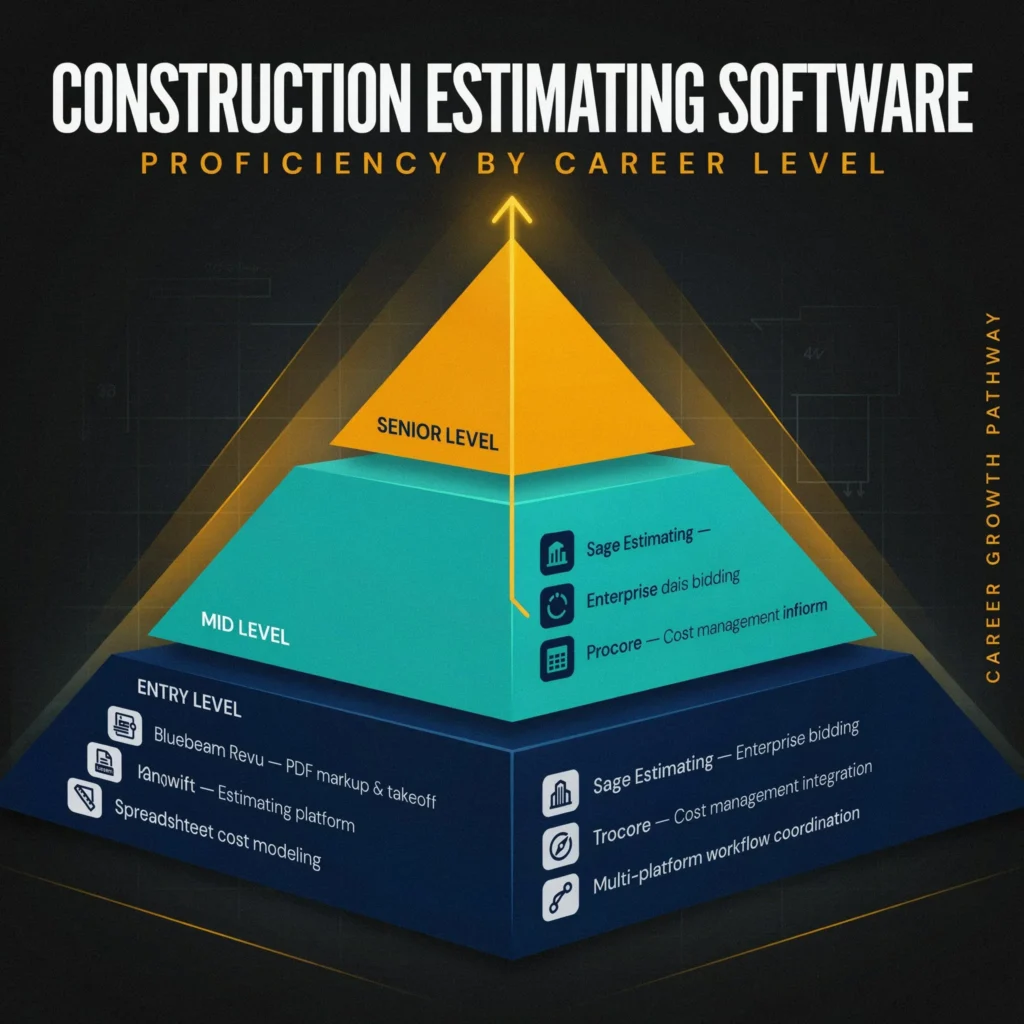
Bluebeam Revu is the most universally required software proficiency in professional construction estimating job postings across all project types, employer categories, and regional markets. Bluebeam estimating proficiency covers digital drawing markup, measurement tool calibration, and the overlay and comparison functions that allow estimators to identify drawing revisions and addenda changes efficiently. Most professional estimating positions list Bluebeam proficiency as a baseline expectation rather than a differentiating credential, which means candidates who do not have it are immediately disadvantaged against competitors who do. PlanSwift skills are equally common in estimating job requirements, particularly for residential and small commercial estimating roles, because PlanSwift’s digital takeoff workflow is one of the most widely used in the industry for PDF-based quantity measurement. Candidates who are proficient in both Bluebeam and PlanSwift cover the two most commonly tested software competencies in entry-level professional estimating interviews.
RSMeans estimating skills are the second tier of software proficiency that professional estimating employers expect from candidates seeking advancement beyond the entry level. RSMeans data provides construction labor and material unit costs organized by CSI division and regional location factors, and professional estimators use RSMeans as a benchmark and preliminary pricing tool rather than as a substitute for current regional market research. Understanding how to navigate the RSMeans database, how to apply location adjustment factors correctly, and how to evaluate whether a RSMeans unit cost reflects current market conditions or requires adjustment based on local supplier pricing data is a professional competency that distinguishes an experienced estimator from one who applies database figures uncritically.
The professional material takeoff services that specialist estimating firms deliver are built on the same software platforms described above, and are applied by professionals whose years of daily practice have produced the platform fluency and methodological discipline that software tutorials alone cannot develop.
Professional Certifications That Advance Your Estimating Career
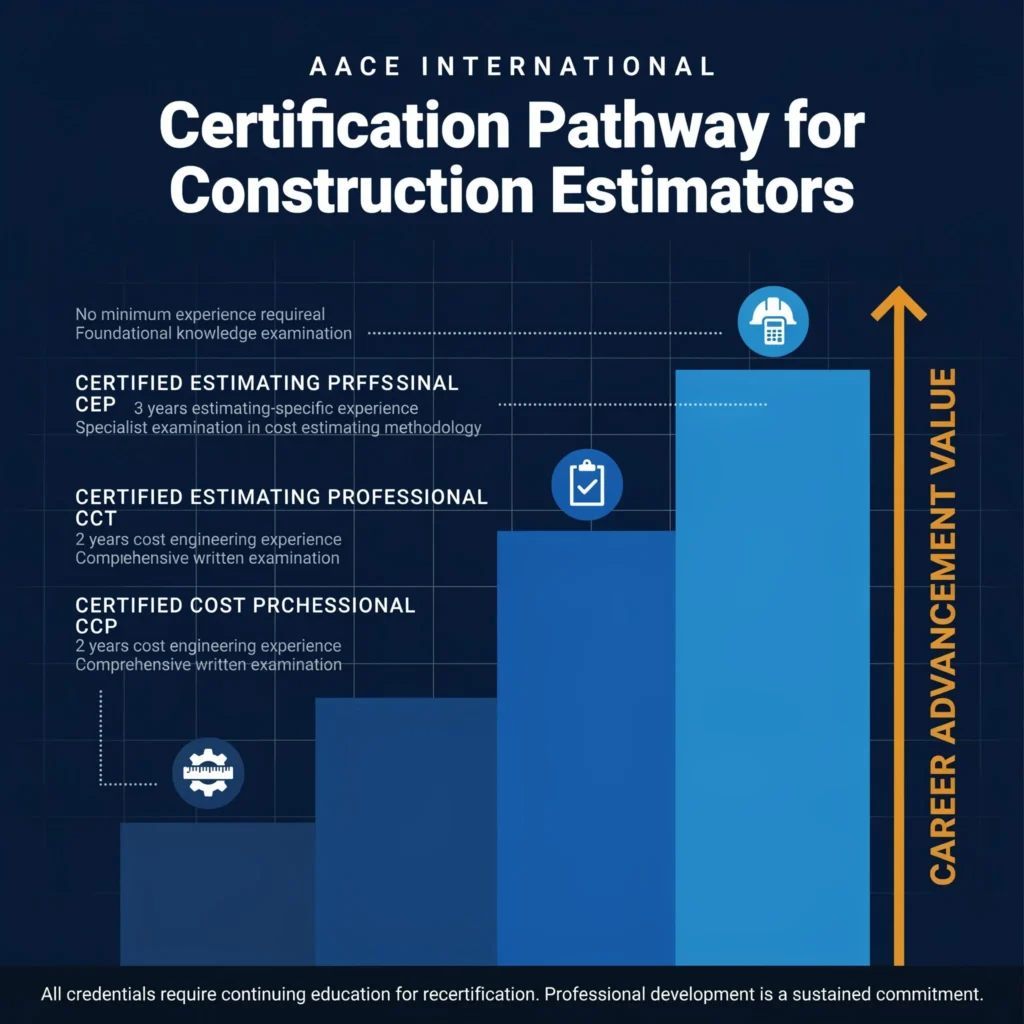
AACE International is the primary professional certification body for construction cost estimators in North America and the organization whose credentials carry the most consistent weight across employers, project types, and regional markets. The AACE International certification pathway begins with the Certified Cost Technician credential for candidates at the early career stage and progresses through the Certified Cost Professional and Certified Estimating Professional designations for practitioners with substantial experience and demonstrated competency across the full range of professional estimating disciplines. AACE International certification in estimating requires passing a rigorous written examination that tests knowledge of estimating methodology, cost engineering principles, and professional practice standards, combined with a documented work experience requirement that varies by credential level. Professional construction estimator certification through AACE signals to employers and clients that the credential holder has been validated against an externally administered professional standard rather than self-assessed against their own experience, which is a distinction that carries meaningful weight in competitive hiring environments and in the professional credibility conversations that estimating professionals have with project owners and lenders who rely on their output.
Professional estimator certification programs beyond AACE include the American Society of Professional Estimators Certified Professional Estimator credential, which is particularly recognized in the specialty subcontractor community, and a range of certificate programs offered through community colleges and professional training organizations that cover blueprint reading, quantity surveying, and construction estimating methodology for candidates who are building foundational credentials before pursuing full professional certification. Professional development in construction estimating does not end with initial certification. AACE certified professionals are required to complete continuing education hours within each recertification cycle to maintain their credentials, which means that professional estimating is a career that rewards sustained learning investment throughout its entire arc. Contractors who engage professional outsourced estimating services benefit from the continuing professional development that specialist estimating firms require of their team members as a condition of maintaining the quality standard their clients depend on.
Construction Estimator Salary and Job Outlook
The Bureau of Labor Statistics reports that construction cost estimators earn a median annual salary that reflects the significant financial responsibility the role carries within every project they support. Entry-level estimators in their first two years of professional employment typically earn in the lower range of the occupation’s reported salary distribution, reflecting the period during which their methodology proficiency and regional market knowledge are still developing under the supervision of more experienced professionals. Mid-level estimators with three to seven years of experience, demonstrated project type specialization, and active participation in successful competitive bids typically earn in the middle range of the occupation’s distribution. Senior estimators with eight or more years of professional experience, AACE International certification, and a documented track record of successful bid submissions on large commercial or industrial projects earn in the upper range of the distribution and frequently receive performance-based compensation structures that link their earnings directly to the financial success of the bids they produce. The Bureau of Labor Statistics Occupational Outlook Handbook for construction cost estimators provides current salary data and employment projection figures that candidates should reference directly for the most accurate and current compensation benchmarks available.
The job outlook for construction estimators reflects sustained demand driven by the volume of infrastructure investment, residential construction activity, and commercial development that characterizes the current construction market. Contractors who recognize professional estimating as a competitive differentiator rather than an overhead cost are increasingly choosing to build dedicated estimating capacity, either through direct employment of certified professionals or through relationships with professional outsourced estimating firms that deliver the same standard of output without the fixed overhead of a full-time hire. Construction estimating career growth is supported by this structural shift in how the industry values pre-construction cost expertise, and candidates who invest in the education, experience, and certification pathway described in this guide enter a job market where professional credentials and demonstrated accuracy carry genuine financial value to every employer who evaluates them.
How CSI Estimation LLC Develops and Works With Professional Estimators
CSI Estimation LLC employs trade-specific estimating professionals across all CSI MasterFormat divisions, serving contractors, developers, and project owners across all 50 states with the standard of professional estimating practice described throughout this guide. Their estimating team operates with proficiency in Bluebeam, PlanSwift, RSMeans, and Trimble estimating platforms, applies assembly-based quantity takeoff methodology to every project they handle, and produces deliverables that include the quantity backup documentation that allows contractors to verify, review, and apply estimate data with full confidence. Candidates who are developing their construction estimating careers and want to work within a professional environment that applies these standards consistently can explore current estimating career opportunities at CSI Estimation LLC, where the professional development context matches the standards described in this guide.
For contractors and project owners who want the education, certification, and hands-on expertise described in this guide applied to their next project rather than developed in-house, CSI Estimation LLC’s professional construction estimating services deliver that standard of professional practice on every estimate they produce, with verified quantity takeoffs, current regional market pricing, and 24 to 48 hour turnaround for most standard residential and commercial project types across all 50 states.
Start Your Construction Estimating Career or Find Your Professional Estimating Partner Today
Every stage of the professional construction estimating career path described in this guide builds toward the same professional outcome: the ability to produce cost models that are accurate enough to win competitive bids and precise enough to protect the margins those bids are supposed to deliver. Contractors who build their businesses on that standard of estimating accuracy consistently outperform competitors who rely on intuition and experience, and the professionals who develop the education, skills, software proficiency, and certification that this guide describes build careers at the financial center of one of the largest industries in the economy.
Whether you are beginning the career path that leads to professional construction estimating or you are a contractor looking for a professional estimating partner whose team has already completed that path, CSI Estimation LLC is ready to support your next project. Submit your project drawings for a professional estimate delivered within 24 to 48 hours, or reach out to discuss how their estimating team can support your business’s growth in your specific market. Contact CSI Estimation LLC today and take the first step toward professional estimating that protects every project you win.