How Much Does A Construction Estimator Cost depends on project type, scope, trade count, and whether you hire in-house or outsource the work. In-house estimators carry significantly higher annual overhead than professional outsourced estimating services, which scale with your actual project volume rather than creating fixed costs regardless of workload. Outsourced professional estimating services consistently deliver the same level of accuracy at a fraction of the total annual cost of maintaining a full-time in-house estimating function.
Every contractor who has ever absorbed an unexpected cost mid-project knows that wrong estimating is far more expensive than accurate estimating. The financial damage from a single miscalculated quantity takeoff, an overlooked trade scope, or a labor rate pulled from an outdated database can wipe out the profit margin on an entire project before the finishing trades arrive on site. Understanding how much does a construction estimator cost is not just a budgeting question. It is a risk management decision that determines whether your business grows, breaks even, or loses money on the work you win. This guide gives you the full picture across every project type, pricing model, and hiring approach so you can make the right decision for your business before your next bid goes out.
What Does A Construction Estimator Actually Do?
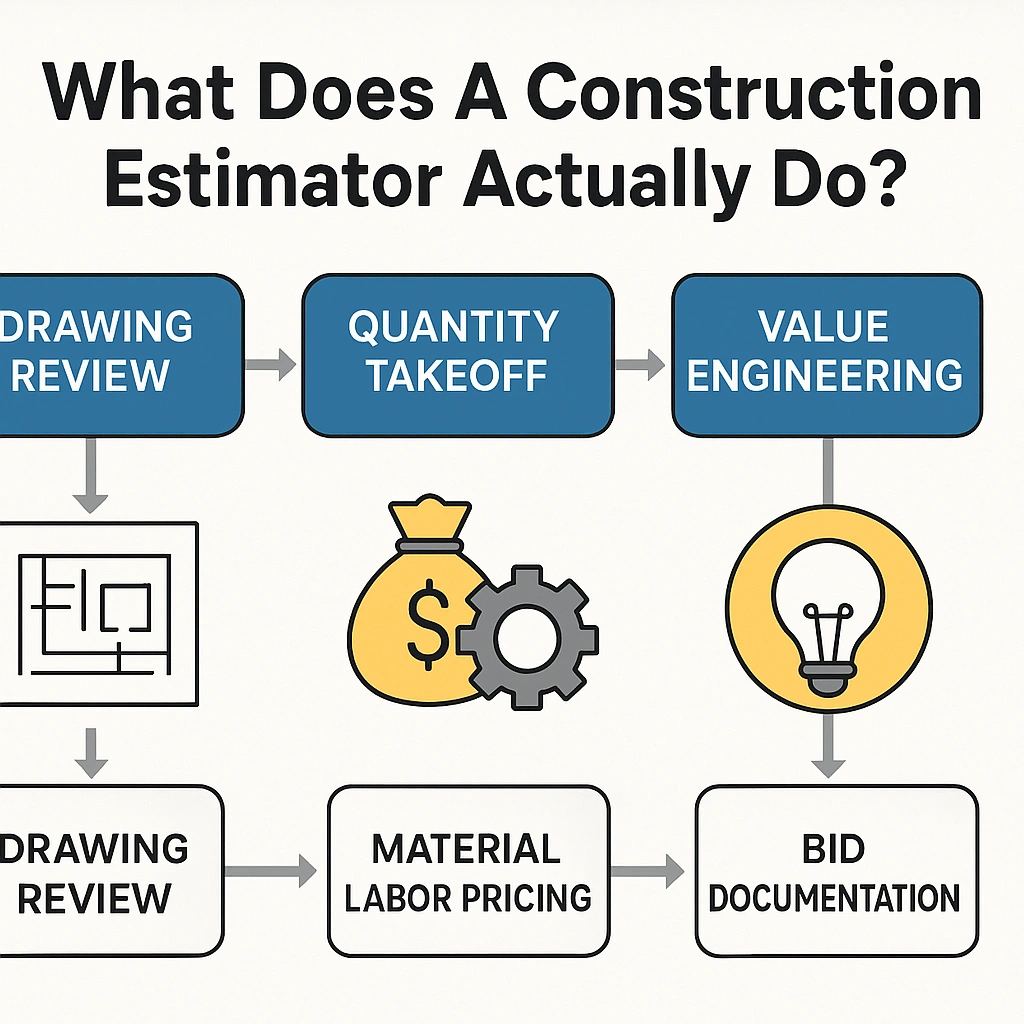
A construction estimator is the professional responsible for calculating every cost element of a construction project before a single dollar is committed to materials, labor, or equipment. This work begins with a detailed review of architectural drawings, engineering plans, and project specifications to produce verified quantity takeoffs that measure exactly how much of each material the project requires across every trade. From those quantities, the estimator applies current local market pricing for materials and confirmed labor rates for each trade to build a comprehensive cost breakdown that covers everything from site preparation and concrete through framing, roofing, mechanical systems, and interior finishes. The trade-by-trade quantity verification that turns architectural drawings into actionable procurement data is precisely what our material takeoff services are structured to deliver, giving contractors reliable procurement data from the first purchase order through project completion.
Beyond the initial takeoff and pricing work, a professional estimator also structures the overhead and profit margin components of the estimate, prepares the bid documentation that contractors submit to project owners, and conducts value engineering reviews that identify where project costs can be reduced without compromising design intent or construction quality. Construction cost estimation fees reflect the depth and complexity of this work, and understanding what drives those fees is what allows contractors and project owners to budget accurately for estimating services before committing to a project scope. Contractors who engage a dedicated construction cost estimating team gain access to specialists whose entire professional focus is producing estimates accurate enough to win bids and precise enough to protect margins throughout every phase of construction.
Key Factors That Affect The Cost Of A Construction Estimator
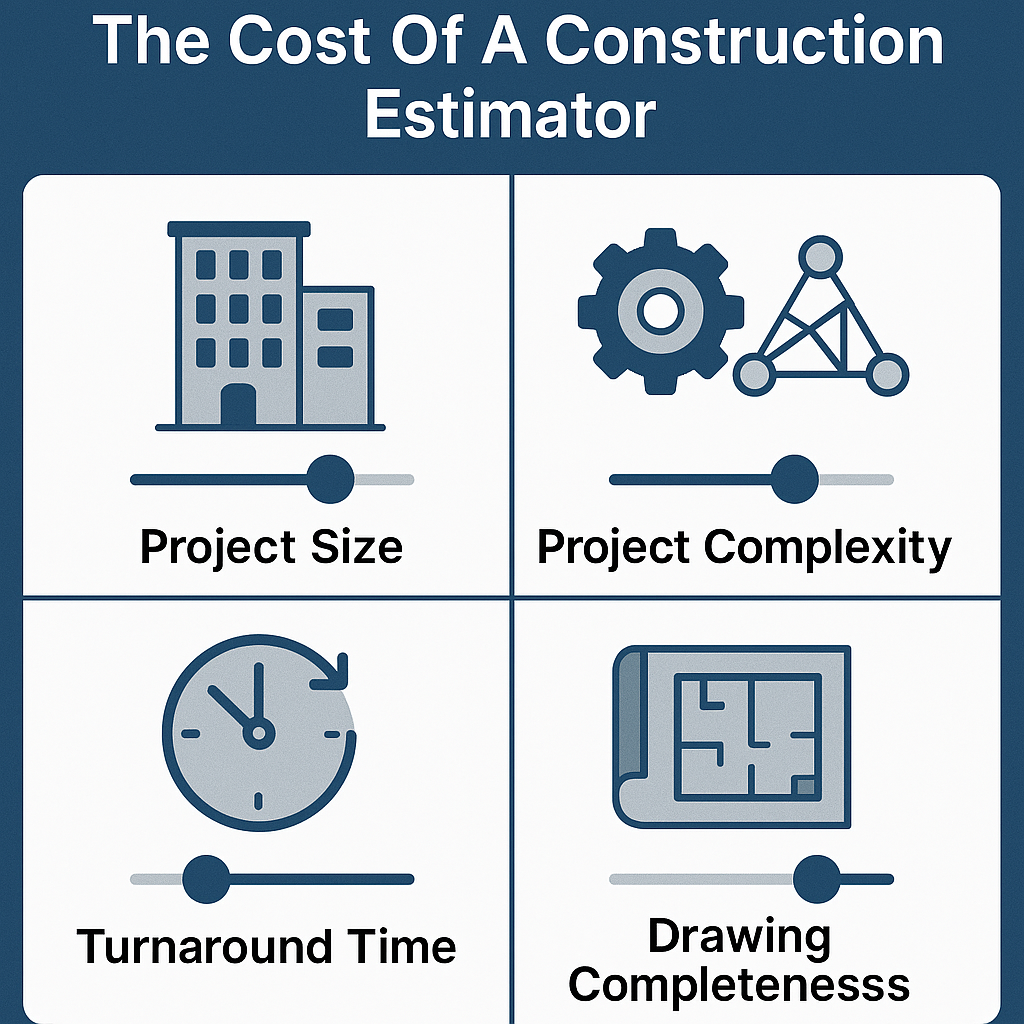
Project size and scope is the most direct driver of estimating cost across every pricing model and every type of estimating service. Larger projects with more trades, more drawings, more specification documents, and more procurement complexity require more estimator hours to analyze, calculate, and verify. A single-trade residential project and a multi-story commercial development with full MEP, structural, and architectural scopes are simply different categories of work that reflect their size difference in the estimating fee. Contractors who submit larger, more complex projects for professional estimating should expect higher fees that reflect the greater depth of analysis required to produce an estimate accurate enough to submit confidently in a competitive bid environment. General contractors managing multiple large projects simultaneously benefit from construction estimating services tailored specifically for general contractors, which provide the consistent estimating capacity and trade coverage that active project pipelines demand.
Project complexity and type introduces a second layer of cost variation beyond raw size. Residential estimating follows relatively standardized construction methods and material categories that experienced estimators work through efficiently. Commercial and industrial estimating introduces trade-specific estimating fees for mechanical systems, electrical infrastructure, structural steel, specialty finishes, and building envelope systems that require deeper technical knowledge and more detailed takeoff methodology than residential work. Contractors who outsource construction estimating for complex commercial or industrial projects receive fees that reflect the specialized expertise required to produce estimates credible and defensible at the bid submission stage and throughout the construction process.
Turnaround time and urgency is a factor that contractors frequently underestimate when budgeting for estimating services. Standard turnaround on most project types gives the estimating team sufficient time to review drawings thoroughly, verify quantities across all trades, and produce a complete and well-documented cost breakdown. Rush estimates that must be delivered under tighter deadlines than the standard service level require the estimating team to prioritize your project above other work in the queue, which carries a premium above the standard fee. Contractors who consistently need fast turnaround should discuss this requirement upfront when selecting an estimating partner so that speed expectations and fee structures are aligned before project drawings are submitted. A professional virtual bid manager working alongside your estimating service ensures that bid preparation and submission deadlines are handled professionally even when timelines are compressed.
Drawing completeness is the single factor most directly within the contractor’s control when managing their estimating cost. Incomplete drawings, missing specifications, or schematic-level documents that have not been developed to construction document standards require the estimator to make assumptions, request clarifications, and spend additional time working around gaps in the information provided. Each of these activities adds to the estimating hours required and increases the fee accordingly. Submitting complete, fully coordinated architectural and engineering drawings with all relevant specifications attached from the start of the estimating engagement is the most effective step a contractor can take to keep their estimating cost at the lower end of the applicable range without sacrificing any accuracy in the estimate they receive.
How Much Does A Construction Estimator Cost Per Project?
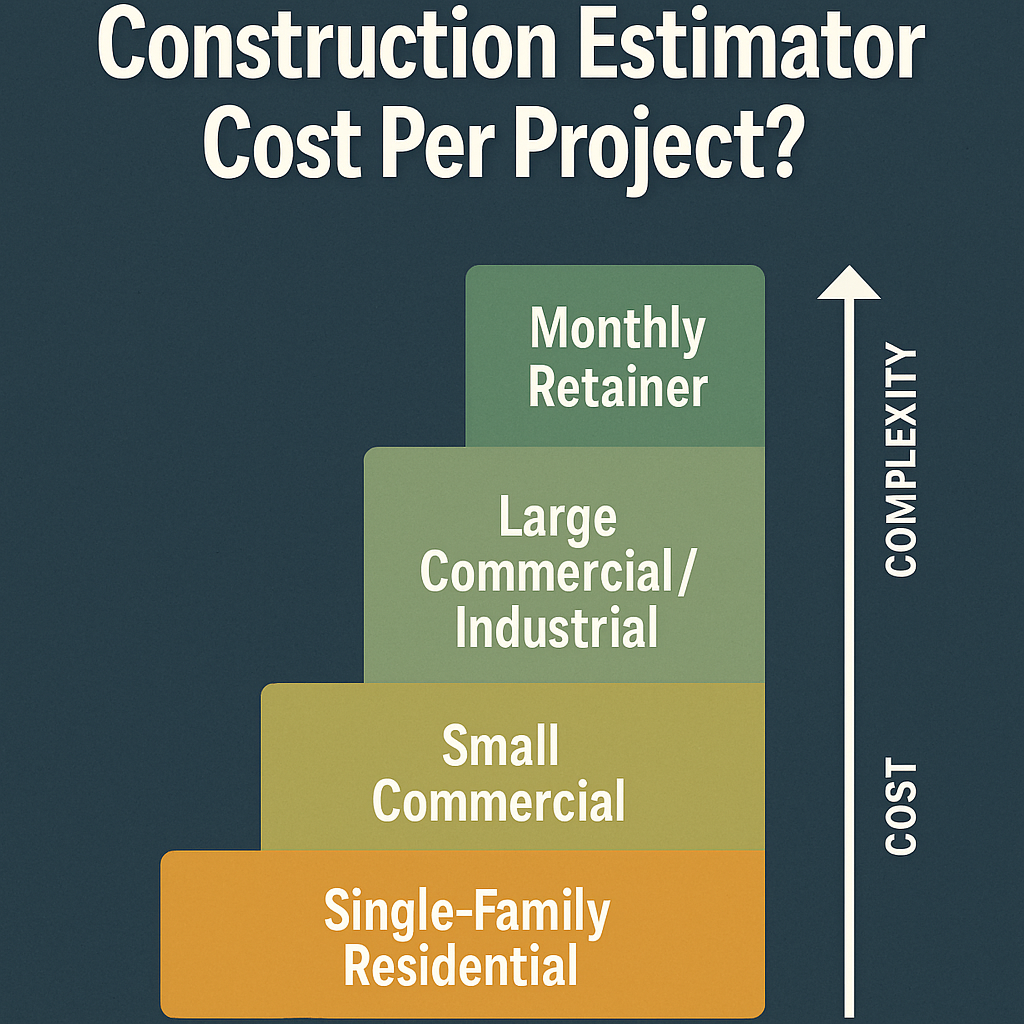
Residential single-family home estimates represent the entry point of the professional estimating market in terms of project complexity and estimating workload. A standard single-family home with complete architectural plans, a clear specification package, and a straightforward structural and mechanical scope is one of the more efficient project types for a professional estimating team to process. Within this category, costs rise when the home is custom-designed with non-standard structural elements, high-end finish specifications across multiple trades, or complex site conditions that require detailed sitework estimating in addition to the building itself. Contractors who specialize in this sector work with single family residential estimating professionals who are calibrated specifically to the documentation standards and trade categories that residential construction involves, which produces more accurate and more efficiently delivered estimates than a generalist approach allows.
Small commercial project estimates cover a broad range of project types including retail fit-outs, small office tenant improvements, single-trade commercial renovations, and light commercial new construction with straightforward specifications. This category costs more than residential estimating because commercial projects typically involve more complex building code requirements, stricter documentation standards, and a greater number of trades that must be individually quantified and priced. Even a relatively modest commercial scope requires the estimator to address structural, mechanical, electrical, plumbing, and finish trades with greater technical precision than a comparable residential project would demand.
Mid-size commercial project estimates address multi-trade commercial projects such as medical office buildings, educational facilities, hospitality projects, and mixed-use ground-floor retail developments. At this level, the estimating scope expands to include full MEP system takeoffs, detailed structural analysis, envelope systems, and often specialist trade categories that require specific technical expertise to quantify accurately. The depth and precision that institutional clients and public sector project owners expect in bid documentation at this project scale is what MEP estimating professionals are specifically equipped to deliver across mechanical, electrical, and plumbing scopes on every project they handle. The commercial estimating service rates for this project category reflect the breadth of trade coverage required and the level of detail that lenders and project owners expect to see in the bid documentation submitted by competing contractors.
Large commercial or industrial project estimates represent the highest-complexity and highest-cost category of professional estimating work. Multi-story commercial buildings, manufacturing facilities, large-scale warehouse and distribution center construction, and infrastructure projects with complex MEP, structural, and civil engineering scopes require the most extensive estimating analysis. At this level the estimator is not simply quantifying materials. They are coordinating takeoffs across multiple specialist trade categories, reviewing structural and MEP drawings in detail, and producing a cost model that must hold up to scrutiny from project owners, lenders, and the contractor’s own management team throughout the construction process. Projects with significant structural steel components are served by structural steel estimating professionals whose specialist knowledge covers the full scope of steel packages, connections, and erection costs that large-scale commercial and industrial projects require.
Monthly retainer estimating services provide contractors with consistent project pipelines an alternative to per project estimating cost that better matches their actual workload and business model. Under a retainer arrangement, the contractor pays a fixed monthly fee for an agreed volume of estimating work, which eliminates the administrative overhead of negotiating individual project fees and provides the estimating team with the context and familiarity to work more efficiently on each successive project. For high-volume contractors who regularly bid multiple projects each month, retainer pricing typically delivers better value per estimate than per-project pricing while ensuring that estimating capacity is always available when bid deadlines arrive.
Per-trade single takeoffs serve contractors who need one specific trade quantified rather than a full project cost breakdown. This service is appropriate when a general contractor already has most trades covered internally but needs specialist support for a complex MEP scope, a structural steel package, or a specialty finish system that falls outside their in-house team’s expertise. Contractors with a single trade gap in an otherwise complete estimating package rely on targeted quantity takeoff services that deliver precisely the trade-specific information needed without the cost of a full project estimate across all scopes.
In-House Estimator vs Outsourced Estimating Service: Which Costs Less?
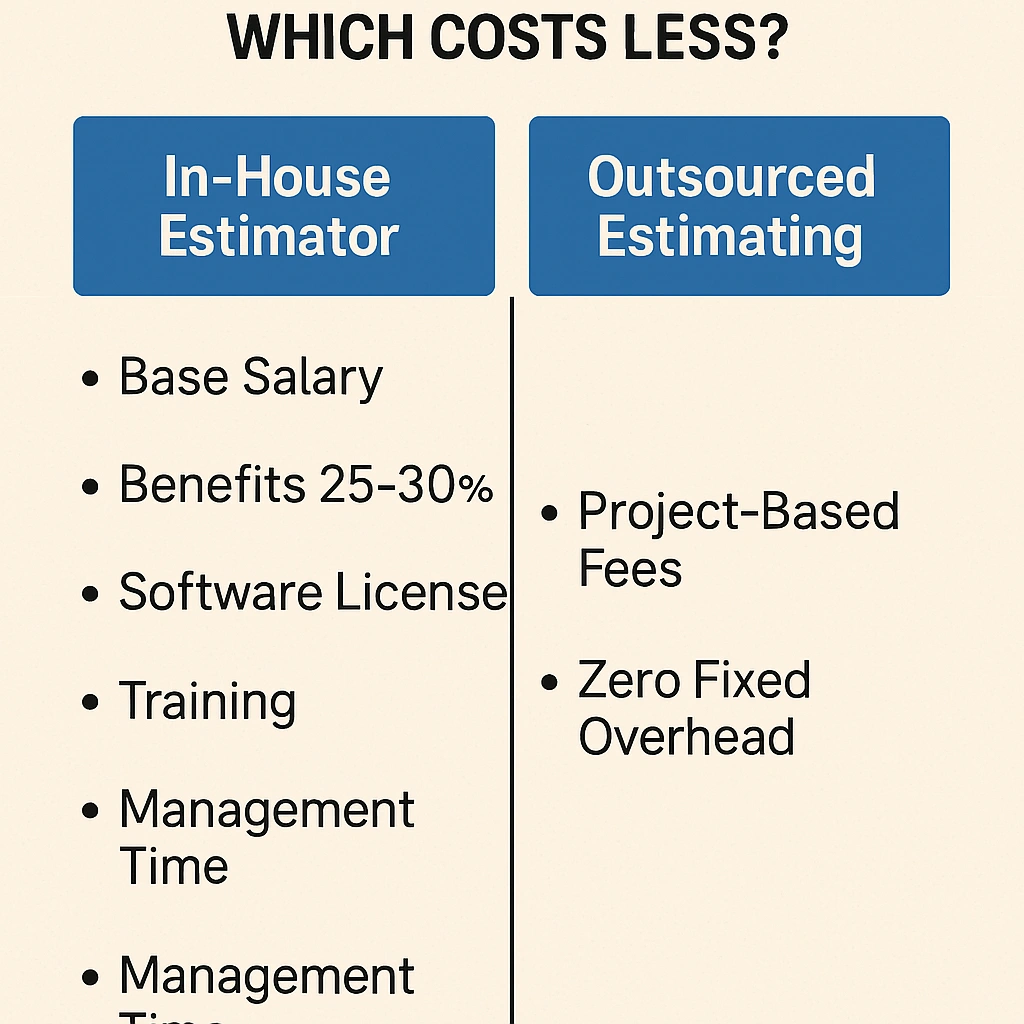
The true cost to hire a construction estimator in-house is consistently higher than most contractors anticipate when they first consider the option. The base salary that a qualified construction cost estimator commands, according to Bureau of Labor Statistics data for the occupation, represents only the starting point of the total annual cost. The benefits package that any full-time employee expects, covering health insurance, retirement contributions, paid leave, and statutory employer obligations, adds a further 25 to 30 percent above the base salary figure. Estimating software licenses required to perform professional-grade quantity takeoffs and cost analysis must be renewed annually and represent a recurring overhead cost that does not diminish regardless of project volume. Continuing education, professional development, and the management time required to supervise, review, and quality-check the estimator’s output add further to the total annual investment. When all these factors are combined honestly, the realistic annual overhead of a single in-house estimator is substantially higher than the salary line alone suggests, and that overhead is fixed regardless of whether the project pipeline is busy or slow.
The outsourced estimating model eliminates fixed overhead entirely by aligning estimating cost directly with actual project activity. When project volume is high, the outsourced firm scales to meet demand. When volume is lower between bid cycles, there is no idle salary cost accumulating for an employee who has less work to do. For a contractor completing a typical annual volume of projects, the total annual spend on professional outsourced estimating is a fraction of the comparable in-house cost when the full overhead picture is considered honestly rather than comparing only the invoice cost against the salary line. Outsourcing also eliminates the recruitment cost, onboarding time, and ongoing management overhead that in-house hiring requires, none of which appear on the estimating budget but all of which represent real business costs.
The coverage advantage of outsourcing is a further factor that the direct cost comparison does not fully capture. A single in-house estimator, however talented, is a generalist whose expertise has natural limits across the full range of trade categories a busy general contractor encounters. Professional outsourced estimating firms employ teams of specialists, each expert in specific trade categories, which means the professional quantity takeoff work produced for complex MEP systems, structural steel packages, or specialty trades carries a depth of expertise that a single in-house generalist cannot match. The estimating company pricing structure of professional outsourced firms reflects this collective specialist expertise and the quality of output it produces across every trade category in every project type the firm handles.
Is Paying For Professional Estimating Services Worth It?
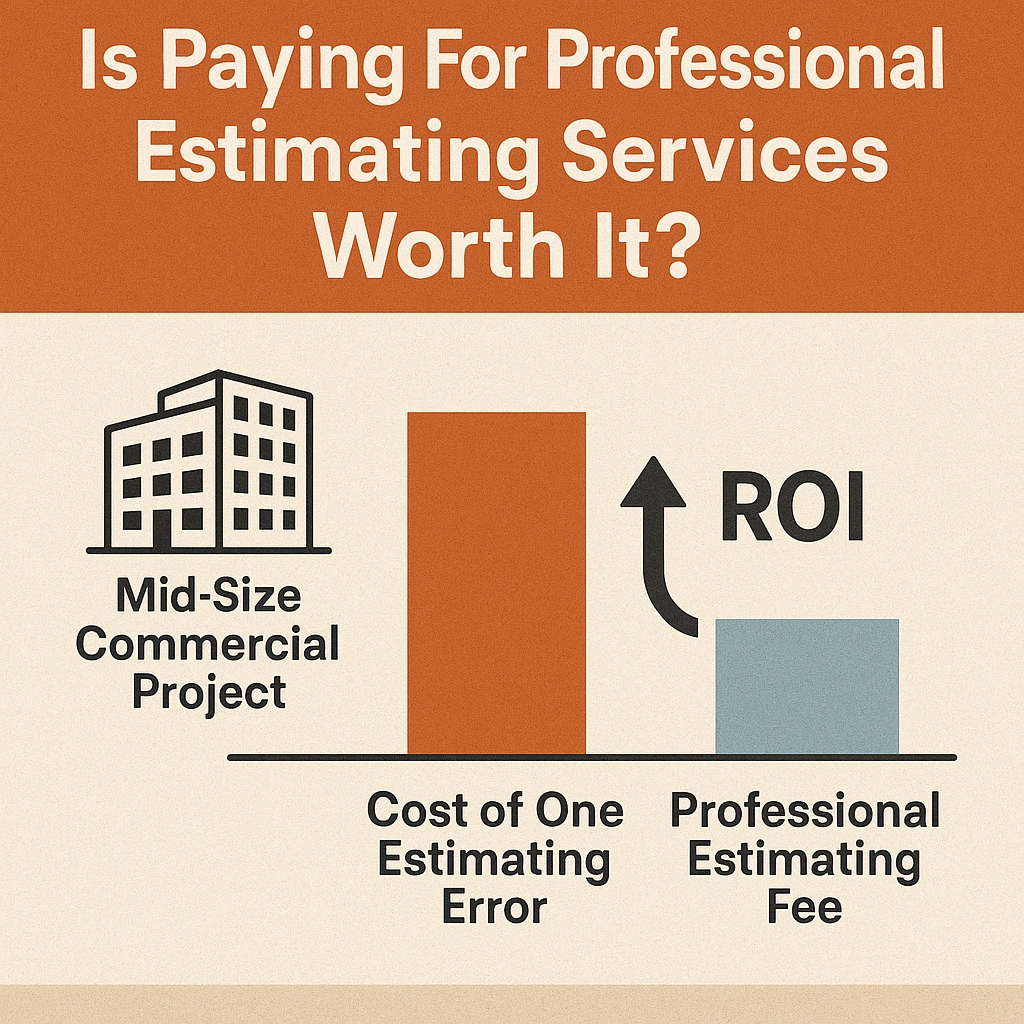
The return on investment for estimating services becomes clear the moment you calculate what a single estimating error actually costs on a real project. Even a modest percentage error on a mid-size commercial project creates a financial gap between the cost you planned for and the cost you actually face that is many times larger than the professional estimating fee that would have identified and prevented that error before construction began. The ratio of financial protection to estimating cost is not marginal. It is significant enough that the professional estimate is almost always the cheapest pre-construction investment a contractor can make relative to the financial risk it removes from the project. Budget estimating specialists who engage at the earliest stage of project planning identify cost exposure before design decisions lock in expenses that cannot be recovered later.
The value of professional estimating extends well beyond this direct financial protection calculation. Contractors who submit professionally prepared estimates win more bids because evaluation committees and institutional clients read the quality of a bid document as a direct signal of the contractor’s organizational competence. Hospitals, universities, government agencies, and large private sector developers do not award contracts to the lowest number on the page. They award contracts to the team whose documentation demonstrates the most thorough preparation and the most credible cost analysis. A professionally estimated bid package delivers that credibility in a form that a rough internal estimate assembled under time pressure cannot replicate.
Subcontractor negotiations also improve measurably when the general contractor’s estimate is built on verified market data rather than internal assumptions. When you know what fair trade-specific estimating fees and subcontractor rates look like for each scope of work, you negotiate from a position of market knowledge rather than guesswork. This informed negotiating position routinely recovers a meaningful percentage of subcontractor costs on any project of significant scale, which adds directly to the profit margin that the professional estimating investment was partly designed to protect.
How CSI Estimation LLC Delivers Professional Estimating At The Right Cost
CSI Estimation LLC provides trade-specific professional estimating services to contractors, developers, and project owners across all 50 states with fast turnaround on standard residential and commercial projects. Their estimating team covers the full range of construction trades from concrete, masonry, and structural systems through mechanical, electrical, plumbing, and specialty finish categories, delivering complete and verified cost breakdowns that contractors can submit confidently in competitive bid environments. Whether you need a single-trade takeoff for a specific scope gap, a full estimate for a residential build, or ongoing monthly estimating support for a high-volume commercial contracting business, their service structure scales to match your actual project requirements. Their commercial estimating team and residential estimating professionals are built on the same foundation of trade-specific expertise and locally calibrated market data that produces estimates accurate enough to protect your margin on every project you win.
For contractors who have been managing estimating in-house with limited resources, CSI Estimation LLC represents a straightforward path to professional-grade estimating output without the fixed overhead of a full-time hire. Their per-project pricing, monthly retainer packages, and dedicated estimator options give every contractor a cost structure that fits their business model and their project volume, from a single homebuilder submitting their first professional bid to a regional general contractor managing a pipeline of simultaneous commercial projects across multiple states.
Get An Accurate Estimate Within 24 Hours and Contact CSI Estimation LLC Today
The financial case for professional estimating is straightforward. The cost of one missed quantity, one underestimated trade scope, or one labor rate applied without current market verification is orders of magnitude higher than the fee for a professional estimate that prevents all three errors before your bid goes out. Every project you estimate accurately is a project where your planned profit margin is the profit margin you actually earn when the work is complete.
Submit your project drawings to CSI Estimation LLC today and receive a complete, trade-specific professional estimate within 24 hours for most standard project types. Their team reviews your drawings, covers every trade in your scope, and delivers a verified cost breakdown you can use to bid with confidence, negotiate with subcontractors from a position of market knowledge, and execute your project with a financial plan that reflects what the work actually costs in your local market. Contact CSI Estimation LLC today and take the first step toward estimates that protect every project you win.