

What to Expect from Professional Construction Estimating Services begins with a verified quantity takeoff produced from your actual project drawings, followed by trade-specific labor cost calculations, current regional market pricing, and a complete cost breakdown delivered within 24 to 48 hours for most residential and commercial project types. The primary standard every contractor should hold their professional estimating partner to is a final deliverable that is accurate enough to submit in a competitive bid and precise enough to protect project margins from award through completion.
Most contractors who consider professional construction estimating for the first time share the same uncertainty. They understand that accurate estimates matter and that their current in-house process has cost them bids or margin. What they do not know is what a professional estimating service does differently, what they will receive when the engagement is complete, and whether the deliverable will meet the standard their projects require. Understanding what to expect from professional construction estimating services before you engage a firm is the clearest path to choosing the right partner and getting full value from every estimate you commission.
What Professional Construction Estimating Services Are
Professional construction estimating services are specialized pre-construction planning functions that translate your architectural drawings, engineering plans, and project specifications into verified cost breakdowns before any financial commitment is made on site. A qualified estimating team calculates precise material quantities, confirmed labor hours, equipment costs, and overhead expenses across every trade involved in the project scope. The output is a cost estimate built on verified quantities and current local market pricing rather than assumptions, national averages, or databases that do not reflect regional supplier and labor conditions.
From Drawings to Verified Cost Breakdowns
The professional estimating process begins with your drawing package and ends with a complete, trade-specific cost model that covers every scope item your project requires. The estimator reviews your architectural and engineering documents, identifies every trade involved in the project, and works through the drawing set systematically to measure every material and labor component. This process replaces the generic pricing database approach that most in-house teams rely on with verified quantities applied to current regional supplier pricing and confirmed local labor rates. Working with a dedicated construction cost estimating team ensures this entire process is handled by specialists whose professional focus is producing estimates accurate enough to win bids and precise enough to protect margins throughout construction.
Why Professional Estimating Differs From In-House Estimating

In-house estimating teams frequently rely on pricing databases that miss regional cost variations of 15 to 20 percent. They also lack the trade-specific expertise to accurately estimate complex mechanical, electrical, structural steel, or specialty finish scopes without specialist knowledge. Professional estimating firms address both gaps by combining dedicated estimating software platforms, assembly-based quantity measurement tools, and trade-specific specialists who work exclusively on construction cost estimation. This specialization produces a fundamentally different quality of output than a generalist in-house approach can deliver consistently across varying project types and trade categories.
What Information You Need to Provide Before the Process Begins
The accuracy of a professional construction estimate is directly determined by the completeness of the drawing package submitted to the estimating team. A complete submission includes architectural drawings, structural plans, MEP drawings where the project scope includes mechanical, electrical, or plumbing systems, project specifications covering materials and installation standards, and any addenda or clarification documents that affect scope or quantities. Providing complete documentation at the time of submission is the single most effective step a contractor or project owner can take to receive the most accurate estimate in the shortest possible turnaround time.
Drawing Completeness and Its Direct Impact on Estimate Accuracy
Incomplete or schematic-level drawings require the estimator to make assumptions, request clarifications, and spend additional time working around documentation gaps. Each of these activities extends the turnaround timeline and introduces assumptions into the estimate that reduce its reliability. Preliminary estimates produced from incomplete drawings carry wider cost ranges than estimates produced from fully detailed construction documents. Contractors who submit complete, well-coordinated drawing packages consistently receive faster and more accurate deliverables. Our material takeoff services demonstrate how drawing completeness directly determines the precision of the quantity output that drives every subsequent cost calculation in the construction estimating process.
What the Professional Estimating Process Looks Like
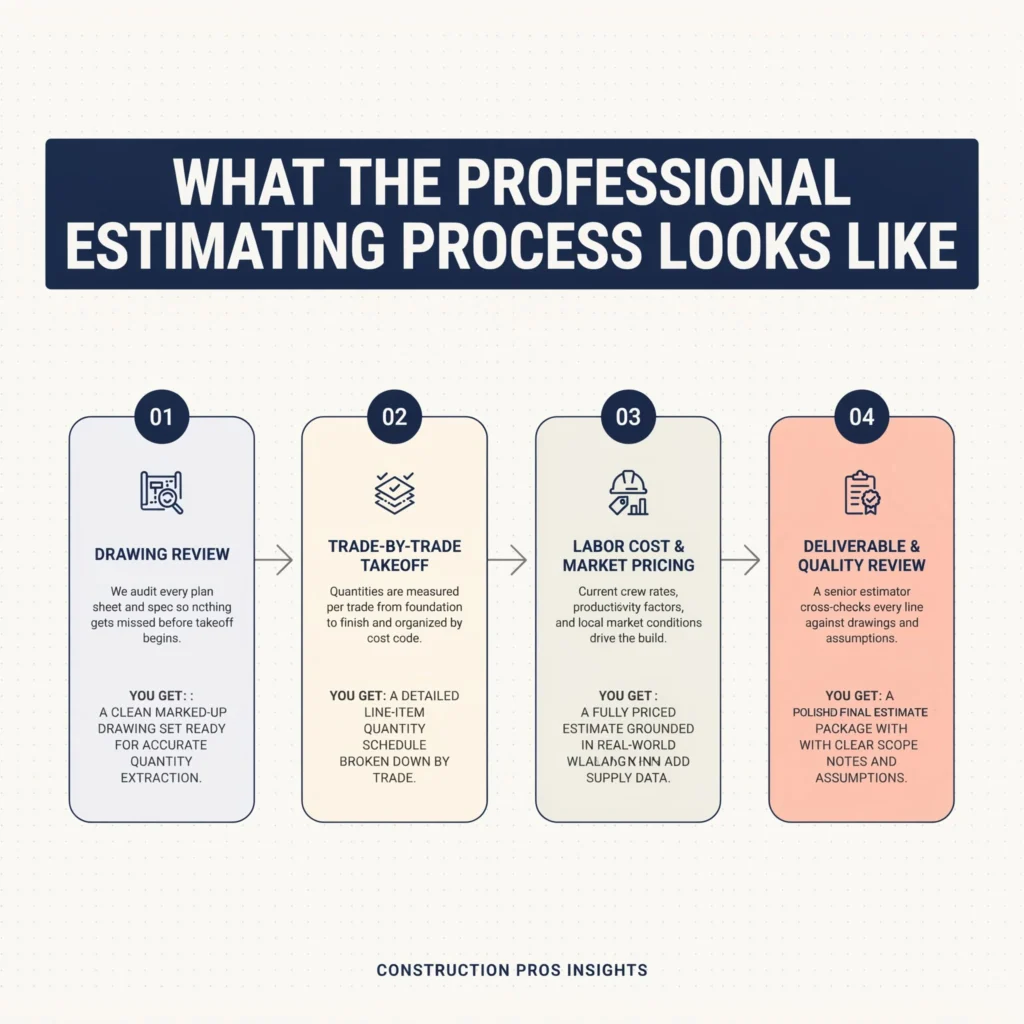
A professional construction estimating engagement follows a repeatable four-stage workflow. Understanding each stage before your first project submission helps you set accurate timeline expectations, prepare the right documentation, and evaluate the quality of the deliverable you receive at the end of the process.
Drawing Review and Scope Confirmation
The first stage of every professional estimating engagement is a thorough review of the submitted drawing package. The estimating team confirms that all required documents are present, that the project scope is clearly defined across all trades, and that any drawing ambiguities that could affect quantity accuracy are identified and resolved before measurement work begins. This front-end review is not a procedural formality. It is the quality control step that prevents mid-estimate scope gaps and drawing conflicts from compressing turnaround time and reducing estimate reliability. A professional estimating firm that skips this stage and moves directly to measurement produces estimates with a meaningfully higher probability of scope omissions that only become visible after the bid is submitted.
Trade-by-Trade Quantity Takeoff
The second stage is the systematic measurement of every material required to complete the project scope. Professional estimators work through the drawing set trade by trade, applying dedicated estimating software platforms and assembly-based measurement tools to produce verified lists of every material, component, and system element the project requires. Our quantity takeoff services apply this trade-by-trade methodology to every project scope we handle, ensuring that no trade is estimated as a lump sum and that every quantity in the deliverable has a measurement basis traceable to a specific drawing location. Trade-specific construction estimates of this quality allow contractors to negotiate subcontractor pricing from a position of verified market knowledge rather than internal assumptions that their subcontractors can challenge without difficulty.
Labor Cost Calculation and Market Pricing Application
Once verified quantities are produced, the estimating team applies current local market labor rates, regional material pricing, and equipment costs to every item in the quantity list. This is the stage where the difference between professional estimating and in-house estimating carries the most significant financial consequences. Professional estimating firms track current labor rates and supplier pricing in specific regional markets rather than applying generic national database figures. The gap between these two pricing sources reaches 15 to 20 percent in many regional construction markets, which means in-house estimates built on national databases are systematically wrong in a direction that either makes your bid uncompetitive or leaves your profit margin dangerously thin on projects where the true local cost is higher than the database reflects.
Deliverable Production and Quality Review
The final stage is the assembly of the cost model from the verified quantities and applied pricing, followed by an internal quality review before the deliverable is released. A professional estimating team checks the completed estimate for internal consistency between the quantity backup and the cost summary, confirms that every trade specified in the project documents appears in the breakdown with a quantity basis, and verifies that the contingency allowance reflects the specific risk profile of the project type and location rather than a flat percentage applied without documented justification. This verification step is what separates a professionally produced estimate from a quantity measurement that has not been reviewed for completeness or accuracy before delivery to the contractor.
What a Professional Construction Estimate Deliverable Should Contain

A complete professional estimate deliverable contains a project cost summary showing total estimated cost by trade and by construction phase, individual trade breakdowns showing material quantities, unit costs, and extended totals for every scope item, labor hour summaries by trade phase, equipment and overhead cost schedules, and a contingency allowance with a documented basis. The quantity backup sheets that support the cost summary are an essential component of the deliverable because they allow the contractor to trace every cost line item back to its measured quantity and verify that the scope used to produce the estimate matches the project documents they intend to build from.
Evaluating the quality of an estimate deliverable requires checking for internal consistency between the quantity backup and the cost summary, verifying that regional market pricing was applied rather than national database rates, and confirming that every trade specified in the project documents appears in the cost breakdown with a quantity basis. Construction estimate accuracy standards require that every cost line item in the deliverable is traceable to a verified measurement rather than a lump sum figure inserted to fill a gap in the estimator’s trade knowledge.
What Turnaround Times to Expect
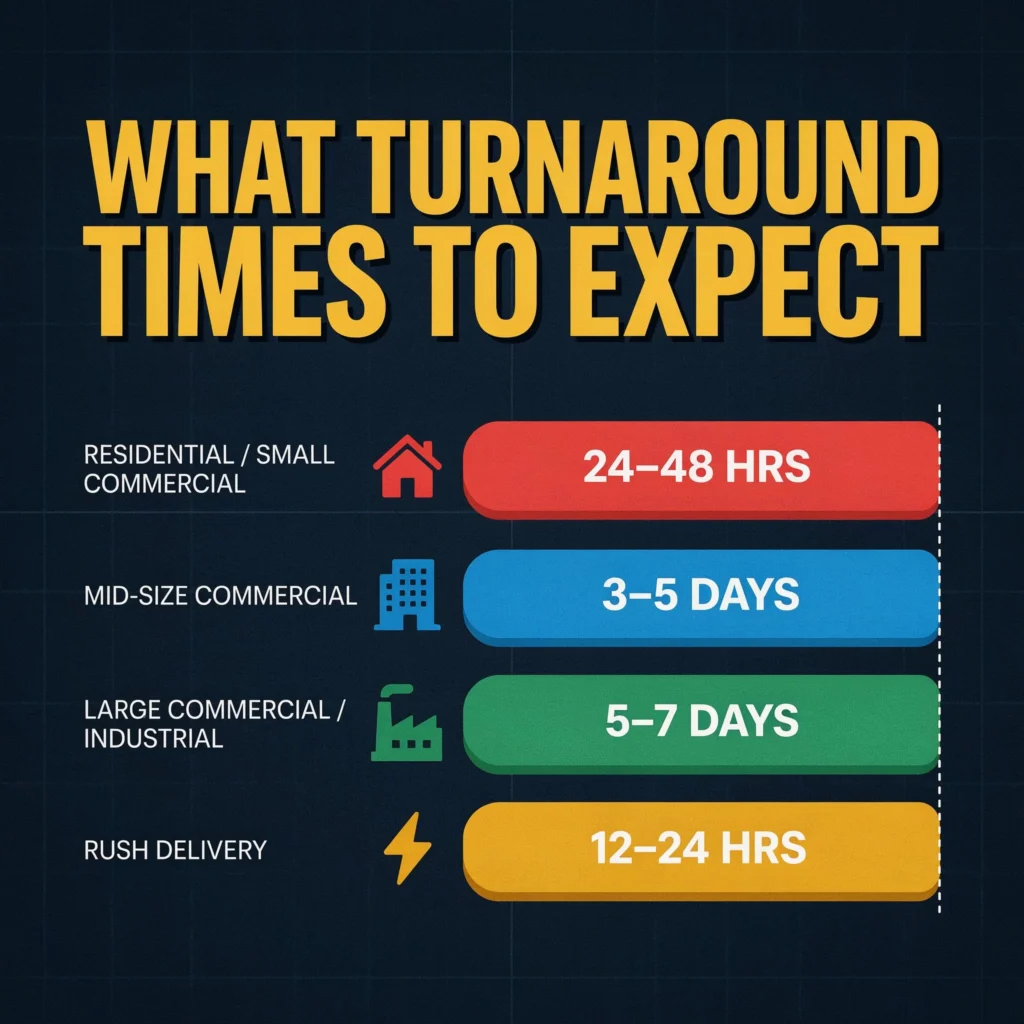
Standard professional estimating turnaround time varies by project type and drawing completeness. Most residential and small commercial projects with complete drawing packages are delivered within 24 to 48 hours. Mid-size commercial projects involving multiple trades typically require 3 to 5 business days. Large commercial or industrial projects with complex MEP and structural scopes require 5 to 7 business days depending on the number of specialty trades involved and the completeness of the documentation provided at submission.
Rush delivery options are available for contractors facing compressed bid deadlines. Most professional estimating firms offer expedited turnaround for an additional fee, with some project types deliverable within 12 to 24 hours when a complete drawing package is submitted with a clear scope description. Contractors who consistently need fast turnaround should discuss their typical bid timeline requirements with their estimating partner at the start of the relationship. When you outsource your construction estimating to a firm that knows your project types and documentation standards, consistent delivery within your bid timeline becomes a reliable feature of the engagement rather than a special request made under deadline pressure.
How Professional Estimating Protects Your Profit Margin
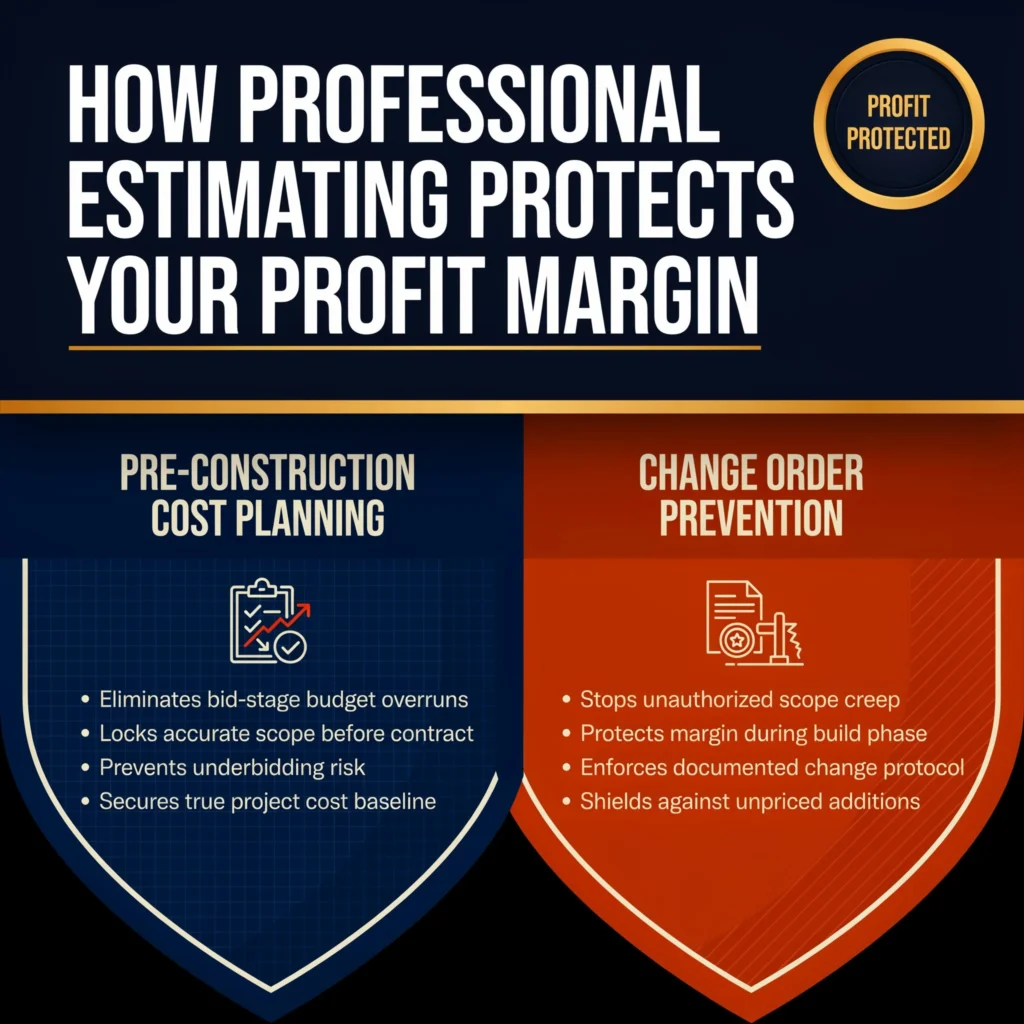
Pre-Construction Cost Planning That Prevents Budget Overruns
A verified professional estimate protects the contractor’s profit margin at the bid stage by ensuring that every cost element required to complete the project is accounted for before the bid price is submitted. Scope omissions, under-measured quantities, and labor rates applied without current market verification are the three most common sources of post-award cost surprises that erode project margins after contracts are signed. Working with professional construction cost management services at the earliest stage of project planning ensures that cost exposure is identified and addressed before construction commitments are made and before the financial damage becomes unavoidable.
Change Order Prevention Through Verified Quantities
Professional estimating also protects margin throughout the construction phase by providing a verified quantity baseline that the project team uses for procurement planning, subcontractor scope documentation, and change order management. When the quantities in the estimate are verified against the drawings before bid submission, scope disputes with subcontractors and change order claims from material shortfalls are substantially reduced because the verified baseline answers most scope questions before they arise in the field. Change order prevention estimating is one of the most financially significant benefits that contractors who have only worked with in-house estimates frequently do not recognize until they experience it on their first professionally estimated project.
How Accurate Estimating Improves Bid Win Rates
Contractors who submit professionally prepared estimates win more contracts. Accurate, thorough, and well-formatted estimate packages signal organizational competence to evaluation committees, institutional clients, and private project owners. In competitive markets where multiple qualified firms are bidding the same project, the quality of the bid documentation influences the award decision at the margin. A professionally estimated bid package tells the evaluation committee that the contractor has done the pre-construction work rigorously and can be trusted to execute with the same discipline throughout the project.
Winning bids built on accurate estimates also means every contract you win actually earns the profit you planned for. Many contractors win work with bids that are too optimistic to support profitable execution and discover the gap only after mobilization. Professional estimating prevents this outcome by ensuring every bid reflects true market costs plus an appropriate profit margin rather than aspirational numbers produced under deadline pressure by an understaffed in-house team with limited trade-specific expertise.
What to Expect When Working With a Professional Estimating Firm for the First Time
A first-time professional estimating engagement typically begins with a drawing submission and a brief scope discussion that confirms the project type, the trades to be included in the estimate, and the timeline required. The estimating team handles the technical complexity of the measurement and pricing work from that point forward, communicating with the contractor if drawing clarifications are needed before measurement work begins. The contractor’s role during the estimating period is to be available to answer scope questions quickly and to review the deliverable carefully when it arrives.
When the estimate is delivered, the review conversation with the estimating team is the most valuable part of the engagement for a first-time client. Walking through the quantity backup against the project drawings confirms that the scope used to produce the estimate matches the project the contractor intends to build. This review also produces the most useful insights for applying the quantity data to procurement planning and subcontractor negotiations. Contractors who treat the first professional estimating engagement as a learning process as well as a deliverable production exercise consistently get more value from every subsequent engagement they commission.
How CSI Estimation LLC Delivers on Every Expectation Described in This Guide
CSI Estimation LLC delivers trade-specific professional estimating services to contractors, developers, and project owners across all 50 states with standard turnaround of 24 to 48 hours on residential and commercial projects. Their estimating team covers the full range of construction trades, producing verified quantity takeoffs and locally calibrated cost breakdowns that meet the accuracy standards described throughout this guide on every project they handle. Their dedicated commercial estimating services and residential estimating services are built on the same foundation of trade-specific expertise, assembly-based measurement methodology, and regional market pricing research that produces estimates accurate enough to win bids and protect margins throughout construction.
For contractors transitioning from in-house estimating to professional outsourced estimating for the first time, CSI Estimation LLC provides a straightforward engagement process designed to fit existing bid workflows without disruption. Their estimating team is available to answer scope and deliverable questions throughout the process, and every deliverable includes the quantity backup documentation that allows the contractor to review, verify, and apply the estimate data with full confidence.
Submit Your Drawings and Experience Professional Estimating on Your Next Project
Every contractor deserves estimates that are accurate enough to win bids and precise enough to protect the margins those bids are supposed to deliver. Professional construction estimating services produce that standard of accuracy consistently because they apply verified measurement, current market pricing, and a systematic quality review to every project they handle. That is the standard described throughout this guide and the standard every contractor should hold their professional estimating partner to from the first project submission forward.
Submit your project drawings to CSI Estimation LLC today and receive a complete, trade-specific professional estimate within 24 to 48 hours. Their team reviews your drawing set across all relevant trades, applies verified assembly data and regional market pricing to every quantity, and delivers a cost breakdown you can carry directly into your bid with confidence. Contact CSI Estimation LLC today and take the first step toward estimates that protect every project you win.