

Introduction
Accurately estimating PECO electrical service for a commercial building is a critical step in ensuring safe, reliable, and cost-effective power distribution. Commercial projects demand precise planning because electrical service sizing directly impacts equipment performance, long-term operational costs, and code compliance. An undersized system can cause overloads and costly upgrades, while oversizing can unnecessarily increase infrastructure expenses.
A proper estimate begins with detailed load calculations, including lighting, HVAC systems, machinery, and other operational equipment. Understanding PECO’s commercial rate structure especially demand charges and the Price to Compare also plays an important role in budgeting and forecasting energy expenses. Additionally, early coordination with PECO ensures that service applications, transformer requirements, and voltage selections align with utility standards.
Because commercial buildings typically have higher and more complex power demands than residential properties, detailed electrical planning is essential to avoid delays, unexpected costs, and compliance issues.
Understanding PECO’s Electric Price to Compare (PTC)
What Is PECO’s Electric Price to Compare?
PECO’s Electric Price to Compare (PTC) is the default electricity supply rate charged per kilowatt-hour (kWh) for customers who do not choose a third-party energy supplier. It represents the cost of the electricity supply portion of a bill, separate from delivery and distribution charges. The Price To Compare is approved and adjusted periodically based on wholesale market conditions and procurement costs.
For commercial building owners and contractors, understanding the PTC is essential for accurate budgeting. Since the supply rate directly affects monthly operating expenses, incorporating the correct kWh rate into electrical service planning helps forecast energy costs more realistically during the estimation phase.
PECO’s Price per kWh for Commercial Customers
Commercial electricity rates typically differ from residential rates due to higher usage volumes and demand-based billing structures. In addition to a per kWh supply charge, commercial customers may also face demand charges based on peak kW usage during a billing cycle.
When estimating electrical service for a commercial building, it is important to verify the current effective date of PECO’s rate and anticipate the next rate change. Rate updates can significantly influence projected annual operating expenses and long-term financial planning.
How Rate Changes Impact Commercial Electrical Estimates
Fluctuations in PECO’s supply rate directly affect a building’s operational costs. Even small increases in per kWh pricing can substantially impact large commercial facilities with high energy consumption.
By factoring potential rate adjustments into service size and demand calculations, property owners can better forecast operating expenses and evaluate energy efficiency investments. Proper planning supports long-term utility budgeting, improves financial predictability, and helps businesses avoid unexpected cost increases.
Commercial vs Residential PECO Electrical Service
Residential Customers vs Commercial Customers
Commercial electrical service differs significantly from residential service in both scale and complexity. Residential properties typically require smaller service capacities, commonly ranging from 100 to 400 amps, with standard voltage configurations such as 120/240V single-phase systems. In contrast, commercial buildings often require much larger service sizes, frequently involving three-phase systems such as 120/208V or 277/480V to support heavy equipment, HVAC systems, lighting loads, and operational machinery.
Another key difference is billing structure. Residential customers are generally billed at a flat rate per kilowatt-hour (kWh) based solely on energy consumption. Commercial customers, however, are often subject to demand billing, where charges are based not only on total energy used but also on the highest kilowatt (kW) demand recorded during the billing cycle.
Voltage requirements also vary. Commercial buildings typically require higher voltages and more complex distribution systems to ensure efficiency and reliability for larger loads.
PECO Commercial Electricity Rate Structures
PECO commercial rate structures are more detailed than residential plans and typically include multiple cost components. One of the most significant is the demand charge, which is calculated based on the building’s peak kW usage during a specific billing period. This charge can substantially impact monthly utility expenses if demand spikes are not managed properly.
In addition to demand charges, commercial customers pay energy consumption charges, calculated per kWh used. These charges are influenced by the Price to Compare or selected supplier rates.
Some commercial accounts may also be subject to time-of-use pricing, where electricity costs vary depending on peak and off-peak hours. Understanding these structures is essential when estimating electrical service, as they directly affect long-term operational budgeting and service capacity planning.
How to Calculate/Estimate the Actual kW Demand for a Commercial Building
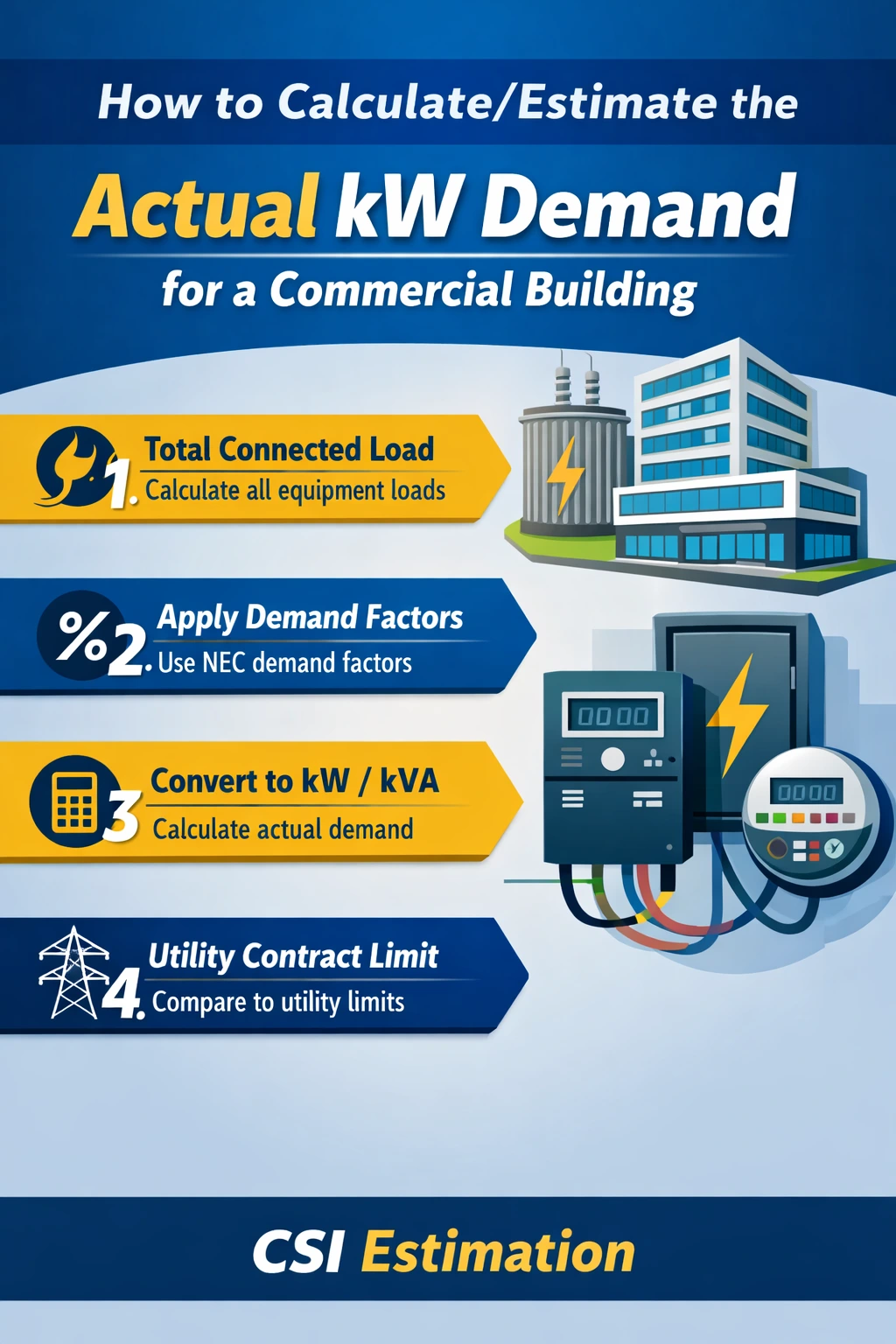
Accurately estimating the actual kW demand of a commercial building is essential when determining the appropriate PECO electrical service size. This process ensures compliance with electrical codes, prevents overload conditions, and supports proper utility contract limits.
Step 1 – Determine Total Connected Load
The first step is calculating the total connected load, which represents the combined electrical capacity of all equipment and systems installed in the building.
Lighting loads
should be calculated based on square footage and lighting type, following NEC lighting load requirements per occupancy type.
HVAC systems
often represent one of the largest loads in commercial buildings. Include chillers, rooftop units, air handlers, and electric heating elements.
Equipment and machinery
such as elevators, kitchen equipment, manufacturing tools, IT infrastructure, and motors must also be included.
Using the NEC load calculation guidelines ensures accurate sizing. The National Electrical Code provides standardized methods for determining general lighting loads, receptacle loads, and motor loads, which form the foundation of a compliant service estimate.
Step 2 – Apply Demand Factors
After determining the connected load, demand factors must be applied to reflect realistic usage conditions. Not all electrical systems operate at full capacity simultaneously.
Diversity factors
account for the probability that certain loads will not run at the same time. This adjustment prevents oversizing the electrical service.
It is also important to distinguish between continuous loads (operating for three hours or more) and non-continuous loads. Continuous loads must typically be calculated at 125% of their rated value, as required by code, to ensure safety and reliability.
Step 3 – Convert to kW / kVA for Utility Contract Limit
Once adjusted demand is calculated, the total load must be converted into kilowatts (kW) or kilovolt-amperes (kVA), depending on the utility’s requirements. This value determines the service size and transformer capacity required.
Proper transformer sizing ensures the system can handle peak demand without overheating or inefficiency.
The service panel capacity must also be selected based on calculated demand, allowing room for both present loads and reasonable future expansion.
Avoiding Common Load Calculation Mistakes
One of the most common errors is undersizing the service, which can lead to system overloads, equipment failures, and costly upgrades.
Another mistake is ignoring future expansion, such as planned equipment additions or tenant build-outs, which may require increased capacity.
Finally, many estimators misinterpret connected load versus actual demand load, resulting in inaccurate service sizing. Understanding this distinction is critical for precise PECO electrical service estimation and long-term operational efficiency.
Benchmark Your Building Before Estimating Service Size
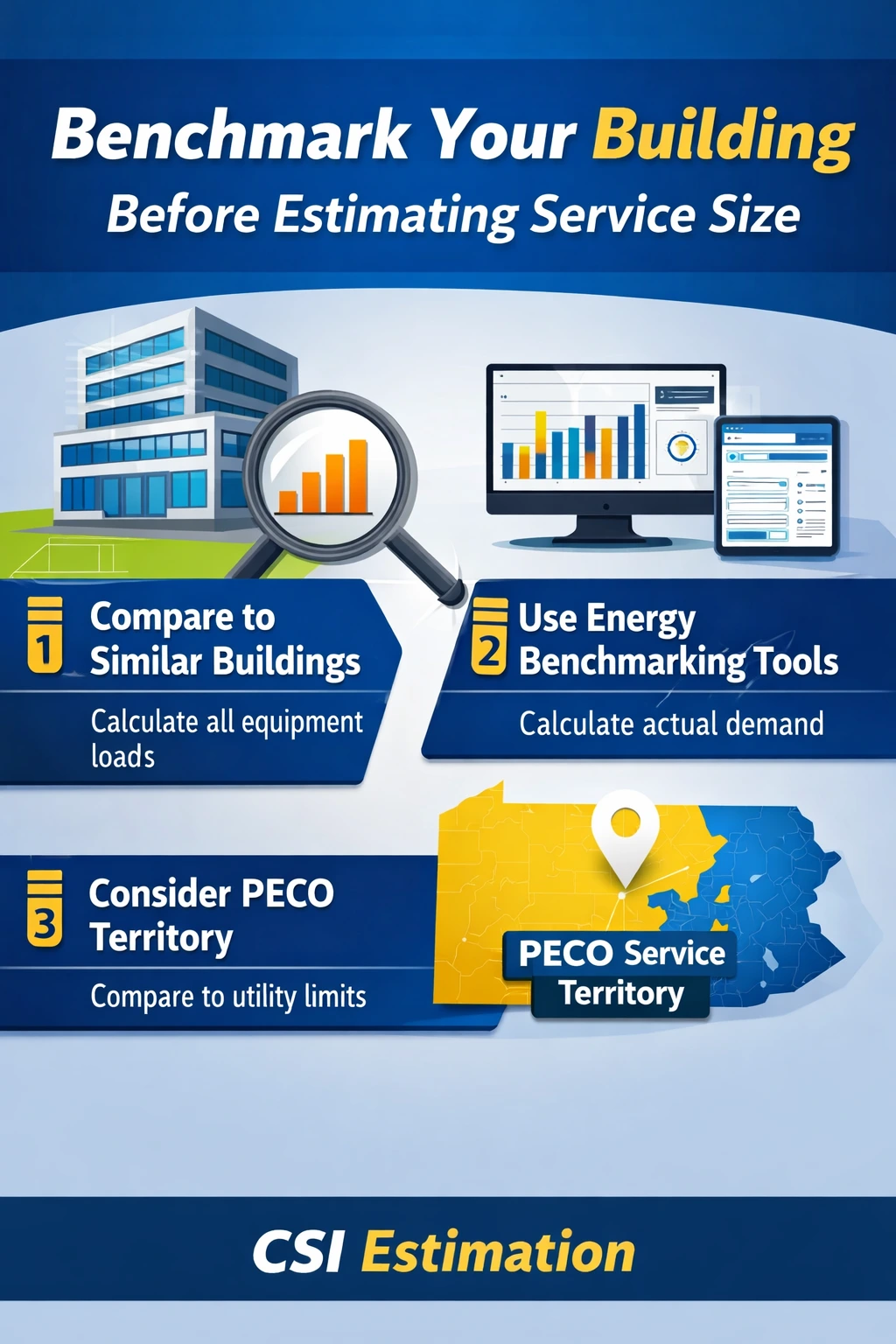
Before finalizing electrical service sizing, benchmarking the building’s expected energy usage is a critical step. Comparing projected consumption against similar commercial properties helps validate load calculations and ensures the selected PECO service capacity aligns with real-world operating patterns. Benchmarking reduces the risk of oversizing or undersizing the system and supports more accurate demand forecasting.
Using Energy Usage Data Tools
Energy usage data tools allow property owners and contractors to analyze historical consumption trends and compare them with buildings of similar size, occupancy type, and operational hours. These tools help estimate expected kilowatt-hour (kWh) usage and peak demand (kW), providing a realistic baseline for service planning.
By benchmarking against comparable commercial buildings such as offices, retail centers, warehouses, or mixed-use facilities, estimators can better predict average load profiles and seasonal variations. This approach strengthens the accuracy of load calculations and improves long-term budgeting.
Buildings Located in Philadelphia (PECO Territory Considerations)
For buildings located in Philadelphia and surrounding PECO service areas, it is essential to consider local utility infrastructure and service availability. Factors such as proximity to distribution lines, transformer capacity, and feeder limitations may influence the final service size and installation requirements.
Additionally, PECO has specific service application requirements for commercial projects, including load letters, site plans, and equipment specifications. Coordinating early with the utility ensures compliance, avoids delays, and helps align electrical design with local infrastructure constraints.
PECO Service Application Process for Commercial Buildings
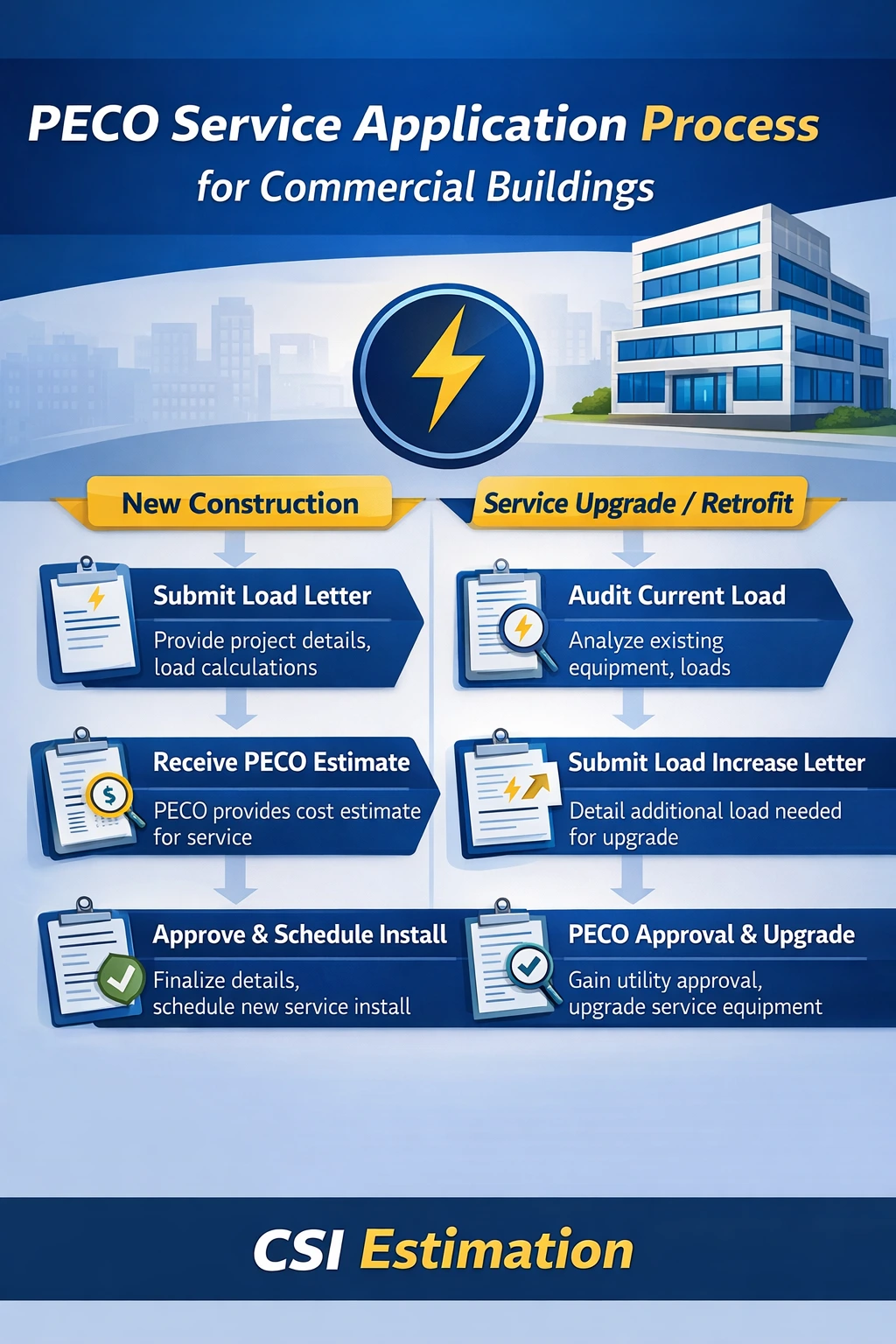
Securing PECO electrical service for a commercial building requires following a structured application process. Whether you’re a new construction project or upgrading an existing facility, understanding the documentation, timelines, and utility requirements is essential for accurate cost estimation and smooth service activation.
New Construction Customers
For new commercial buildings, PECO requires specific documentation to process service requests:
- Site Plans & Load Letters: Detailed architectural and electrical plans, including calculated load requirements, are essential for sizing the service and transformers.
- Permit Approvals & Specifications: Local permits, building approvals, and equipment specifications ensure compliance with utility and safety regulations.
Submitting these documents early helps PECO review and approve service capacity efficiently, preventing delays in energizing the building.
Service Upgrades & Retrofits
Commercial buildings often require service upgrades or retrofits due to increased load or modernization:
- Transformer Upgrades: When existing transformers cannot meet new load demands, replacements or additions are necessary.
- Panel Upgrades: Upgrading switchboards or main panels ensures proper distribution and safety compliance.
- Utility Coordination Timelines: Scheduling with PECO for inspections, approvals, and meter installation is critical for avoiding project delays.
Careful planning and early coordination with PECO help ensure a seamless transition to the required electrical service level.
Key Cost Factors in Estimating PECO Electrical Service
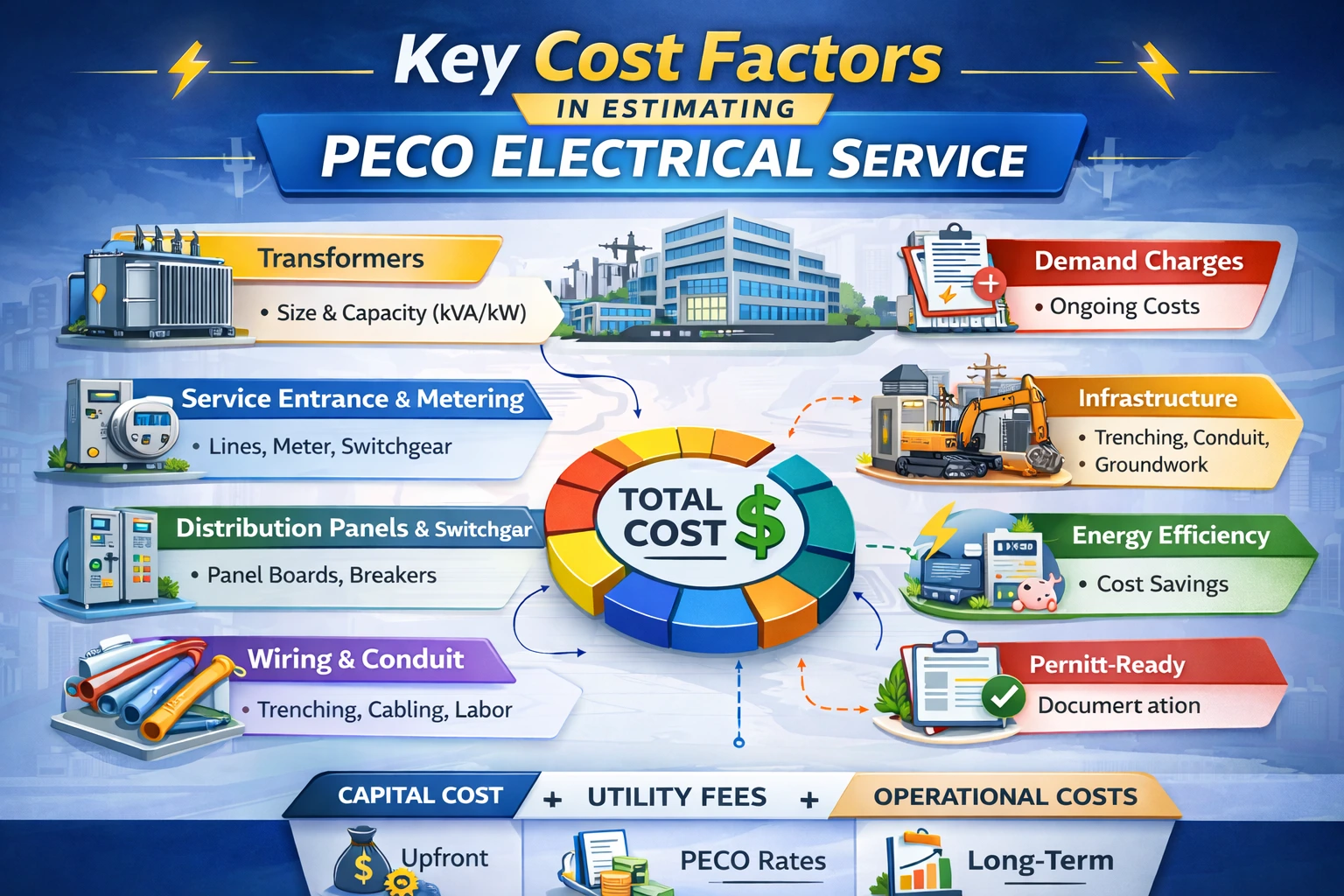
Estimating PECO electrical service for a commercial building involves understanding the major factors that influence costs. These elements impact both the upfront installation expenses and long-term utility bills. Accurate assessment helps contractors, developers, and building owners budget effectively and avoid surprises during project execution.
- Distance from Utility Lines: Longer distances require additional cabling, trenching, and sometimes easements, increasing installation costs.
- Transformer Installation: Depending on the building’s load, transformers may need to be installed or upgraded. The size and type of transformer significantly affect both equipment and labor costs.
- Trenching & Conduit: Excavation for underground cables, conduit materials, and labor can represent a significant portion of the overall cost.
- Metering Requirements: Commercial meters, including advanced interval meters, can vary in price depending on service size and complexity.
- Switchgear & Distribution Systems: Properly sized switchgear and distribution panels ensure safety and efficiency but can add to material and labor costs.
Considering these factors early ensures accurate budgeting and smooth coordination with PECO for commercial electrical service.
Compare PECO Commercial Electricity Rates and Suppliers
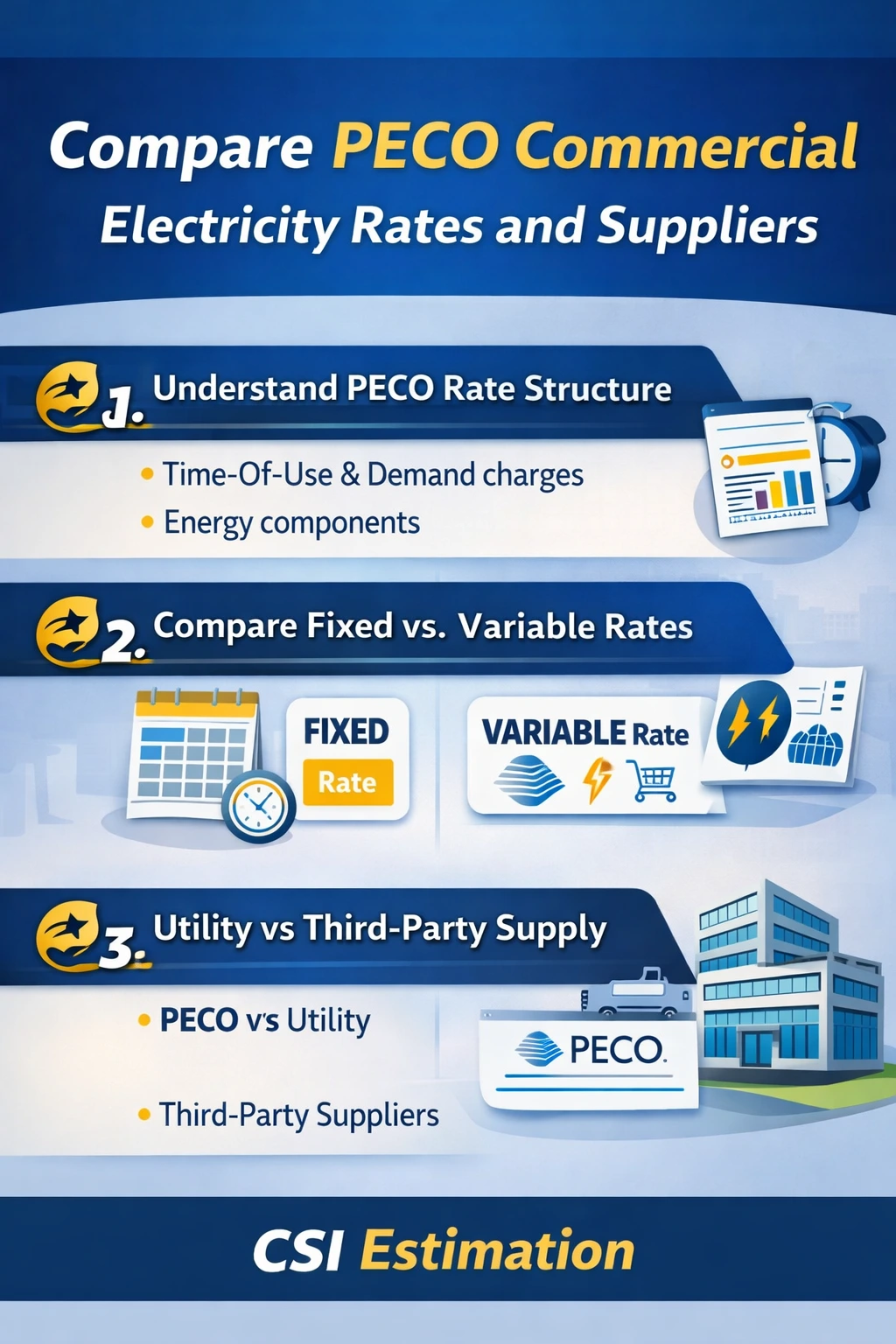
When estimating PECO electrical service for a commercial building, understanding the difference between the utility company and energy suppliers is crucial. PECO handles the delivery of electricity, maintaining poles, lines, and meters, while third-party energy suppliers provide the electricity itself. Knowing this distinction allows building owners to make informed decisions on contracts and costs.
Difference Between Utility Company and Energy Supplier
PECO ensures reliable delivery and maintenance of the electrical infrastructure, whereas energy suppliers compete to offer competitive rates for the electricity consumed. Choosing the right supplier can significantly impact your monthly operational costs.
How to Get a Competitive Commercial Electric Rate
Commercial customers should evaluate fixed vs. variable rates based on their energy usage patterns. Fixed rates provide predictable costs over the contract term, while variable rates may fluctuate with market conditions. Consider contract term length, potential renewal clauses, and supplier reputation to secure a cost-effective plan.
Comparing rates and suppliers alongside PECO delivery charges ensures accurate budgeting and helps optimize overall electrical expenses for your commercial building.
Energy Efficiency & Cost Reduction Strategies for Commercial Buildings
Optimizing energy efficiency is a key factor when estimating PECO electrical service for commercial buildings. Implementing advanced technologies not only reduces operating costs but also helps in sizing electrical services more accurately and avoiding unnecessary utility expenses.
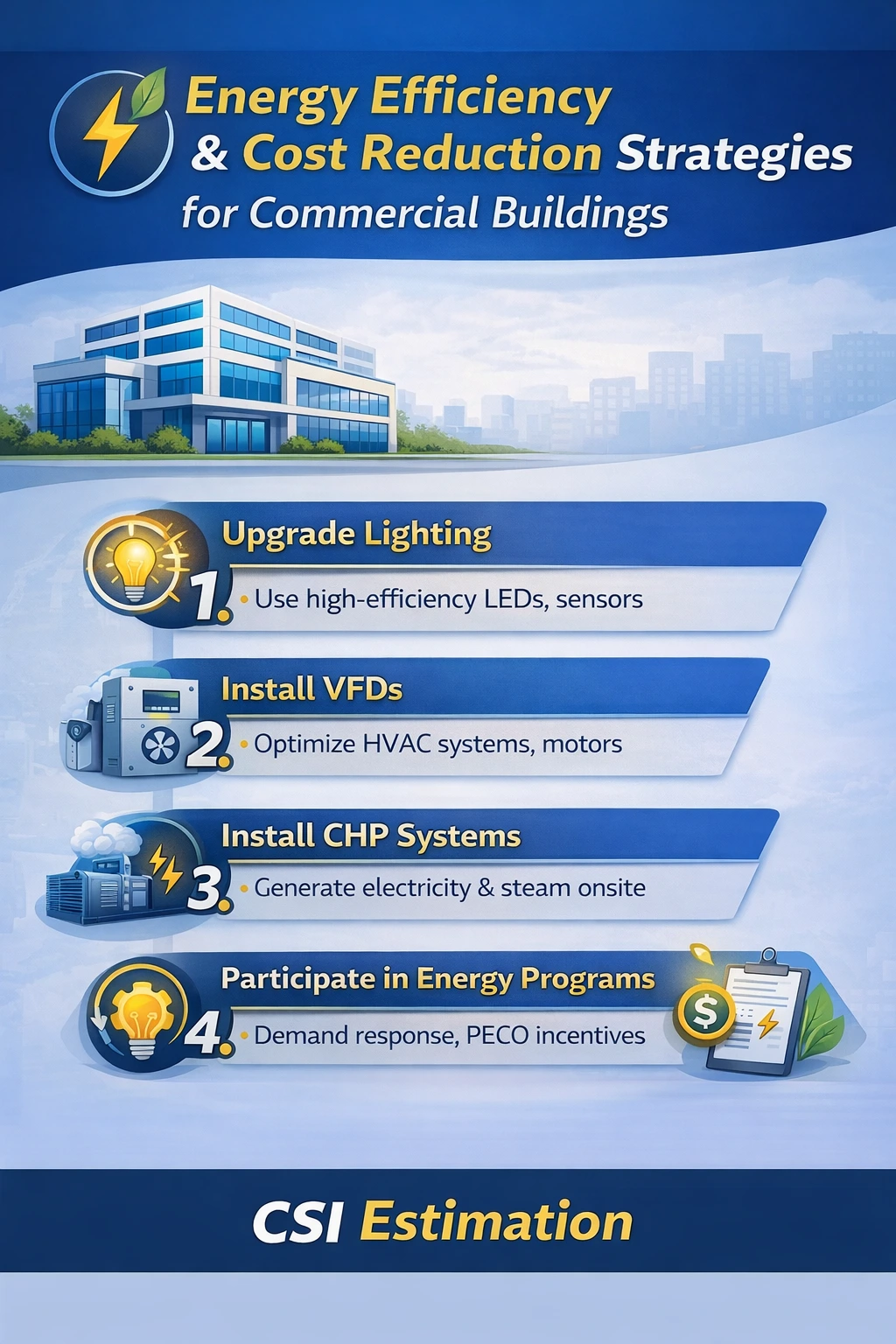
Advanced Lighting & Energy Management Systems
Upgrading to LED lighting and integrating building-wide energy management systems allows precise control of electricity usage. These systems help monitor consumption patterns, reduce waste, and lower demand charges on your PECO bill.
Variable-Frequency Drives (VFDs)
Installing VFDs on motors and HVAC equipment adjusts energy use based on actual demand. This reduces peak load requirements, which can lower the kW demand calculation and result in smaller service sizing needs.
Combined Heat & Power (CHP)
CHP systems generate electricity on-site while capturing waste heat for heating or cooling. This improves overall efficiency and can reduce reliance on the grid, impacting your PECO electrical service estimate.
Financial Incentives & Energy Saving Programs
PECO and other programs offer rebates, grants, or incentives for energy efficiency upgrades. Leveraging these programs can offset installation costs, encourage sustainable practices, and reduce long-term operational expenses.
Incorporating these strategies ensures commercial buildings not only meet energy goals but also optimize electrical service requirements for cost-effective and efficient operation.
Common Mistakes When Estimating PECO Electrical Service
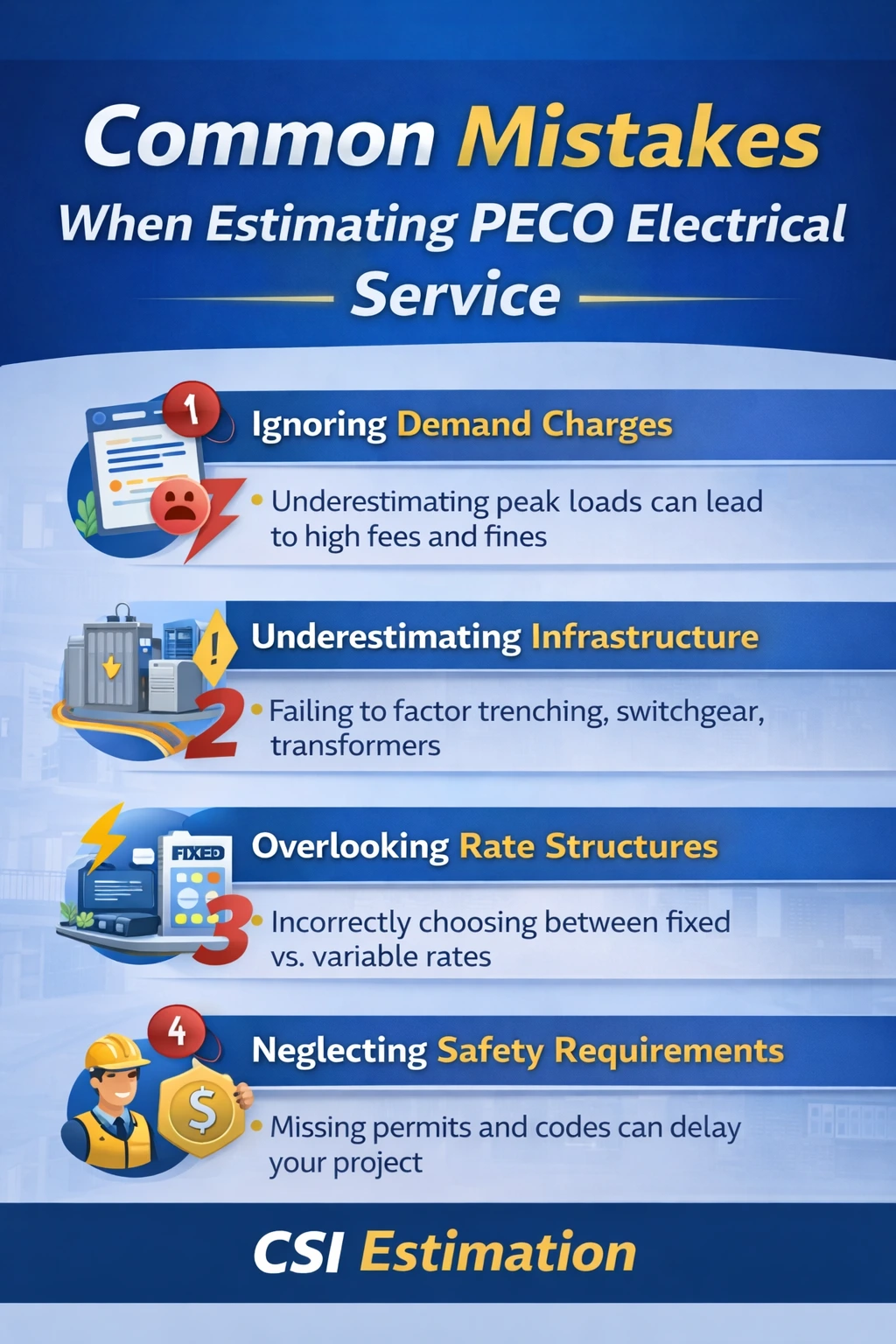
Estimating PECO electrical service for commercial buildings can be complex, and errors can lead to oversized services, higher bills, or operational issues. Being aware of common mistakes helps ensure accurate planning and budgeting.
- Ignoring Demand Charges
Many commercial customers focus only on energy consumption but overlook demand charges, which can significantly impact monthly bills. Accurately factoring in peak demand ensures proper sizing of transformers and service panels. - Overlooking Rate Structure
Commercial rates often include time-of-use, energy, and demand components. Failing to understand PECO’s rate structure can lead to underestimating operating costs. - Failing to Benchmark Usage
Not comparing your building’s energy use to similar properties can result in incorrect kW demand estimates. Benchmarking helps forecast realistic consumption and plan service size accordingly. - Underestimating Infrastructure Costs
Costs like trenching, conduit, switchgear, and metering are often overlooked. Accounting for these expenses early prevents surprises during installation or upgrades.
By avoiding these pitfalls, commercial property owners and contractors can achieve accurate PECO service estimates, optimize energy costs, and prevent unnecessary expenditures.
Why Hiring a Professional Electrical Estimator Matters
Hiring a professional electrical estimator for your commercial building ensures accurate planning, compliance, and cost control. With CSI Estimation, you get specialized expertise that saves time, prevents costly mistakes, and ensures your project runs smoothly.
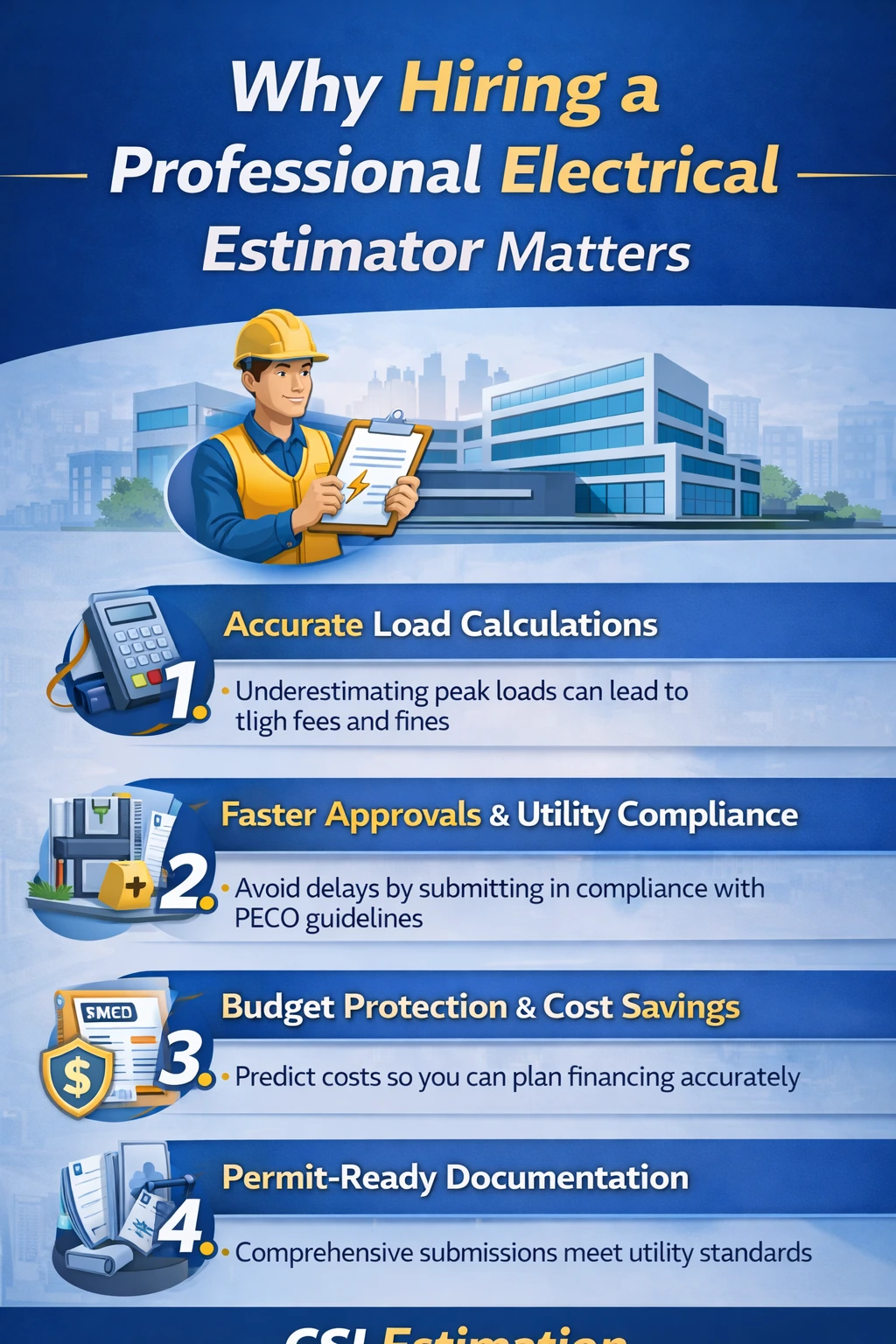
- Accurate Load Calculations
CSI Estimation precisely calculates total connected load, applies demand factors, and determines required kW/kVA. This ensures your PECO service is sized correctly for both current requirements and future expansion. - Utility-Compliant Documentation
Our team prepares complete documentation, including load letters, site plans, and permit-ready calculations, streamlining PECO service applications and approvals. - Budget Protection
CSI Estimation provides transparent cost breakdowns for transformers, panels, metering, and distribution systems, helping you avoid unexpected expenses and optimize your project budget. - Faster Approvals
With accurate calculations and professional documentation, service applications are approved more quickly, reducing delays and ensuring timely electrical service activation.
For reliable, detailed, and utility-compliant estimates, trust CSI Estimation’s Electrical Estimating Services or MEP Estimating Services to simplify your PECO electrical service planning.
Frequently Asked Questions
-
What is PECO’s current Price to Compare?
The Price to Compare (PTC) is PECO’s benchmark rate for electricity. CSI Estimation can help you interpret PTC rates and forecast your commercial building’s energy costs accurately.
-
How long does PECO service approval take?
Approval timelines vary depending on project complexity. With CSI Estimation, all documentation, load calculations, and site plans are prepared accurately, which speeds up the service approval process.
-
What documents are required for commercial service?
PECO typically requires site plans, load letters, electrical drawings, and permit-ready calculations. CSI Estimation provides comprehensive documentation to ensure your submission meets utility requirements.
-
Can commercial service size be upgraded later?
Yes, service upgrades are possible. CSI Estimation can plan your initial load with future expansion in mind, preventing undersized installations and additional costs.
-
How do I lower my PECO energy bill?
By implementing energy efficiency strategies like advanced lighting, VFDs, and combined heat & power systems, you can reduce consumption. CSI Estimation offers guidance on optimizing loads and costs while complying with PECO regulations.