
Becoming an MEP estimator is one of the most in-demand career moves in the construction industry today. MEP stands for Mechanical, Electrical, and Plumbing, and an MEP estimator is the professional responsible for calculating the full cost of these systems before a single wire is pulled or pipe is installed.
If you have ever asked how to become an MEP estimator, the honest answer is that it requires a combination of technical education, hands-on exposure, software proficiency, and industry-recognized certifications. This guide covers every step of that path, from education and skills to tools and salary.
Also, it explains how contractors in North Carolina and Michigan are solving their MEP estimating needs right now without building an in-house team from scratch.
What Is an MEP Estimator and What Do They Do?
An MEP estimator is a construction cost professional who evaluates the mechanical, electrical, and plumbing system requirements for a building project and produces detailed, bid-ready cost estimates before construction begins.
Their estimates include material quantities, equipment costs, labor hours, subcontractor pricing, and overhead allowances for every MEP system in a proposed structure.
MEP estimators work during the preconstruction phase, which means their accuracy directly determines whether a contractor wins a bid and whether that bid is profitable once work begins.
They collaborate closely with mechanical engineers, electrical engineers, plumbing designers, general contractors, project managers, and subcontractors throughout the bidding process.
What separates a strong MEP estimator from an average one is the ability to read complex construction drawings and specifications accurately, translate those readings into precise quantity takeoffs, apply current labor and material rates, and deliver a complete cost picture under tight deadlines.
The role demands both technical knowledge and financial discipline. A single miscalculation on a large commercial project can cost a contractor hundreds of thousands of dollars, which is exactly why the demand for qualified MEP estimators continues to grow across every construction market in the country.
Core Responsibilities of an MEP Estimator on a Real Project
On a real project, an MEP estimator begins by reviewing architectural and engineering drawings alongside full project specifications. They identify the scope of every mechanical system, including HVAC units, ductwork, and piping; every electrical system, including panels, conduit, wiring, and lighting; and every plumbing system, including supply, drainage, and fixture installations.
From those drawings, the estimator performs a quantity takeoff, which is the process of measuring and counting every item that needs to be purchased or installed.
This includes linear footage of conduit and pipe, square footage of ductwork, counts of fixtures, devices, and equipment units, and labor hours required to install each component based on recognized productivity standards.
Once quantities are established, the estimator applies current material pricing from supplier quotes or published cost databases and calculates labor costs using local wage rates and union or non-union labor agreements.
They then solicit pricing from subcontractors for specialized scopes, compare those bids, and incorporate the most competitive and reliable numbers into the final estimate.
The completed estimate is formatted, reviewed, and submitted as part of the contractor’s bid package, usually under a deadline that allows very little margin for error. The entire process demands precision, speed, and deep familiarity with how MEP systems are actually built in the field.
What Education Do You Need to Become an MEP Estimator?

Most employers in commercial construction prefer candidates who hold a bachelor’s degree in mechanical engineering, electrical engineering, civil engineering, or construction management.
These programs provide the foundational understanding of building systems, structural loads, material properties, and construction sequencing that makes a new estimator functional on the job faster.
That said, an associate degree combined with two or more years of verified field experience in MEP installations is also a recognized and respected pathway into the profession.
Many of the strongest estimators working today began as apprentices, journeymen, or field coordinators before moving into the estimating office.
For candidates who want to enter the field more quickly, specialized estimating courses through platforms like MEP Academy can be completed in under six months and cover blueprint reading, digital takeoff methods, cost database navigation, and bid preparation fundamentals.
These programs do not replace a degree in the eyes of every employer, but they demonstrate initiative, build real skills, and can bridge the gap between general construction knowledge and estimating-specific competency.
The key is pairing any formal education with genuine exposure to MEP systems, whether through coursework, internships, or field rotations, because no amount of classroom instruction fully substitutes for understanding how mechanical, electrical, and plumbing work actually gets installed on a job site.
Alternative Pathways Into MEP Estimating Without a Four-Year Degree
Not every MEP estimator took the traditional academic route, and the industry increasingly recognizes this. Several bridge roles lead directly into MEP estimating for candidates without a four-year degree.
Working as a field coordinator on MEP projects gives exposure to installation sequences, scope limitations, and real-world productivity rates that textbooks cannot replicate.
Project engineer roles, particularly on mechanical or electrical subcontractor teams, develop blueprint literacy and cost awareness simultaneously.
BIM technician positions are another strong entry point. Professionals who work with three-dimensional building models develop spatial reasoning and quantity extraction skills that translate directly to modern estimating workflows.
Junior estimator roles, even in adjacent trades, build the process discipline and software familiarity that hiring managers want to see.
What employers are increasingly prioritizing is workflow competence: the ability to open a takeoff tool, navigate a drawing set, and begin quantifying scope on day one.
Candidates who can demonstrate that capability, regardless of the credential behind their name, consistently move faster through the hiring process than those with degrees but no practical experience.
What Skills Does an MEP Estimator Need to Succeed?

A successful MEP estimator combines technical knowledge with strong analytical and communication skills. On the technical side, the role demands deep literacy in reading and interpreting construction drawings, including plan views, elevations, sections, and details across mechanical, electrical, and plumbing disciplines.
Understanding how these systems interact with each other and with the structural and architectural elements of a building is essential for producing estimates that reflect real-world installation conditions.
Mathematically, the estimator must be comfortable with unit conversions, area and volume calculations, labor productivity analysis, and percentage-based markup structures. Math errors are not recoverable once a bid is submitted.
Attention to detail separates reliable estimators from costly ones. A missed equipment specification, an overlooked drawing revision, or a misread scale can inflate or deflate a bid significantly.
Written and verbal communication skills matter because estimators regularly explain their assumptions to project managers, negotiate pricing with suppliers, and present their numbers to clients.
Knowledge of local construction codes in the states and jurisdictions where work is being bid is also a non-negotiable skill. Code requirements drive scope, and scope drives cost. An estimator who does not understand the applicable code in a given market will consistently underprice or overprice their bids.
Contractors who rely on professional construction cost estimating services understand exactly why this level of technical skill is so difficult to replicate without years of dedicated experience behind it.
Which Certifications Help You Become a Better MEP Estimator?
Certifications in construction estimating signal professional commitment, validate technical knowledge, and directly influence earning potential.
The most recognized credential for general estimating professionals is the ASPE Certified Professional Estimator designation, offered by the American Society of Professional Estimators. This certification requires demonstrated experience, a written examination, and ongoing continuing education to maintain.
The AACE International organization offers two relevant credentials: the Certified Cost Professional and the Certified Estimating Professional. Both are widely respected in commercial and industrial construction, particularly on large-scale MEP projects tied to healthcare facilities, data centers, manufacturing plants, and government buildings.
Employers in these sectors actively seek credentialed estimators because project complexity and financial exposure demand a higher standard of accuracy.
LEED familiarity, while not an estimating credential in the traditional sense, adds meaningful value for estimators working on sustainable construction projects where mechanical and electrical system specifications are significantly more complex than conventional builds.
Certifications are not always mandatory at the entry level, but they consistently separate candidates in competitive hiring situations and justify higher compensation at the senior level.
Certified estimators at the mid-career and senior stages regularly earn more than their non-certified counterparts, and they are the first professionals considered when firms are staffing up for major project pursuits.
What Software Tools Does an MEP Estimator Use Daily?
Software proficiency is not optional in modern MEP estimating. The tools used daily determine how fast and how accurately an estimator can work, and employers expect new hires to arrive with at least foundational familiarity with the industry-standard platforms.
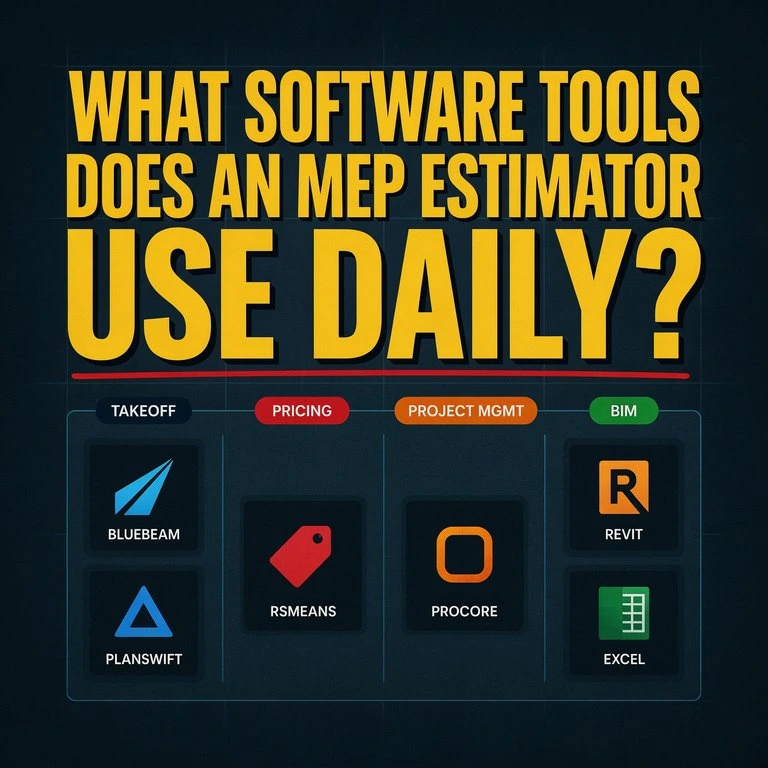
Bluebeam Revu is the most widely used tool for digital plan markup and on-screen takeoffs. Estimators use it to measure linear runs, count fixtures and devices, and annotate drawings with scope notes.
PlanSwift and CostX are dedicated quantity takeoff platforms that allow estimators to assign assemblies and cost codes to measured quantities directly within the software. RS Means and Gordian are the primary cost databases for labor and material pricing, providing location-adjusted unit costs that reflect real market conditions.
Procore is used on many commercial projects for project management integration, allowing estimating data to flow into project controls and scheduling workflows.
AutoCAD and Revit are essential for estimators working in BIM-enabled environments, where quantity extraction is performed directly from three-dimensional models rather than two-dimensional drawings.
Microsoft Excel remains the universal tool for budget modeling, bid summaries, and cost tracking, regardless of how sophisticated the primary estimating platform is.
An estimator who is proficient across even four or five of these tools is a significantly more productive and employable professional than one who relies on manual methods or spreadsheets alone.
Many contractors who recognize how tool-heavy and time-intensive this work is choose to work with a professional blueprint estimator rather than attempting to manage the full software stack in-house.
How BIM Technology Is Changing MEP Estimation
Building Information Modeling, known as BIM, has fundamentally changed how MEP estimators work on complex projects. BIM platforms like Revit allow estimators to work directly from three-dimensional models of mechanical, electrical, and plumbing systems rather than interpreting two-dimensional drawings and making assumptions about spatial relationships.
This matters for accuracy because MEP systems in dense commercial buildings frequently conflict with each other and with structural elements. A duct run that looks clean on a floor plan may intersect with a beam or a conduit tray in three dimensions.
BIM allows the estimator and the design team to identify and resolve those conflicts before construction begins, which prevents costly change orders and rework that would otherwise destroy a project’s budget.
Quantity extraction from BIM models is also faster and more repeatable than manual takeoff methods. Model-based estimating reduces the risk of missed items and supports more granular cost breakdowns by floor, zone, or system.
Estimators who are proficient in Revit and model-based takeoff workflows are among the most sought-after professionals in the current construction market, particularly on healthcare, laboratory, and mission-critical facility projects where MEP density is highest.
How Long Does It Take to Become a Qualified MEP Estimator?
The honest answer is that it takes time, and anyone telling you otherwise is likely oversimplifying the role. Most professionals who enter MEP estimating through a relevant degree or trade background become productive on clearly defined scopes within two to three years.
Handling complex, multi-system projects independently, including full mechanical, electrical, and plumbing scopes on a large commercial or industrial building, typically requires five to eight years of progressive experience.
Entry-level positions as junior or assistant estimators are the standard starting point. These roles provide supervised exposure to the full estimating process, typically on smaller project scopes, while the new professional builds speed, accuracy, and code knowledge over time.
Structured training programs, mentorship within an established estimating team, and deliberate software practice can accelerate early-career development meaningfully.
Professionals who combine formal education with field exposure and pursue certification early in their career consistently reach full professional competency faster than those who follow only one of those tracks.
What Does an MEP Estimator Earn in North Carolina and Michigan?
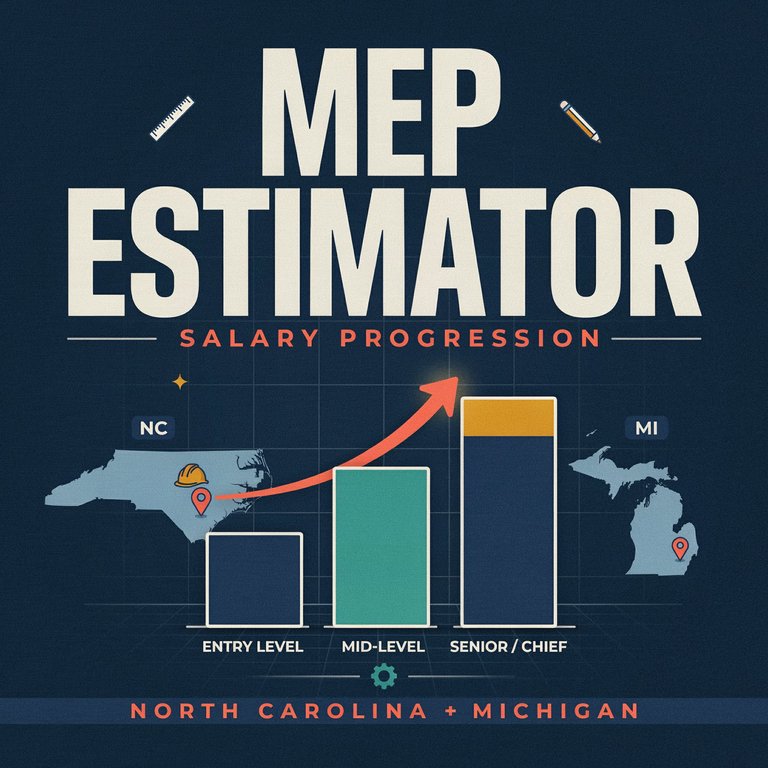
MEP estimating is a well-compensated profession, and the market data reflects sustained demand for qualified professionals. Entry-level estimators, typically those in junior or assistant roles with fewer than three years of experience, earn on the lower end of the pay scale.
Senior estimators and chief estimators at established commercial construction firms earn significantly more, and those working on large-scale industrial or infrastructure projects can earn considerably more.
North Carolina and Michigan are both active construction markets with ongoing demand for MEP estimating talent. North Carolina’s continued population growth, particularly in Charlotte, Raleigh, and the Research Triangle, is driving sustained commercial and residential construction activity.
Michigan’s industrial base, combined with significant investment in data centers, automotive manufacturing facilities, and healthcare infrastructure, is creating strong demand for MEP estimating expertise.
For contractors in these states who cannot access or afford a full-time qualified MEP estimator, the practical alternative is working with a team that specializes in dedicated MEP estimating services and delivers the same level of accuracy without the overhead of a permanent in-house hire.
Why Contractors in North Carolina and Michigan Outsource MEP Estimating
Building a qualified MEP estimating capability in-house takes years. It requires hiring the right person, investing in software licenses, subscribing to cost databases, and waiting for that professional to develop the speed and accuracy that competitive bidding demands.
For many contractors in North Carolina and Michigan, that timeline is simply incompatible with the pace of their project pipeline.
The challenges these contractors face are real and immediate. Bid deadlines do not accommodate slow ramp-up periods. Rising labor and material costs in both states mean that estimating errors have a larger financial impact than they did even three years ago.
State-specific code compliance in North Carolina and Michigan adds scope complexity that generic national estimating templates cannot account for accurately.
This is where outsourcing becomes not just a convenience but a competitive advantage. Contractors across Charlotte, Raleigh, Durham, Greensboro, Wilmington, and Fayetteville in North Carolina, and across Detroit, Grand Rapids, Lansing, Ann Arbor, and Flint in Michigan, are choosing to outsource estimating services to CSI Estimation LLC to win bids with confidence and protect their project margins.
CSI Estimation LLC brings 14 years of industry experience, a 98 percent job success rate, and a team of estimators who have already developed the education, certifications, software proficiency, and local pricing knowledge this article has been describing.
Contractors who make this choice are not compromising on quality. They are accessing a higher level of estimating expertise than most small to mid-size firms could afford to maintain on their own payroll.
How CSI Estimation LLC Delivers Accurate MEP Estimates Across Both States
The process CSI Estimation LLC uses is straightforward and contractor-friendly. The contractor submits their project plans and drawings through a simple intake process. The team reviews the scope, provides a project-based quote, and issues an invoice upon approval.
Once the engagement is confirmed, the estimating team delivers a bid-ready estimate in CSI MasterFormat, complete with marked-up plans that show exactly how each quantity was measured and counted.
Turnaround time is 24 to 48 hours on most project scopes, which means contractors can respond to bid invitations without falling behind the deadline. Pricing is project-based rather than hourly, so there are no surprises.
Contractors know exactly what they are paying before work begins, and they receive a professionally formatted estimate they can submit with confidence.
For contractors who need precise quantity takeoff services that reflect real local labor rates, current material pricing, and state-specific compliance requirements across North Carolina and Michigan, CSI Estimation LLC is the firm that consistently delivers within the deadlines the market demands.
Frequently Asked Questions
Is a degree required to become an MEP estimator?
A degree is preferred by most commercial construction employers, but it is not universally required. Contractors and subcontractors often hire experienced field professionals who demonstrate strong blueprint literacy, software competency, and a working knowledge of MEP systems.
Combining trade experience with a relevant certification can effectively compensate for the absence of a four-year degree in many hiring situations.
What is the difference between an MEP estimator and an MEP engineer?
An MEP engineer designs mechanical, electrical, and plumbing systems, producing the drawings and specifications from which the project is built. An MEP estimator works from those drawings to calculate how much those systems will cost to construct.
The two roles require different credentials and serve different functions, though both require a deep understanding of MEP system components and installation requirements.
Can you become an MEP estimator without field experience?
It is possible, but significantly more difficult. Estimators who have never worked in the field tend to underestimate installation complexity and labor productivity variances.
Most hiring managers strongly prefer candidates who have at least some direct exposure to MEP installations, either through field rotations, internships, or trade apprenticeship work. Field experience builds the instincts that help an estimator catch errors before they reach the bid document.
What is the career growth path from junior to senior MEP estimator?

The typical progression moves from junior estimator to estimator to senior estimator to chief estimator or estimating manager. Each step involves taking on larger and more complex project scopes with less supervision. Senior and chief estimators are often involved in strategic bid decisions, client relationships, and team development in addition to their direct estimating responsibilities.
Conclusion:
Becoming a qualified MEP estimator requires building a strong foundation across multiple disciplines simultaneously. Start by developing solid MEP system knowledge through relevant education or field experience. Pursue certifications like the ASPE Certified Professional Estimator or the AACE Certified Cost Professional to validate your expertise and strengthen your professional profile.
Master the core estimating software tools, including Bluebeam, PlanSwift, RS Means, and Revit. Seek out entry-level roles or supervised project exposure that lets you build speed and accuracy under real deadline pressure.
For contractors in North Carolina and Michigan who need MEP estimates now, without the years it takes to build that capability in-house, CSI Estimation LLC offers reliable, accurate, and fast-turnaround estimating support backed by 14 years of industry experience and a proven system that works across both states.
Whether you need a single-trade takeoff or a complete MEP estimate for a complex commercial project, the team is ready to deliver bid-ready numbers within 24 to 48 hours. Contact CSI Estimation LLC today and submit your project plans to get started.