

A missed conduit run on an industrial electrical scope or an underestimated mechanical piping system on a commercial healthcare project can produce a cost gap that wipes out the profit margin on the entire contract before the first subcontractor mobilizes. These are not software failures. They are workflow failures, and they happen because the Viewpoint MEP Estimating platform requires a specific, disciplined process to produce reliable quantities. Most MEP takeoff errors trace back to setup mistakes made at the beginning of the workflow or verification steps that were skipped under deadline pressure at the end. This guide walks you through how to do a takeoff with Viewpoint MEP Estimating correctly at every stage so that the quantities you carry into your next bid reflect what the project actually requires.
What Is an MEP Quantity Takeoff?
An MEP quantity takeoff is the systematic measurement of every material, equipment item, and system component required to install the mechanical, electrical, and plumbing systems specified for a construction project. The output of a completed takeoff is a verified list of quantities organized by trade and system type that drives material procurement, labor hour calculations, subcontractor scope documents, and the cost estimate that the contractor submits at bid time. Without accurate quantity data at this stage, every subsequent cost calculation in the estimating process is built on an unreliable foundation regardless of how precisely labor rates or material pricing are applied to the numbers.
Viewpoint MEP Estimating is a digital platform that systematizes this measurement process across all three trade scopes within a single estimating environment. It connects quantity measurements directly to assembly-based cost components, which means that every unit of pipe, conduit, or ductwork measured within the platform automatically carries with it the associated material items, labor hours, and accessory components defined in the assembly library. Contractors who rely on professional MEP estimating services use the same systematic approach that Viewpoint MEP Estimating is designed to support, applying trade-specific expertise and verified assembly data to produce takeoff output that is accurate enough to submit confidently in competitive bid environments across all project types and sizes.
Why MEP Quantity Takeoffs Matter in Construction

The financial consequences of inaccurate MEP takeoffs reach further into a project’s budget than most contractors recognize until they are absorbing unexpected costs in the field. When a mechanical piping scope on a commercial healthcare project is underestimated because a secondary distribution loop was not traced completely on the drawing set, the contractor faces a procurement shortfall mid-construction that cannot be resolved without a change order, a schedule disruption, or both. When a missed conduit run on an industrial electrical system is discovered after the ceiling grid is installed, the correction cost includes not only the missing materials and labor but also the overhead of coordinating access, protecting finished work, and documenting the scope addition for the owner’s approval. These are not edge-case scenarios. They are the predictable outcome of a takeoff process that was not systematic, not verified, or not completed against a fully coordinated drawing set before bid submission.
Accurate MEP quantity takeoffs protect the contractor’s profit margin by ensuring that the cost estimate submitted at bid time reflects the full scope of work required to complete the project. They improve bid win rates by producing numbers that are neither inflated by over-counting nor dangerously thin from under-counting, which allows the contractor to price competitively without sacrificing the margin needed to execute profitably. They reduce change order exposure throughout the construction phase by establishing a verified quantity baseline that the project team can reference when scope questions arise. Contractors whose internal estimating capacity cannot consistently produce this level of accuracy within their available bid timeline have a reliable professional alternative in outsourced MEP takeoff services that deliver the same systematic takeoff process managed by trade-specific specialists on their behalf.
Key Components of an MEP Quantity Takeoff

An MEP quantity takeoff is divided into three trade-specific components because mechanical, electrical, and plumbing systems are designed, drawn, specified, and installed by different trades with different measurement conventions, material categories, and assembly structures. Each trade’s takeoff feeds its quantity data into the complete MEP cost model independently, which means errors in one trade’s takeoff do not propagate into the others but gaps in any one component leave the overall estimate incomplete. Understanding what each component measures and how it is structured within Viewpoint MEP Estimating is the foundation of an accurate full-scope MEP takeoff.
Mechanical Takeoff
The mechanical takeoff procedure in Viewpoint MEP Estimating covers the quantification of every component required to install the HVAC and mechanical systems specified for the project. This includes air handling units, fan coil units, and rooftop equipment measured from the mechanical equipment schedules, ductwork systems measured by linear foot and cross-sectional area from the ductwork plans, piping networks measured by pipe size and system type from the mechanical piping drawings, and the insulation, hangers, supports, and accessories associated with each system. Each mechanical element is identified on the mechanical drawing sheets and quantified within Viewpoint by tracing the system against the drawing set and assigning the appropriate assembly from the platform’s mechanical database. Working with mechanical estimating professionals on complex HVAC and piping scopes ensures that every system component is captured with the trade-specific knowledge that prevents the assembly mismatches responsible for the most common mechanical takeoff errors.
Electrical Takeoff
The electrical takeoff process in Viewpoint MEP Estimating covers the quantification of every material required to install the electrical distribution and branch circuit systems shown on the electrical drawing set. Core measurement categories include conduit runs measured by type, size, and linear footage from the electrical plans, wire and cable quantities calculated by circuit and run length from the riser diagrams and panel schedules, distribution panels and switchgear counted from the equipment schedules, and branch circuit devices, receptacles, switches, and lighting fixtures counted from the floor plans and reflected ceiling plans. The electrical drawings for a commercial or industrial project are organized by system type, with power distribution, lighting, fire alarm, and low-voltage systems typically drawn on separate sheets, and the electrical takeoff sequence in Viewpoint follows this organization to ensure that each system is measured completely before the estimator moves to the next drawing set.
Plumbing Takeoff
The plumbing takeoff steps in Viewpoint MEP Estimating cover the quantification of all pipe, fittings, fixtures, and equipment required for each plumbing system specified in the project documents. Primary system categories include sanitary drainage and vent piping measured by pipe size and linear footage from the sanitary plans, domestic cold and hot water distribution measured by pipe size and run length from the water distribution plans, storm drainage systems measured from the roof drain and site drainage plans, gas piping where applicable measured from the gas distribution drawings, and plumbing fixture rough-in assemblies counted from the fixture schedule and floor plans. Pipe sizing is a critical variable in the plumbing takeoff because different pipe sizes carry different material costs and labor hours within the Viewpoint assembly library, and a takeoff that does not correctly categorize quantities by pipe size produces cost estimates that are systematically wrong across the entire plumbing scope.
Step-by-Step Process for MEP Quantity Takeoff in Viewpoint MEP Estimating
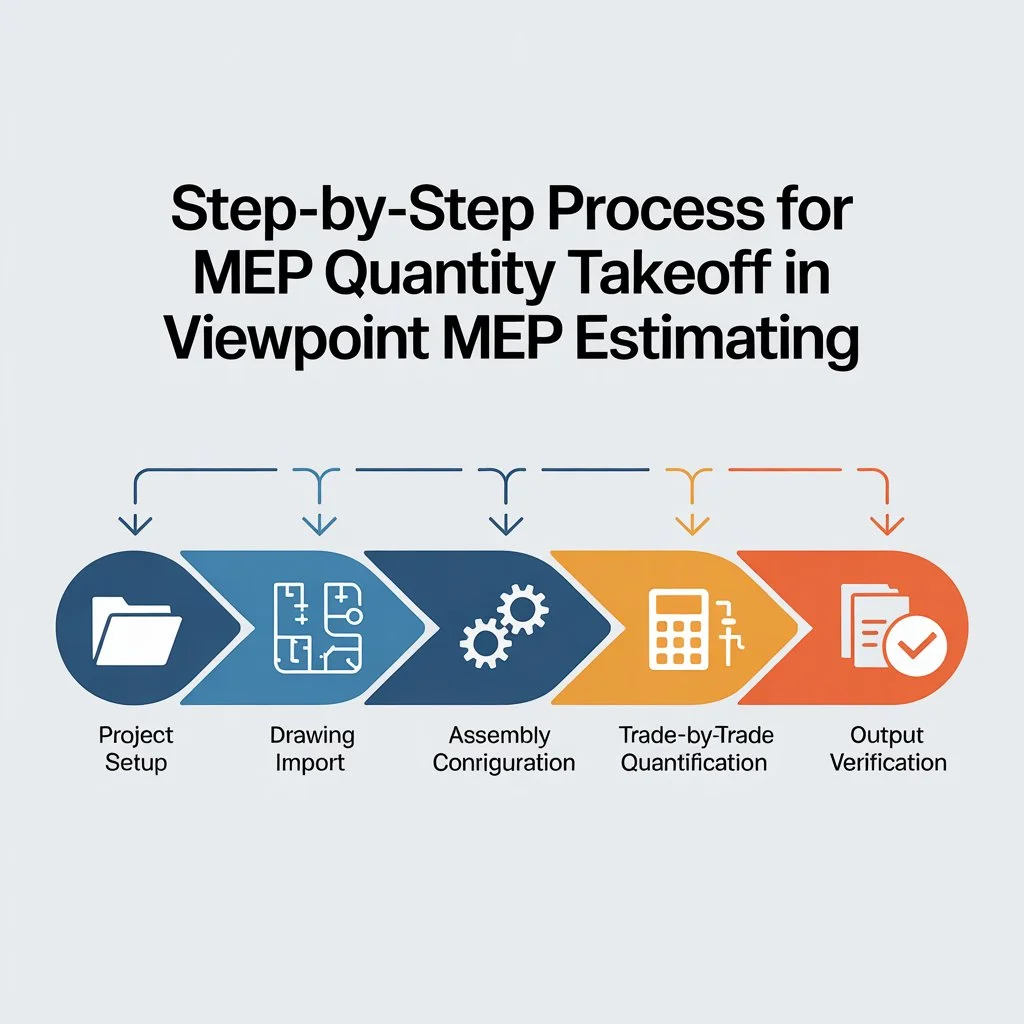
The Viewpoint estimating workflow follows a logical sequence that builds from project configuration through drawing organization, assembly-based quantity measurement, and verified output production. Working through this sequence in order is not a procedural preference. It is a technical requirement because each stage of the workflow depends on the accuracy of the stage that precedes it. A correctly configured project setup makes drawing import accurate. Accurate drawing import makes quantity measurement reliable. Reliable quantity measurement makes the output verification meaningful. Skipping or rushing any stage in this sequence does not save time. It transfers the error from the estimating workflow into the bid, where it costs far more to resolve.
Setting Up Your Project in Viewpoint MEP Estimating
The Viewpoint MEP project setup stage is where the estimating workflow begins and where the most consequential configuration decisions are made. Creating a new project in Viewpoint MEP Estimating requires the estimator to establish the project name and reference number using a consistent naming convention that makes the project identifiable in the database across bid cycles and project types. Trade category selection at the project creation stage determines which assembly libraries and cost databases are available for quantity assignment throughout the takeoff, and selecting the wrong trade categories at this point means that the assembly options needed for specific system types will not appear when the estimator reaches the measurement stage. Project parameter configuration covers bid date, location, labor agreement type, and the wage rate tables that will apply to labor cost calculations across all three trade scopes. Setup errors at this stage do not immediately produce visible problems. They propagate silently through every subsequent measurement and produce cost errors that are difficult to trace back to their source without reviewing the entire project configuration from the beginning.
Importing and Organizing Your MEP Drawings
Importing digital drawing sets into Viewpoint MEP Estimating requires the estimator to verify three things before any measurement work begins: that the drawings are complete, that the scale is correctly configured, and that the layers are organized in a way that allows each trade’s systems to be identified and traced without ambiguity. Drawing sets should be organized by trade before import, with mechanical, electrical, and plumbing sheets separated into distinct drawing groups within the platform so that the estimator can work through each trade’s scope independently without switching between mixed drawing sets mid-takeoff. Scale verification is the most critical technical step at this stage because Viewpoint MEP Estimating uses the drawing scale to convert screen measurements into real-world quantities, and an incorrectly set scale produces quantity errors that are proportional to the scale difference and systematic across every measurement taken against that drawing sheet. Incorrect scale settings at the drawing import stage are among the most common sources of large, difficult-to-diagnose quantity discrepancies in completed MEP takeoffs.
Performing the Trade-by-Trade Quantity Takeoff
Executing the digital MEP takeoff within Viewpoint MEP Estimating is where the assembly library becomes the central tool in the workflow. Each time the estimator identifies and measures a system component on a drawing, whether a length of ductwork, a conduit run, or a section of sanitary piping, that measurement must be assigned to the correct assembly in the Viewpoint database before the measurement is recorded. The assembly library connects the measured quantity to its associated material items, labor hours, and accessories automatically, which means that assigning the correct assembly to each measurement is what transforms a raw geometric measurement into a complete cost component. An incorrectly assigned assembly does not produce an error message. It silently generates wrong material lists and wrong labor hours for every unit of that system type measured against it, which means the error multiplies with every additional measurement taken under the same assembly assignment.
The sequence discipline required to complete a trade-specific quantity takeoff in Viewpoint without missing scope items or double-counting components follows from the way MEP drawings are organized. Working through each trade’s drawing set sheet by sheet in system sequence, completing all measurements for one system type before moving to the next, is the approach that produces the most complete and most reviewable takeoff output. Marking each drawing sheet as reviewed after all quantities on that sheet have been measured and assigned prevents the most common form of scope omission, which is returning to a drawing set that has been partially measured and being unable to distinguish which elements have already been captured from those that have not yet been included in the takeoff.
Reviewing and Verifying Your MEP Takeoff Output
The takeoff verification process is the stage between completed quantity measurement and bid submission, where errors that survived the measurement workflow are identified and corrected before they affect the cost estimate. Verification in Viewpoint MEP Estimating requires the estimator to cross-check the quantity output against the drawing notes and specifications for each system type, confirming that every line item in the takeoff corresponds to a real scope element shown on the drawings and that no system components visible on the drawings are absent from the quantity list. Confirming that all system extensions are included means checking that every branch, every connection point, and every accessory assembly associated with each primary system measurement has been captured in the takeoff output rather than counted only at the main run level. Contractors who work with teams that apply accurate material takeoff verification as a standard step in every estimating engagement understand that this stage is where the difference between a reliable estimate and an expensive bid error is determined.
Common Mistakes in MEP Quantity Takeoffs in Viewpoint
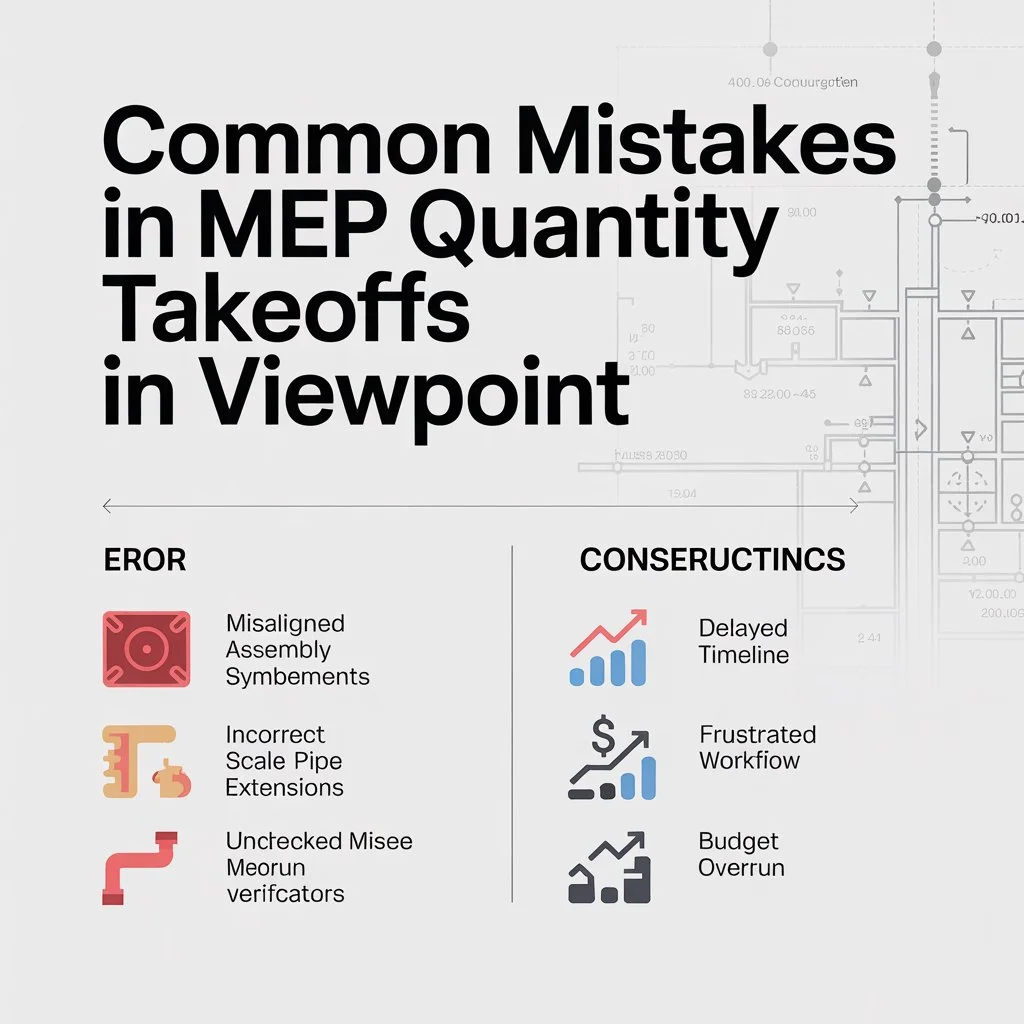
Incorrect assembly assignments are the most technically damaging error category in Viewpoint MEP Estimating because their consequences are systematic rather than isolated. When an estimator assigns a two-inch copper assembly to a run of three-inch copper pipe, the error does not affect only that one measurement. It affects every foot of three-inch copper pipe measured against that same assignment throughout the entire takeoff, producing a material list that understates copper weight and overstates fitting counts for the full system scope. Because Viewpoint MEP Estimating calculates material and labor from assembly components rather than from raw dimensions, the assembly assignment decision at each measurement point is effectively a cost calculation decision, and an incorrectly selected assembly produces a wrong cost calculation at a rate proportional to the total quantity measured against it.
Drawing scale errors and missed system extensions produce a different category of inaccuracy in the MEP bid preparation process that is often harder to detect during review because the individual measurements appear plausible. A drawing imported at ninety percent of its correct scale produces quantities that are consistently ten percent short across every measurement taken against that sheet, which means the error is not visible in any individual line item but accumulates across the entire system scope into a significant total shortfall. Missed system extensions occur when the estimator captures the primary distribution runs for a system but does not follow the branch runs, connections, and terminal assemblies shown on the same drawing set to their endpoints, producing a takeoff that accounts for the main system backbone but excludes a portion of the installed scope that the specification requires.
Carrying unchecked takeoff quantities directly into a competitive bid without a verification step is the workflow habit most consistently responsible for preventable bid losses and post-award cost surprises among MEP subcontractors. The takeoff accuracy of a Viewpoint MEP Estimating output is a function of the quality of the process that produced it, and a takeoff produced under time pressure with skipped verification has a meaningful probability of containing errors that a systematic review would have identified and corrected. Submitting a bid built on unverified quantities is not a calculated risk. It is an avoidable exposure that professional MEP estimating discipline eliminates as a standard practice on every project, regardless of deadline pressure.
The Role of MEP Takeoffs in Preconstruction Planning
MEP quantity takeoffs do more than support the bid submission process. They feed directly into every material and labor planning decision made during the preconstruction phase of a construction project. The pipe quantities produced by a verified plumbing takeoff drive the procurement schedule for rough-in materials and inform the lead time calculations that determine when purchase orders must be placed to support the construction schedule. The ductwork quantities from a mechanical takeoff define the scope documents issued to sheet metal fabricators and the labor hour projections used to staff the mechanical crew at each phase of installation. The panel and conduit quantities from an electrical takeoff establish the equipment delivery schedule and the wiring sequence that the electrical superintendent uses to plan crew deployment across the project’s electrical phases. A verified MEP takeoff is not an estimating deliverable. It is a project planning document that the construction team relies on from the day the contract is signed through the completion of each trade’s rough-in work.
When MEP takeoff errors survive preconstruction planning and reach the construction phase undetected, their cost impact is compounded by the circumstances in which they are discovered. Procurement gaps identified after a floor is framed require expedited material orders, schedule revisions, and often rework to install the scope that should have been included in the original rough-in sequence. Change orders generated by missed MEP scope items consume management time, strain owner relationships, and, in public sector projects, trigger documentation requirements that add administrative burden to every subsequent project phase. Contractors who use professional quantity takeoff services during MEP system cost estimation at the preconstruction stage substantially reduce their exposure to the downstream cost events that follow from takeoffs completed without the verification discipline that commercial MEP estimating demands.
When to Outsource Your MEP Takeoff Instead of Performing It in Viewpoint In-House

There are specific business conditions under which outsourcing an MEP takeoff delivers better results than completing it internally in Viewpoint MEP Estimating, regardless of the internal team’s software proficiency. When bid deadlines are compressed to the point that the internal estimating team cannot complete a thorough three-trade takeoff with full verification within the available window, submitting a bid based on a rushed and unverified takeoff exposes the contractor to the exact category of errors this guide describes. When a project scope involves MEP systems that exceed the internal team’s trade expertise, particularly on industrial MEP takeoffs, complex healthcare mechanical systems, or large-scale commercial electrical distributions, the assembly assignment decisions that determine takeoff accuracy require specialist knowledge that a generalist estimating team cannot reliably supply. When project volume is variable and bid cycles create peaks that exceed internal estimating capacity, the fixed overhead of maintaining a fully staffed in-house estimating function cannot be justified by the work volume available during slower periods. In each of these conditions, the practical choice is to outsource your MEP estimating to a professional firm that delivers faster and more accurate results than an understaffed or under-resourced internal process can produce.
Framing outsourcing as a strategic business decision rather than a software capability failure clarifies what contractors are actually choosing when they work with a professional MEP estimating firm. They are choosing to redirect the time their project managers and field supervisors would have spent operating complex estimating software back into the activities that generate revenue and build client relationships. They are choosing verified takeoff accuracy over the risk of bid errors that a rushed internal process produces under deadline pressure. They are choosing access to dedicated MEP estimating support from trade-specific specialists whose entire professional focus is producing MEP quantity takeoffs that are accurate enough to win bids and precise enough to execute against profitably, which is a standard of output that a single in-house estimator covering all three MEP trades simultaneously cannot consistently match.
How CSI Estimation LLC Handles MEP Takeoffs for Contractors Across the United States
CSI Estimation LLC provides trade-specific MEP estimating to contractors, subcontractors, and project owners across all 50 states, covering mechanical, electrical, and plumbing scopes on residential, commercial, and industrial projects with a fast turnaround that supports active bid timelines. Their estimating team includes specialists in each of the three MEP trade categories, which means that the assembly assignment decisions, system extension calculations, and output verification steps that determine takeoff accuracy are handled by professionals whose expertise is specific to the trade being estimated rather than spread across all three simultaneously. Their complete MEP estimating services cover single-trade takeoffs for contractors who have most scopes covered internally but need specialist support on one trade, full three-trade MEP packages for contractors who outsource their entire MEP estimating function, and ongoing estimating support for firms with consistent monthly bid volume that benefits from a retainer-based service structure.
Working with a professional MEP estimating firm rather than relying exclusively on internal Viewpoint MEP Estimating capacity changes the risk profile of every bid the contractor submits. The assembly knowledge, drawing review discipline, and verification process that a specialist MEP estimating team applies to each takeoff are not replicable by a contractor whose primary business is building rather than estimating, regardless of the software platform available to them. Contractors who want to understand how professional MEP takeoff support can improve their bid accuracy and protect their project margins are welcome to get in touch with our estimating team and submit their project drawings for a professional MEP takeoff review.
Get Your MEP Takeoff Completed by Professionals Within 24 Hours
Performing an accurate MEP takeoff with Viewpoint MEP Estimating requires correct project setup, verified drawing import, disciplined assembly-based measurement across all three trade scopes, and a systematic output verification process before any quantity is carried into a bid. Each of these stages requires time, trade-specific knowledge, and the workflow discipline to resist the pressure to skip verification when deadlines are close. Professional outsourced MEP estimating delivers all of these elements without the software overhead, the learning curve, or the deadline risk that internal takeoff processes impose on contractors managing active project pipelines alongside their estimating responsibilities.
Submit your project drawings to CSI Estimation LLC today and receive a complete, trade-specific MEP quantity takeoff within 24 hours for most standard project types. Their team reviews your drawing set across all three trade scopes, applies verified assembly data to every system measurement, and delivers a complete quantity output you can carry directly into your bid with the confidence that every scope item has been captured, verified, and priced against current market data. Take the next step toward MEP bids that protect your margin and contact CSI Estimation LLC today to get started with your next project takeoff.