
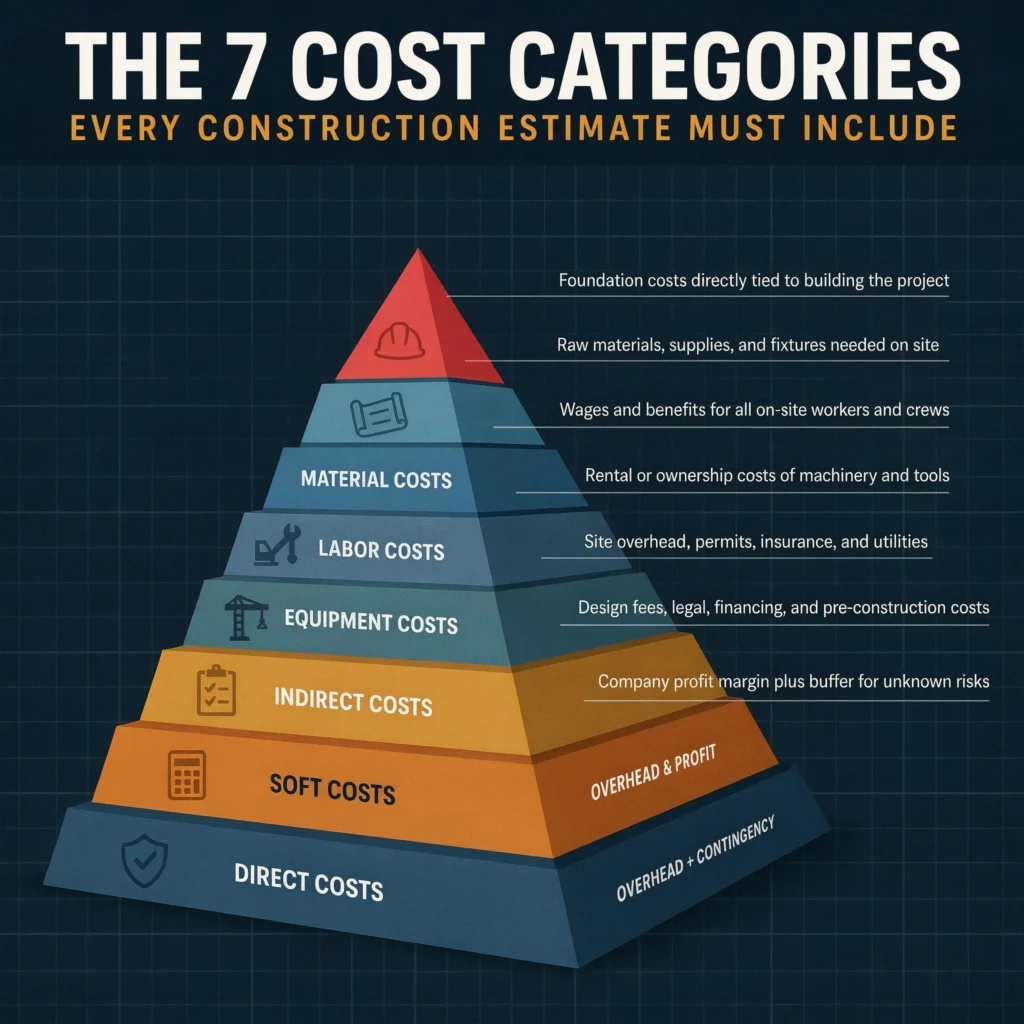
What Costs Factor Into A Construction Estimation? covers seven primary cost categories that every professional estimate must account for before a project breaks ground. These categories are direct material costs, labor costs, equipment and machinery expenses, indirect costs, soft costs including permits and professional fees, contractor overhead and profit margin, and project-specific contingency allowances. Missing any one of these categories in an estimate does not produce a minor inaccuracy. It produces a financial gap that surfaces as an unavoidable cost during construction.
Every contractor, developer, and project owner who has ever faced a mid-construction budget crisis can trace that crisis back to one of two problems: a cost category that was never included in the original estimate, or a cost category that was included but calculated against inaccurate data. Understanding what costs factor into a construction estimation is not preparatory knowledge reserved for professional estimators. It is the foundational financial literacy that every person who commissions, bids, or manages a construction project needs before a single number is put on paper. This guide covers every major cost category that a complete professional construction estimate must address and explains how each one is calculated, why it matters, and what happens to your project budget when it is omitted or underestimated.
Why Construction Cost Estimates Matter Before a Project Begins
A construction cost estimate is not a formality that precedes the real work of building. It is the financial foundation that every procurement decision, subcontractor negotiation, financing application, and schedule commitment is built on from the day the project is awarded through the day the final trade walks off site. When that foundation is built on incomplete cost data or omitted cost categories, every subsequent decision is made with a distorted picture of what the project actually costs. The result is not simply a budget overrun at the end. It is a cascading series of financial pressures that begins the moment the first cost gap becomes visible in the field and compounds with every week that construction continues against a budget that was never adequate.
Professional construction cost estimation prevents this outcome by ensuring that every cost factor is identified, quantified, and priced before the contractor submits a bid or the project owner commits their capital. Our professional construction cost estimating services apply this comprehensive approach to every project we handle, producing cost models that account for the complete financial picture rather than the partial picture that incomplete estimates provide. Contractors and project owners who begin projects with thorough, verified estimates consistently outperform those who begin with estimates that cover only the most visible cost categories.
What Goes Into a Construction Estimate?
A complete construction estimate is a structured document that organizes every cost factor the project requires into a hierarchy that moves from the most concrete and measurable costs to the most variable and risk-dependent costs. At the base of that hierarchy sit the direct costs: the materials, labor, and equipment that can be measured directly from the project drawings and specifications. Above those sit the indirect costs that support the direct work without being traceable to a single scope item. Above those sit the soft costs that cover the professional, administrative, and regulatory obligations the project carries, regardless of its physical scope. Above all of these sit the overhead, profit margin, and contingency allowances that complete the financial model and make the estimate viable as a basis for a competitive and profitable bid.
Understanding this structure is what allows a contractor or project owner to evaluate whether any estimate they receive is complete or whether critical cost categories have been omitted. Our quantity takeoff services form the measurement foundation of this structure, quantifying every material and system component that the direct cost calculation depends on.
Direct Costs: The Core of Every Construction Estimate
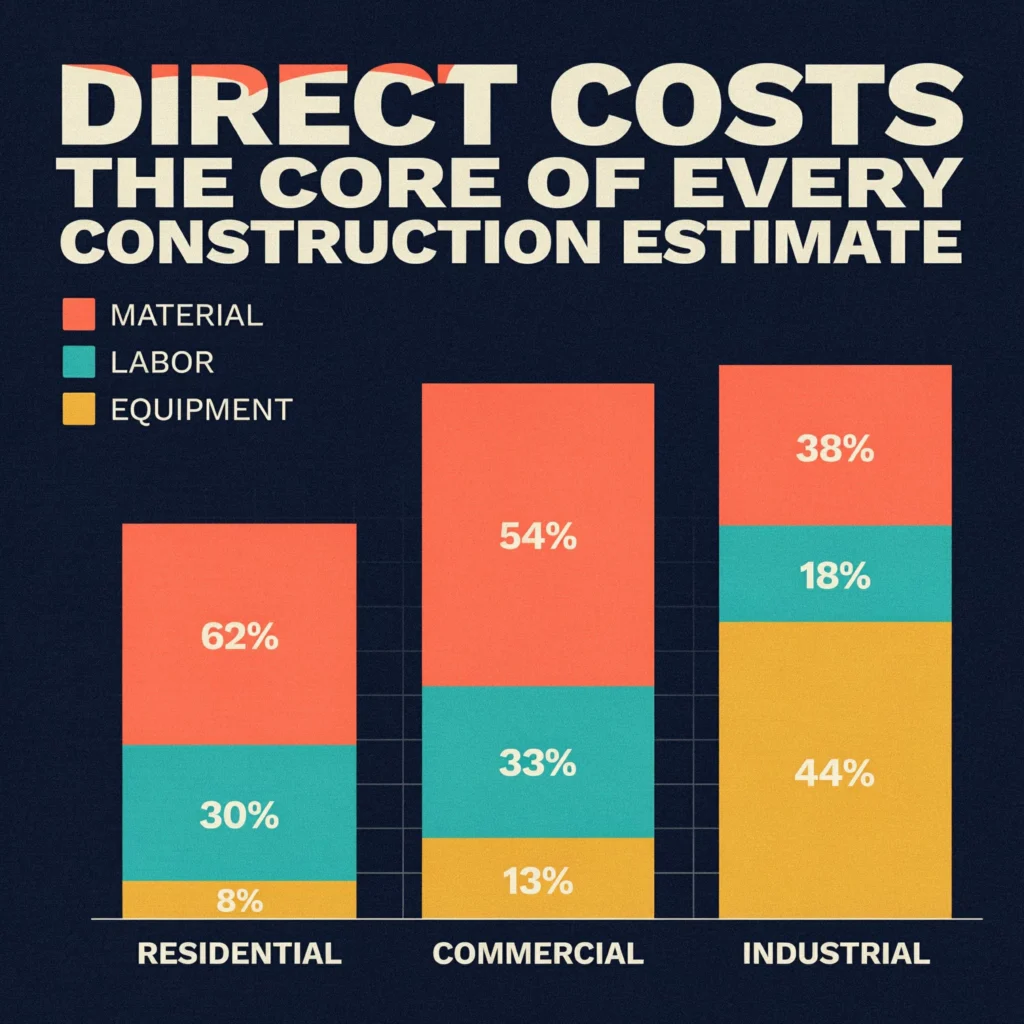
Direct costs are the costs that can be measured, quantified, and priced from the project drawings and specifications before construction begins. They are the largest single component of most construction estimates, typically representing 60 to 70 percent of total project cost on standard residential and commercial projects, and they are the category where estimating errors carry the most immediate and most measurable financial consequences. Every direct cost has a quantity basis derived from the drawing set and a unit price derived from current market conditions, and the accuracy of the estimate depends entirely on the accuracy of both inputs.
Material Costs
Material costs represent the full cost of every physical component required to construct the project as specified, from the concrete in the foundation through the finish hardware on the interior doors. Professional material cost estimation begins with a verified quantity takeoff that measures every material from the architectural and engineering drawings by trade and by specification type. The quantities produced in that takeoff are then priced against current regional supplier pricing rather than national database averages, because the gap between regional market pricing and national database figures commonly reaches 15 to 20 percent in active construction markets and directly determines whether the estimate reflects what the contractor will actually pay from their local suppliers.
Material costs are affected by specification grade, regional availability, procurement lead times, and the quantity discounts available at the project’s purchase volume. A professional estimator accounts for all of these variables rather than applying a single unit price to every specification of the same material type. Our material takeoff services produce the verified quantity data that makes accurate material cost calculation possible, covering every trade from concrete and masonry through mechanical, electrical, and specialty finish systems with the trade-specific detail that procurement decisions require.
Labor Costs
Labor costs represent the cost of every hour of skilled trade work required to install the materials specified for the project, and they typically account for 30 to 50 percent of total direct project costs, depending on project type, trade mix, and regional labor market conditions. Professional labor cost estimation applies current local wage rates for each trade category involved in the project, distinguishing between union and non-union labor where applicable and accounting for the productivity rates that determine how many labor hours each unit of installed work actually requires in field conditions rather than in theoretical calculations.
Labor costs are the most variable component of a construction estimate because they are affected by regional wage agreements, trade availability, site conditions that affect productivity, project complexity that requires specialist rather than journeyman labor, and schedule constraints that require premium time or accelerated crew deployment. A professional estimator who applies a blended average labor rate across all trades and all phases of a project produces labor cost figures that are systematically wrong in ways that are difficult to identify until the project is underway and the payroll data reveals the gap. Our residential estimating services and commercial estimating services both apply trade-specific labor rate analysis calibrated to the regional market where each project is located.
Equipment and Machinery Costs
Equipment and machinery costs cover the cost of every piece of construction equipment required to execute the project scope that is not provided by a subcontractor as part of their trade package. This includes earthmoving equipment for site preparation and foundation work, cranes and material handling equipment for structural and vertical construction phases, concrete pumping equipment, scaffolding systems, and any specialty equipment required for specific scope items such as pile driving, dewatering, or deep excavation work. Equipment costs are calculated either as a rental cost applied to the estimated duration of each equipment deployment or as an ownership cost amortized across the project period for equipment that the contractor owns and operates directly.
The equipment cost calculation must account for both the direct rental or ownership cost of each piece of equipment and the operating costs, including fuel, maintenance, operator labor, and mobilization and demobilization expenses that accompany every equipment deployment. Projects where equipment costs are estimated as a flat allowance rather than calculated from the actual deployment schedule and equipment requirements frequently experience significant cost variance when the real equipment demands of site conditions and construction sequencing become apparent during execution.
Indirect Costs: The Budget Factors Most Estimates Miss
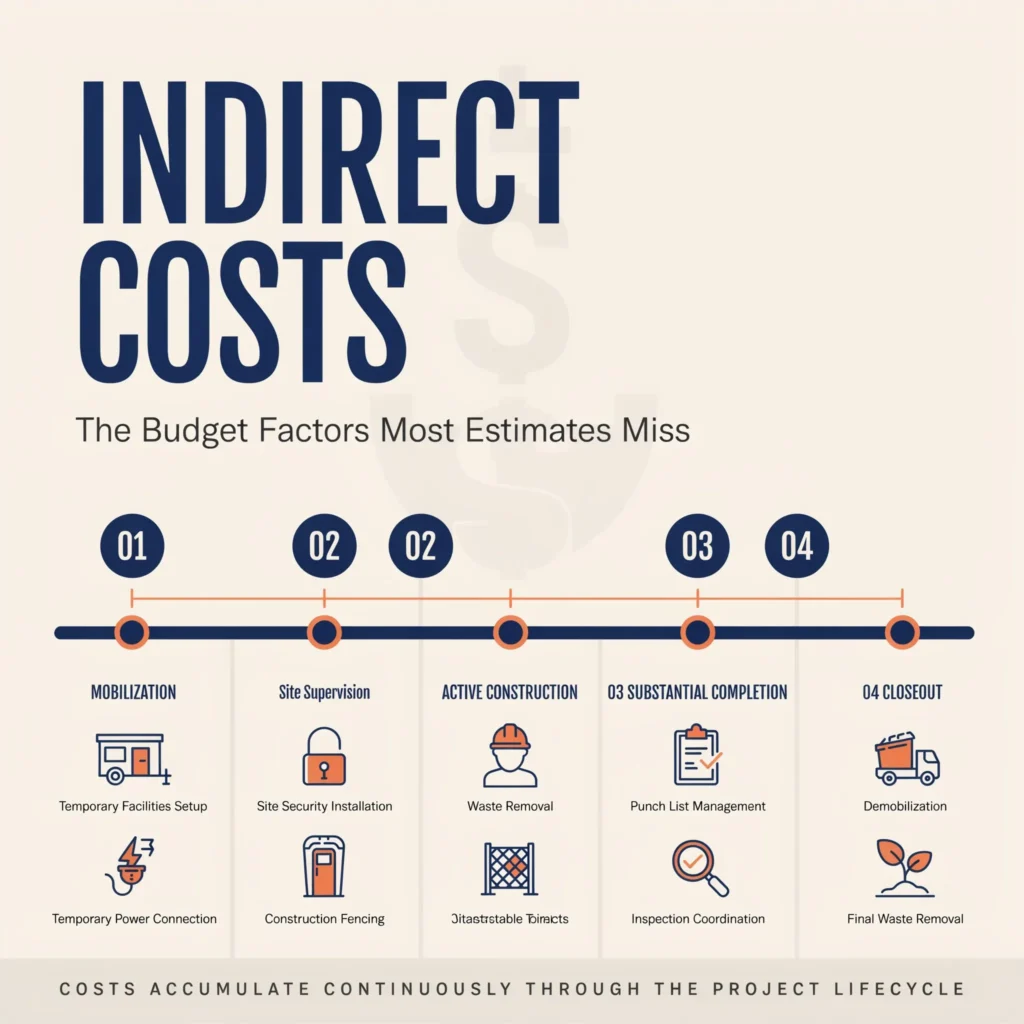
Indirect costs are the project costs that support the direct construction work without being directly traceable to a specific material quantity or labor hour on the project drawings. They include the general conditions costs that keep a construction project operational throughout its duration: site supervision, temporary facilities, site security, portable toilets, dumpsters and waste removal, temporary power and water, construction fencing, project signage, and the management overhead of coordinating multiple trades across an active job site. These costs do not appear on any drawing, but they are as real and as unavoidable as the materials and labor they support.
Indirect costs are one of the most frequently underestimated cost categories in contractor-prepared estimates, particularly among contractors who are new to a specific project type or scale. A residential contractor estimating their first commercial project commonly underestimates the general conditions burden that a commercial job site carries compared to the residential sites they are accustomed to managing. A subcontractor estimating a project where they are responsible for their own general conditions for the first time commonly discovers that the operational overhead of running an independent site is substantially higher than the sub-allocation they received when working under a general contractor’s umbrella. Professional estimating firms account for indirect costs systematically on every project by calculating each general conditions line item from the project schedule and site logistics plan rather than applying a blanket percentage that may or may not reflect the actual operational demands of the specific project.
Soft Costs: Professional and Administrative Fees
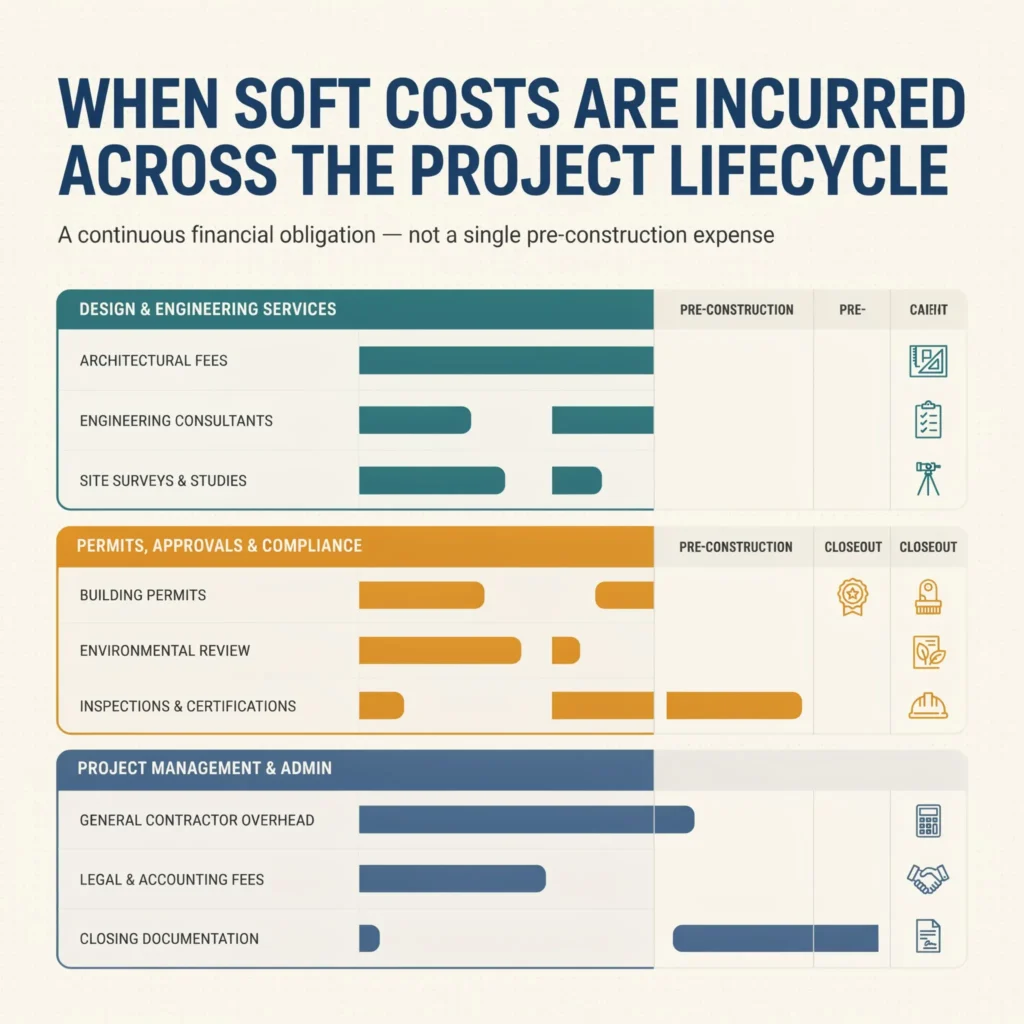
Soft costs are the non-construction expenses that every project carries regardless of its physical scope. They represent the professional, regulatory, and administrative obligations that must be fulfilled before, during, and after construction and that are funded from the project budget even though they produce no physical construction output. Soft costs are frequently underestimated by first-time project owners and occasionally omitted entirely from contractor-prepared estimates that focus exclusively on the physical construction scope.
Design and Engineering Services
Design and engineering costs cover the fees for the architectural design team, structural engineers, MEP engineers, civil engineers, and any specialist consultants whose work is required to produce the construction documents from which the project will be built. These costs are typically calculated as a percentage of the estimated construction cost or as a fixed fee negotiated at the time of professional engagement, and they must be included in the total project budget even when the estimate itself is based on completed construction documents that have already been produced and paid for. Our architectural cost estimation services support project owners and design teams in understanding the relationship between design decisions and construction cost outcomes before those decisions are locked into the contract documents.
Permits, Approvals, and Compliance Costs
Permit and approval costs cover every regulatory fee required to legally commence and complete construction on the project site. These include building permit fees calculated on the estimated construction value, plan review fees, inspection fees for each required inspection phase, specialty permits for mechanical, electrical, and plumbing work, and any environmental compliance fees required by the project’s location or scope. In urban markets and jurisdictions with active development activity, permit fees can represent a meaningful percentage of total project soft cost and must be researched specifically for the project’s jurisdiction rather than estimated from generic fee schedules.
Project Management and Administrative Costs
Project management and administrative costs cover the overhead of managing the project from award through closeout, including owner-side project management fees, construction management fees where a separate CM firm is engaged, legal costs for contract review and dispute resolution, accounting and cost reporting services, and the administrative costs of maintaining project records and processing payments throughout the construction period. These costs are real project expenses that reduce the budget available for physical construction and must be accounted for in the total project cost model from the earliest stage of budget development.
Overhead, Profit Margin, and Contractor Markup
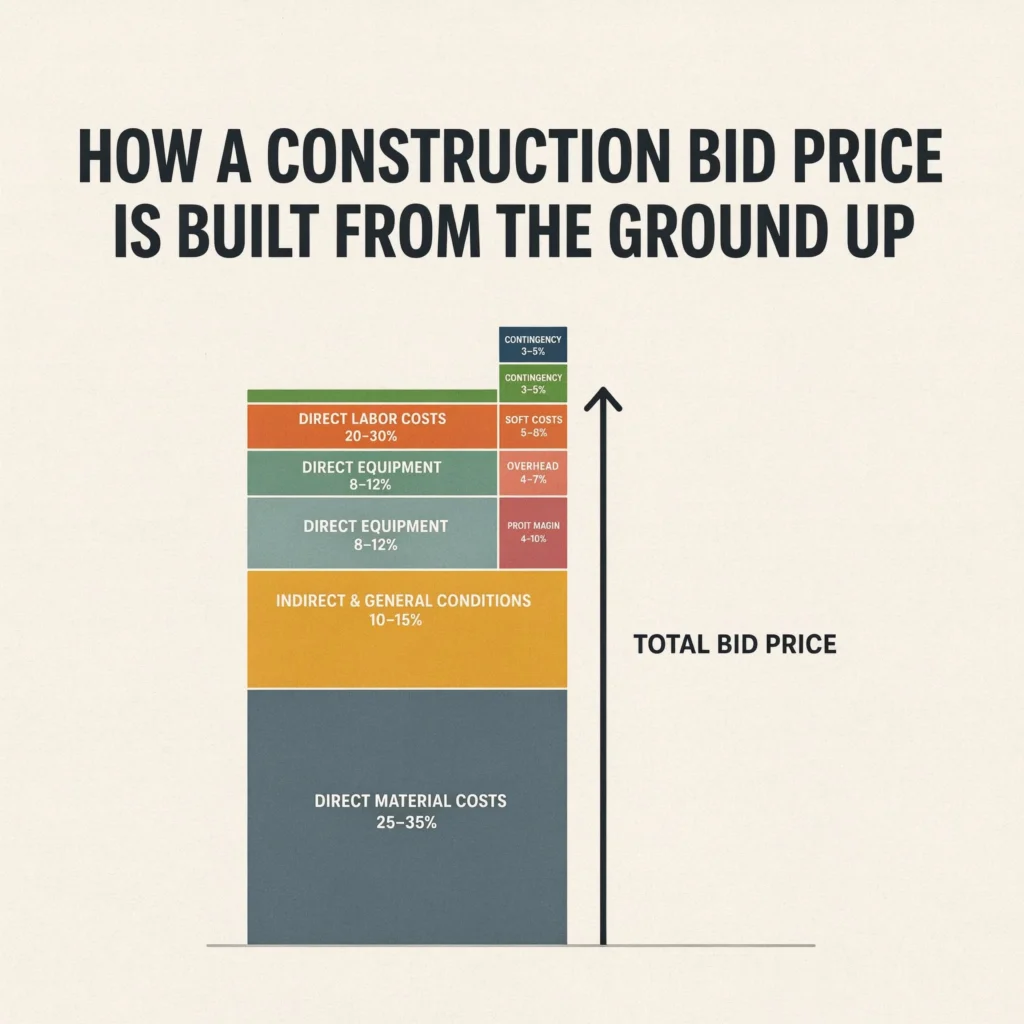
Overhead and profit are the components of a contractor’s bid price that cover the costs of running the contracting business and compensate the contractor for the financial risk they assume by entering into a construction contract. Overhead covers the fixed and variable costs of the contractor’s business operation that are not directly charged to individual projects: office rent, administrative staff salaries, vehicle costs, insurance premiums, bonding costs, marketing expenses, and the cost of estimating and business development activities that produce the project pipeline. These costs must be recovered through the markup applied to each project, and a contractor who underestimates their overhead burden or applies insufficient markup consistently wins bids that do not generate enough revenue to sustain their business operations.
Profit margin is the return the contractor earns on the risk they assume by committing to deliver the project scope at the contracted price regardless of what unforeseen conditions they encounter during execution. It is not optional and it is not a bonus applied only when projects go smoothly. It is a required component of every bid that reflects the real financial risk of construction contracting. Our budget estimating services incorporate overhead and profit margin calculations that reflect the contractor’s actual business cost structure and the risk profile of each specific project type and market, producing bid prices that are both competitive and financially sustainable.
Contingency and Risk Planning in Construction Estimating
Contingency is the cost allowance built into a construction estimate to cover the financial impact of risks that are identified but not yet quantified at the time the estimate is produced. Every construction project carries a set of inherent uncertainties that cannot be fully resolved at the pre-construction stage: subsurface conditions that may differ from geotechnical assumptions, material price movements between estimate date and procurement date, design refinements that increase scope after the estimate is produced, and productivity variations that affect labor cost outcomes in ways that cannot be predicted with certainty from historical averages alone.
Professional contingency calculation is not a flat percentage applied uniformly to all project types regardless of their risk profile. It is a project-specific analysis that evaluates the probability and financial impact of each identified risk and calculates a contingency allowance proportional to the total risk exposure the project carries. A ground-up commercial project in an urban environment with complex logistics carries a different risk profile than a residential renovation in a suburban market, and the contingency allowances in a professional estimate reflect those differences rather than applying the same percentage to both. Our construction cost management services include risk-informed contingency analysis that gives contractors and project owners a defensible basis for the contingency allowance in every estimate we produce.
How Regional Pricing and Market Conditions Affect Construction Costs
Every cost factor discussed in this article is subject to regional variation that can shift total project cost by 20 to 30 percent or more between markets located in the same state, let alone in different regions of the country. Material pricing varies by regional supplier availability, transportation costs, and local demand conditions. Labor rates vary by regional wage agreements, union jurisdiction boundaries, and the supply of skilled tradespeople in the local market. Equipment rental rates vary by market activity level and the availability of specialty equipment in the project’s geographic area. Permit fees vary by jurisdiction. Subcontractor pricing varies by the competitive density of the local specialty trade market and the current volume of work competing for the same subcontractor capacity.
Professional estimating firms that serve contractors across multiple markets maintain active pricing databases for each regional market they cover, which allows them to apply market-specific cost data to every estimate they produce rather than adjusting a national average by a location factor that may or may not reflect current conditions. Our outsource estimating services cover all 50 states with regionally calibrated labor rates, material pricing, and subcontractor cost benchmarks that reflect what contractors actually pay in each market rather than what national databases suggest they should pay.
How CSI Estimation LLC Accounts for Every Cost Factor on Your Project
CSI Estimation LLC provides trade-specific professional estimating services to contractors, developers, and project owners across all 50 states, applying specialist knowledge to every cost category described in this guide on every project they handle. Their estimating team covers direct material costs through verified quantity takeoffs, labor costs through current regional wage rate application, equipment costs through project-specific deployment analysis, indirect costs through general conditions line item calculation, soft costs through jurisdiction-specific permit and fee research, and overhead and contingency through project-specific risk analysis rather than generic percentage applications. Every estimate delivered by CSI Estimation LLC is a complete cost model that accounts for the full financial picture of the project rather than the visible portion that incomplete estimates typically address.
Their MEP estimating professionals cover mechanical, electrical, and plumbing scopes with the trade-specific depth that institutional clients and public sector project owners require, while their structural steel estimating specialists bring the same depth of coverage to steel packages on commercial and industrial projects where structural cost accuracy is critical to bid competitiveness. For contractors managing high volumes of simultaneous projects, their virtual bid management services ensure that every bid package is assembled, formatted, and submitted professionally within the deadline constraints that active bid pipelines demand.
Submit Your Drawings and Get a Complete Construction Estimate Within 24 Hours
Every cost factor described in this guide is a financial risk that grows larger the longer it remains unidentified in your project budget. Material costs that are not verified against current regional pricing, labor costs that are not calculated from trade-specific wage data, indirect costs that are treated as a flat allowance rather than a line-item calculation, and contingency allowances that are not grounded in project-specific risk analysis all represent gaps in the financial model that will surface as real costs during construction at a point where your options for managing them are limited and expensive.
Submit your project drawings to CSI Estimation LLC today and receive a complete, trade-specific professional estimate within 24 hours for most standard residential and commercial project types. Their estimating team reviews your drawing set across all trades, applies verified quantity measurement and current regional market pricing to every cost category, and delivers a cost breakdown that accounts for the complete financial picture of your project before a single dollar is committed to construction. Contact CSI Estimation LLC today and take the first step toward a project budget that reflects what your project actually costs.